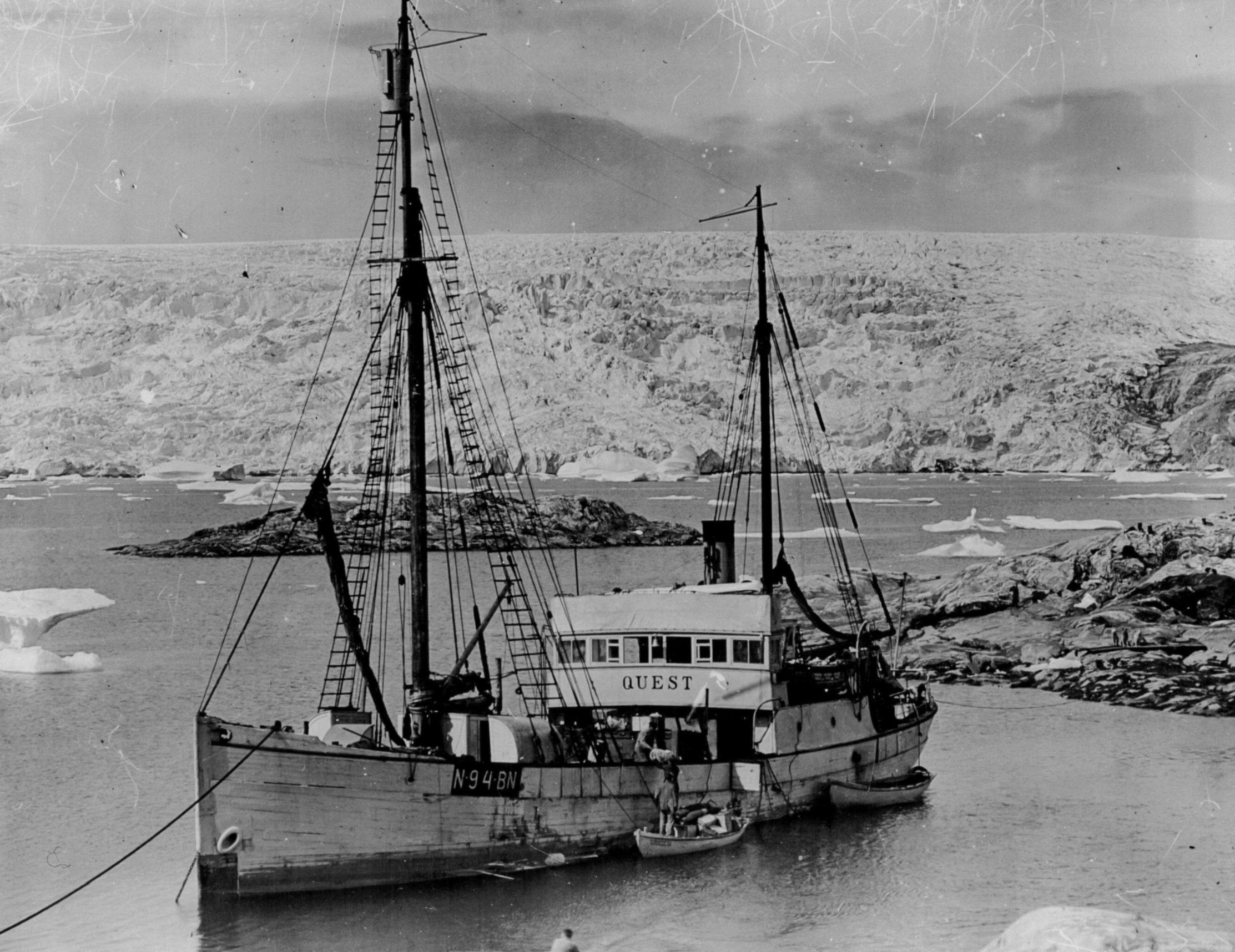
It just appeared.
Out of the black, dead calm of the Labrador Sea.
First close-up images show Shackleton’s Quest, his final ship, resting on the ocean floor for the very first time. More than a hundred years after Ernest Shackleton walked her decks, the wreck has emerged from the abyss. It isn’t pristine. It is battered. Damaged by decades in the deep. And, unsettlingly, entangled.
Pink corals have colonized the bow and portholes. But beneath those marine decorations lie scars left by human hands. Cod, redfish, and wolffish dart through holes where timber once held fast. It is a graveyard transformed into a garden, but also a monument to our lingering impact on the deep.
Seeing the Invisible: How We Finally Found Quest
You couldn’t see Quest well until now.
She was discovered in 2027—no, wait. Let’s get the timeline right. The wreck was located in 2015, resting upright at a depth of roughly 300 meters (985 feet) off Newfoundland. No, that’s Endurance in Antarctica. I’m getting tangled in history. Let’s slow down.
The Quest sits at 154 meters (505 feet). It is shallow by deep-sea standards.
In 2015, John Geiger, expedition leader and CEO of the Royal Canadian Geographical Society, led the charge that found the ship using side-scan sonar. That technology maps the ocean floor by sending out sound pulses. It showed an outline. A shadow. It didn’t show detail.
For nearly a decade, the world has known she was there. But they couldn’t see her face.
This latest mission, led by a joint effort between the Royal Canadian Geographical Society and the Woods Hole Oceanographic Institution (WHOI), changed everything. They didn’t rely on ghosts. They deployed human eyes.
The team used Falcon, a remotely operated vehicle, and Alvin, the famous human-occupied submersible. Yes, that Alvin. It took the first people to the Titanic 40 years ago (well, in the 80s). It dropped these researchers down to meet Quest eye-to-eye.
“At first, there is a lot of darkness,” John Geiger said. “Then the bow emerges.”
It wasn’t just a data drop. It was visceral. They went down. They looked.
Why Fishing Nets Are Ruining Historic Shipwrecks
The Quest is a national historic site. She is the last surviving ship commanded by Ernest Shackleton. She should be pristine.
She is not.
Large fishing nets drape over the deck. They cover the rigging. They block the camera lenses. And they tell a sadder story about our relationship with the sea.
“The nets are a sad story,” Geiger admitted during the dive. “It limits our ability to look at this wreck. I think we have a huge issue with responsibility for what we’re doing to the ocean.”
This is where the romantic idea of the ocean as a untouched wild space collapses. Commercial fishing gear isn’t just catching fish. It is smothering history.
The main mast of the Quest is lying on the deck. Not broken, exactly, but toppled. The hull, made of wood and steel, bears the marks of 70+ years of neglect and now, accidental burial. When researchers tried to document specific features, the ghost of commercial fishing was in the way.
Why does this matter? Because we can’t protect what we don’t see clearly. We can’t argue against industrial activity if the evidence of that activity is physically obscuring our cultural heritage. It creates a paradox: you need clear images to document damage, but the damage blocks the view.
Who Was on This Ship? Understanding the Shackleton Connection
You probably know Ernest Shackleton. If you don’t, you’re living under a rock, or you don’t read adventure history. He is the king of survival.
He led the Imperial Trans-Antarctic Expedition, famously known for the Endurance. Endurance got trapped in Weddell Sea ice and crushed. The ship sank. The men lived. They pulled themselves out of the freezer with bare hands. That story is etched in stone.
But Quest is the end of the line.
In 1921, Shackleton returned south, this time with the Quest. He wanted to explore the Weddell Sea again. He didn’t get the chance.
The ship arrived at South Georgia in January 1922. Shackleton collapsed in his cabin. He died there. Just a day or two after they landed. He was 47 years old. The heart of the expedition failed before the expedition could even truly begin.
Quest didn’t go home to a hero’s welcome and a museum on day one. She stayed in the game. She served in Arctic work. She hauled seals in Canada. She served in World War II as an escort ship. It wasn’t until 1962 that Quest herself went under, crushed by ice near Labrador while on a sealing run.
The crew made it off. But the ship? The ship sank, disappearing from the news, until Geiger found the sonar ghost in 2015. Now, we’re finally seeing it.
Making a Digital Twin: Saving the Ship Without Touching It
So, why go down there with $50 million submersibles? To look at some wood?
To save it, in a way.
Physical objects decay. Salt water rots wood. Fish chew. Nets abrade paint. Quest is rotting. It is biodegrading. By the time someone looks again in ten years, the structure may be weaker.
The team is building a digital twin of the Quest.
Using the Voyis underwater photogrammetry system, the crew took thousands of overlapping images over three days. It looks like data work. It sounds like data work. But the result is a precise, three-dimensional model of the wreck exactly as it looks right now.
“In addition to putting the first human eyes on Quest… we’ll be creating a digital twin,” said Dwight Coleman, WHOI co-chief scientist. “This type of modeling… gives us new ways to make these wrecks real.”
Real how?
Because you don’t have to disturb the site. Researchers in labs in Toronto, or New Bedford, or Boston can fly through the virtual hull. They can count the bolts. They can measure the rust. They don’t have to touch a splinter of that century-old timber.
It also creates a baseline. If the ship collapses in five years, the digital twin remains. It captures a moment in time.
What Next? Finding Terra Nova and Other Lost Shacks
This mission doesn’t end in Newfoundland.
The ships Alvin and Atlantis (both owned by the U.S. Army/Navy and operated by WHOI) are moving northeast. They are heading toward Greenland.
There is another wreck in those cold waters. The Terra Nova.
Yes, that Terra Nova. Robert Falcon Scott’s ship.
Scott lost the race to the Pole. Amundsen beat him. Scott died coming back. His ship, the Terra Nova, eventually sank off Labrador after working as a sealing vessel, just like Quest.
For the first time, researchers are going to link the two wrecks. Quest (Shackleton) and Terra Nova (Scott). They were the titans of the Heroic Age of exploration. Rivals. Friends. Both died on final, fateful trips.
Now, their final resting places are side by side. The mission plans to survey the Terra Nova next. They will map it. They will see if it suffers from the same fishing net curse as the Quest.
There is still a lot we don’t know about these sites. The ice hides secrets. The deep sea is hostile to cameras. And yet, every time we go down, we find more than just rust.
We find mirrors.
We look into the dark water and see how we’ve left our trash, our nets, our grief. But we also see how the sea reclaims things. How coral grows on tragedy. How a ship becomes a reef.
Is that beautiful? It has to be. We have no choice.