JWST just spotted supermassive black holes refueling. This isn’t just another observation of the cosmos’ hungriest residents. It’s the smoking gun for a mechanism that explains how they got so big, so fast, after the Big Bang.
Black holes eat. Then they vomit. The universe, however, has a recycling scheme that brings that vomit right back to the table.
How the cosmic hunger cycle works
We know galaxies with massive black holes sit at their cores. Some are quiet. Dormant. They sip at the gas and dust sparingly. Others, however, are Active Galactic Nuclei (AGN). These are gluttons. They gorge themselves, creating the bright hearts of their galaxies.
But there is a cost. These feasting behemoths shoot matter out of their poles in massive jets. This blasts raw material—the very fuel for new stars—out of the galaxy entirely. Star formation halts. The galaxy effectively dies.
Here is the paradox astronomers have been wrestling with for years: How do early supermassive black holes grow to billions of solar masses in less than a billion years?
Time is on their side now, sure. But in the infant universe? Not really. Even the fastest-eating theories suggest that pushing away gas while consuming it should limit growth. It should act like a self-imposed diet. If they eject the fuel to power their jets, how do they ever restart?
Julie Hlavacek-Larrondo, team leader at the Université de Montréal, put it best when discussing the findings.
“What JWST is revealing is that black holes are the ultimate cosmic recyclers.”
They aren’t just hoarding matter. They release energy that heats their surroundings. But that heat isn’t final. The gas cools. It condenses. It falls back down.
The filament trap
Imagine a river. A black hole jet splashes material up into the galactic halo. For a while, it drifts there, invisible and lost. Then, gravity takes over. The material cools into long, thin streamers. These aren’t dust bunnies. They are structures hundreds of light-years wide, stretching thousands of light-years out into the dark.
They snake their way back to the galaxy center. A disk reforms. The black hole gets fed again.
This isn’t a one-time meal. It’s a loop. Feast. Famine. Feast.
The black hole restarts its jets. The cycle blinks. This self-regulating feedback mechanism explains how black holes sustain growth without violating the cosmic speed limits. Until now, we couldn’t see the connection between those distant filaments and the hole itself. JWST just stitched the picture together.
Inside NGC 4696
To prove this theory, scientists turned their eyes toward Earth. Not onto it. Just near it.
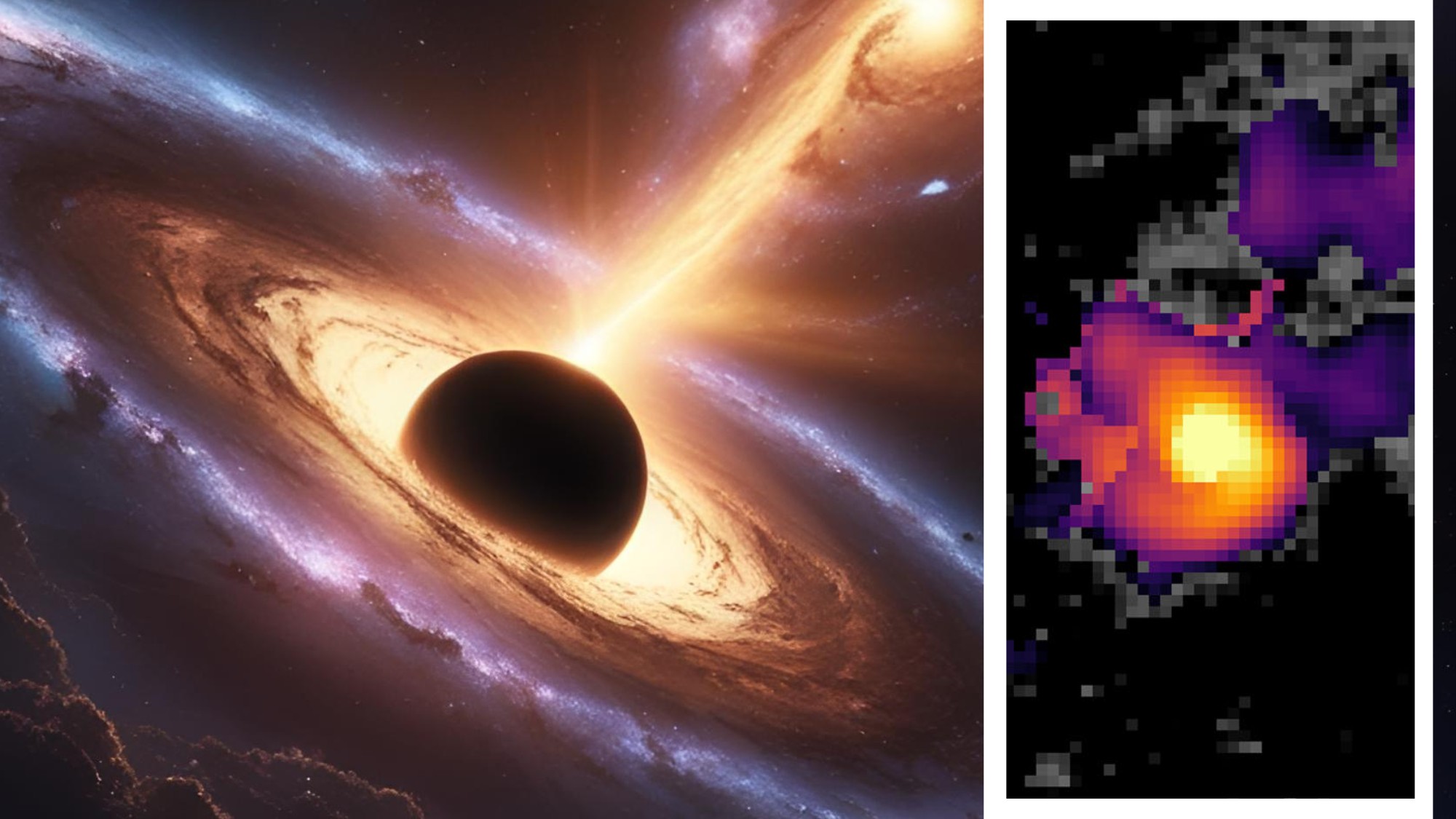
NGC 4696 sits in the heart of the Centaurus Cluster. 145 million light-years away, it’s practically a neighbor in cosmic terms. It houses an AGN that has puzzled astronomers for decades. Hubble saw a strange, hook-shaped spiral of gas near the core before. But it didn’t capture the speed or the structure clearly.
JWST stepped in with its mid-infrared eyes wide open.
The results were shocking in their precision. The “hook” is actually a vast funnel. The gas within it moves at roughly 600 kilometers per second. That is 1.3 million mph. The filament stretches about 800 light-years across, directly feeding the supermassive black hole sitting in the center.
We are no longer guessing if gas returns. We have watched it happen in high definition. The black hole isn’t starving itself. It’s farming itself.
And yet, the questions are starting to multiply. How common is this cycle? Are the massive, ancient black holes from the very first billion years just the heavyweights of a standard cosmic process, or is the recipe for growth even wilder out in the deep field? The loop is closed for NGC 469. The universe has many more to tell.