Total solar eclipses happen roughly every 18 months somewhere on Earth. They have been happening for as long as humans have existed. People watched the moon slide between the sun and our planet. They blocked out the glare. They revealed the sun’s swirling outer layers.
We document this. We always have.
The earliest written record comes from China in the 13th century BC. Scribes wrote that the sun had been “eaten”.
This isn’t just old mythology. It’s data. Researchers use these texts to track how eclipses change over centuries. And how humans change too. Look at this petroglyph carved by early Pueblo people in New Mexico. It likely depicts the eclipse of July 11, 1097. See the swirls? That’s the corona. It looks like nothing else. It only appears when the moon hides the main solar disc.
Why do we need to know how to see solar eclipses safely?
Fast forward to the late 17th century. Art becomes science. A watercolor shows French missionaries with King Narai of Siam in April 1688. Notice what they are doing. They aren’t staring at the sun. That would blind them.
They use the projection method. Light goes through a telescope. It hits a screen. They watch the shadow, not the star. You can do this today. Use a pinhole camera. Or look at the gaps between leaves on the ground. It works.
Which early sketches proved the corona belongs to the sun?
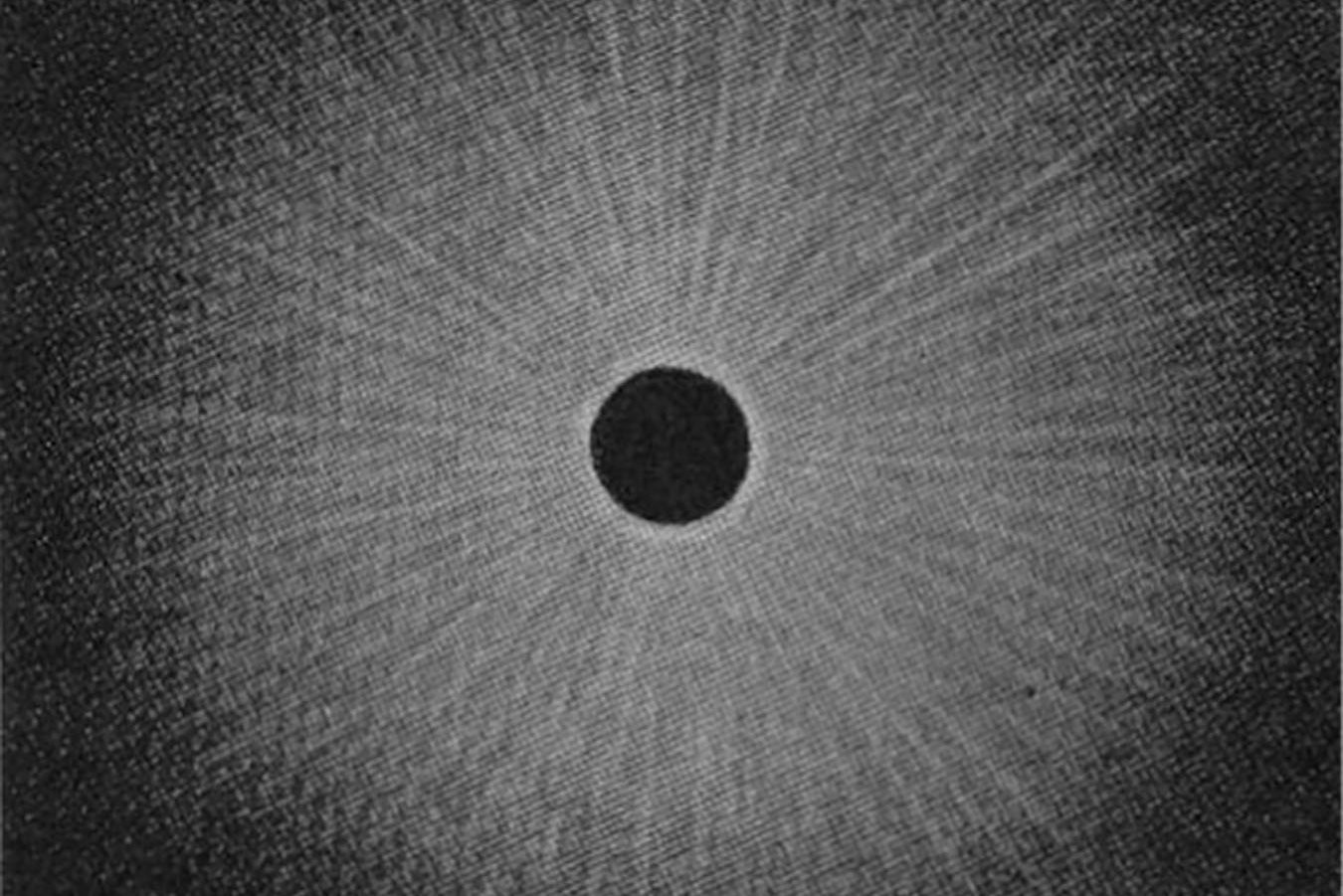
As science became professional, so did the sketches. Astronomer José Joaquín de Ferrer drew the eclipse over New York on June 16, 1806. He gave the outermost layer its name. The corona.
He had an idea. A radical one for the time. The corona isn’t part of the moon. It’s part of the sun. His proof? The size. He sketched it stretching up to 20 times the width of the sun’s main disc. Too big to be lunar.
How was the first scientifically useful eclipse photo taken?
Photography changed everything. Before, it was lines on paper. Then came Julius Berkowski. On July 28, 1851, at the Royal Observatory in Königsburg, Prussia, he took the first detailed photo.
He attached a small telescope to a heliometer. This is a specialized tool for measuring the sun. An 84-second exposure. Daguerreotype. Look closely. The corona is visible. So are eruptions blasting from the sun’s edge over the moon.
Others followed. William and Frederick Langenheim tried in Philadelphia on May 26, 1854. No heliometer. No fancy tools. Just small cameras. The largest daguerreotype they made was 7.2 centimeters tall. Tiny. But clear enough.
Did this photo prove Einstein right about gravity?
Some eclipses matter more than others. The one on May 29, 1919, swept over Africa and South America. It changed physics.
Astronomer Arthur Eddington went to Principe island. He photographed stars near the sun. He marked them with lines. He compared their positions before the eclipse and during it.
The result? The sun’s gravity bent the light from those stars. It proved Albert Einstein’s theory of general relativity. It changed how we understand the universe. Not bad for a dark afternoon in 1919.
What causes the “diamond ring” effect?
Eclipses became cool for everyone. Not just scientists. Frederick Goetz shot this one on January 24, 1925. He captured the diamond ring. Or Baily’s beads.
It happens at the very start or end of totality. The moon covers almost all the sun. Almost. Ridges and craters on the lunar surface let tiny rays of sunlight through. It glares. Goetz called it “Signs and Wonders”. You can’t make that up.
Why is the corona so hot compared to the surface?
Modern tech shows us details we never imagined. Take a photo from California on July 11, 1991. The corona looks sharp. Defined.
But it holds a mystery. The corona is about 300 times hotter than the sun’s surface. How? Why? We don’t fully know.
Eclipses let us study this. If we figure it out, we can predict solar activity. That matters. Solar flares can fry satellites. They can zap astronauts. They can knock out electrical grids on Earth. Knowing when they happen helps us prepare.
How do animals react when the sky goes dark?
The sun isn’t the only subject. Look at Chile, July 2, 2019. The sky went black. Temperatures dropped. Birds stopped singing. Almost entirely.
Researchers study this behavior. What are the animals feeling? How do they perceive sudden darkness? It’s weird. It’s fascinating. It breaks their normal routine.
Where can you see the moon’s shadow from space?
Standing on the ground, you miss the scale. You see darkness. You feel the chill. You don’t see the geometry.
NASA’s Deep Space Climate Observatory (DSCOVT satellite) showed us this during the April 8, 2024, eclipse. It took pictures from orbit. See the dark spot moving across the planet? That’s the moon’s shadow.
If you are in that spot, you see totality. If you are on the edges, you see only a partial eclipse. It puts everything in perspective. We are small. The sun is big.
We’ve come a long way from petroglyphs. Imagine what we’ll see in a few thousand years.
Will we still look up?