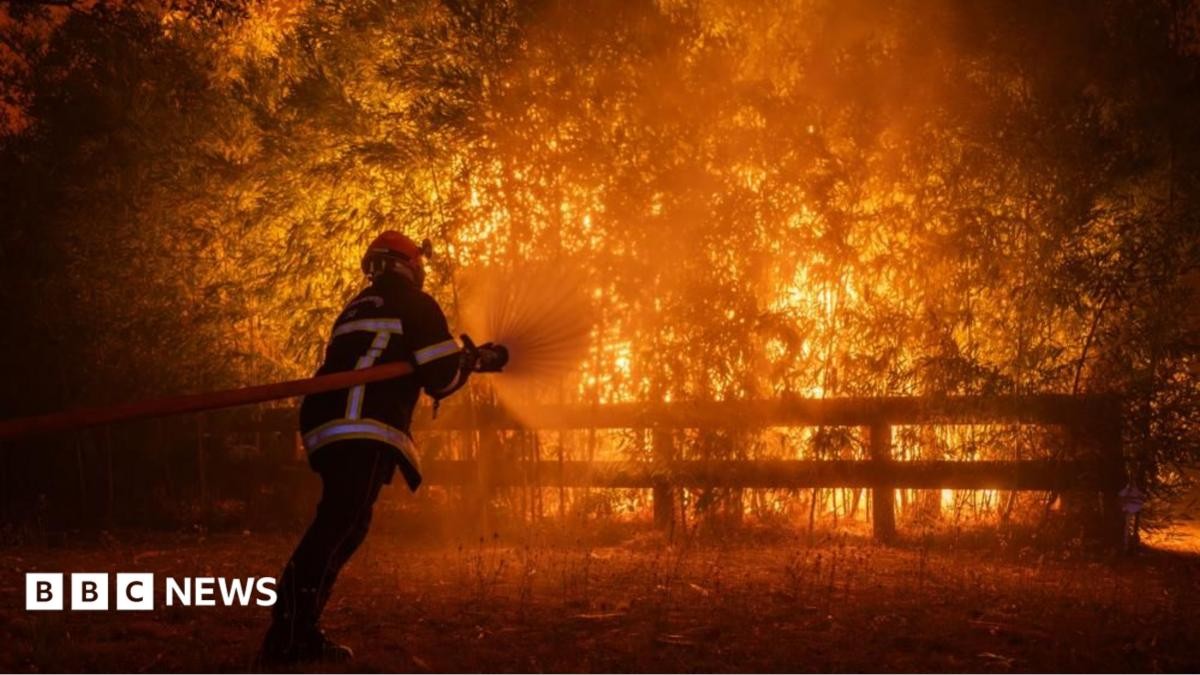
It is not going well.
The heat is relentless. The wind is erratic. And now, President Emmanuel Macron is convening a crisis cabinet meeting this Monday. Why? Because the fire is getting closer to Bordeaux.
Mayor Thomas Cazenave says the blaze is roughly 15 kilometers from the city center. That is close enough to feel the smoke. It is close enough to be a threat. Yet, as of now, there are no plans to evacuate the city’s 850,000 residents.
But don’t get comfortable. A new heatwave is rolling in. It complicates everything. Firefighters are already fighting uphill against conditions that seem designed to defeat them.
How Severe is the Bordeaux Wildfire Crisis?
The scale of destruction in southwest France is hard to parse in numbers alone, but they are stark. Approximately 42,000 hectares of land have been scorched in the Gironde region. For context, that is one of the largest forest fire events since World War Two. Year-to-date, nearly 98,000 hectares are gone.
The situation inside Gironde has reached a level of intensity that defies standard firefighting tactics. The National Firefighters Federation of France reported an unprecedented “pyrocumulonimbus.” That is the technical term for a fire thunderstorm.
Think about what that means. The fire is so hot and so large it is generating its own weather systems. It is fueled by its own winds. It creates its own lightning.
“We don’t know how the blaze will spread… It’s a David-versus-Goliath situation,” said FNSPF spokesman Eric Brocardi.
Interior Minister Laurent Nuñez did not sugarcoat it either. The fire front is shifting constantly. Direct suppression is impossible right now. The best-case scenario? Heavy rain for three straight days. Or, if firefighters can steer the fire’s edge toward the sea where it might naturally die down.
Neither is likely. But the weather forecast offers little hope. Temperatures in some areas could spike to 40°C starting Tuesday.
Why Macron Called a National Emergency Meeting
Macron didn’t call this meeting out of boredom. He said on Saturday that France will “rebuild” and that the government would remain engaged “as long as is needed.”
This is about more than just Bordeaux. More than 220,00 people in the southwest alone have been evacuated. It is a humanitarian logistical nightmare on top of an ecological catastrophe.
The government is signaling that this is not a routine wildfire season. This is a climate emergency event. But signals don’t put out flames. Only resources and weather changes do. And the weather looks set to stay hostile.
How Spain’s Wildfires Compare and Impact
While Bordeaux watches its perimeter burn, Spain is battling its own set of infernos. The crisis is regional but connected by heat and drought.
In Valencia, on Spain’s eastern coast, a new blaze has erupted. It is intense. Around 15,000 locals were forced to flee their homes on Sunday. Pilar Bernabe, the central government’s delegate for the region, warned that weather conditions there are expected to worsen quickly.
Meanwhile, in the province of Ávila, west of Madrid, Prime Minister Pedro Sanchez toured an emergency shelter. His words were bleak.
“Difficult hours lie ahead,” Sanchez said.
He called for what he termed a “major public pact on the climate emergency.” Translation: the current approach is insufficient, and the political will needs to scale up to match the physical reality.
King Felipe VI added a different tone when touring a shelter in Villamanta. He spoke of “incalculable” damage to the nation’s natural heritage. It is a poetic way of saying we have lost things that money cannot buy back.
Interior Minister Fernando Grande-Marlaska noted that the fires in some areas are advancing slowly. But slow fire is still fire. And slow fire consumes forests.
The Bigger Picture of Evacuations Across Europe
When you zoom out from Bordeaux and Valencia, the map of Europe tells a grim story.
Over the past week, wildfires have raged across the continent. France and Spain are the epicenters. The human cost is measured in hundreds of thousands displaced. More than 330,00 people have been evacuated between the two nations.
This isn’t a localized anomaly. It is a widespread pattern.
The tools firefighters use are becoming less effective as temperatures climb. The forests become drier. The winds become more unpredictable. And the “David-versus-Goliath” ratio shifts further against the people trying to hold the line.
Macron’s cabinet meeting will likely discuss resource allocation. Spain’s government will probably announce more funding. Leaders will speak about resilience and rebuilding.
But for now, the fire in Gironde keeps moving. The thunderstorm over the flames keeps generating. And the 15-kilometer gap between the blaze and Bordeaux remains the only buffer that matters.
Whether that gap closes on Tuesday or next week, the air quality in Bordeaux will likely change. The threat won’t disappear. It will just move to the next line.