We found sugar in space.
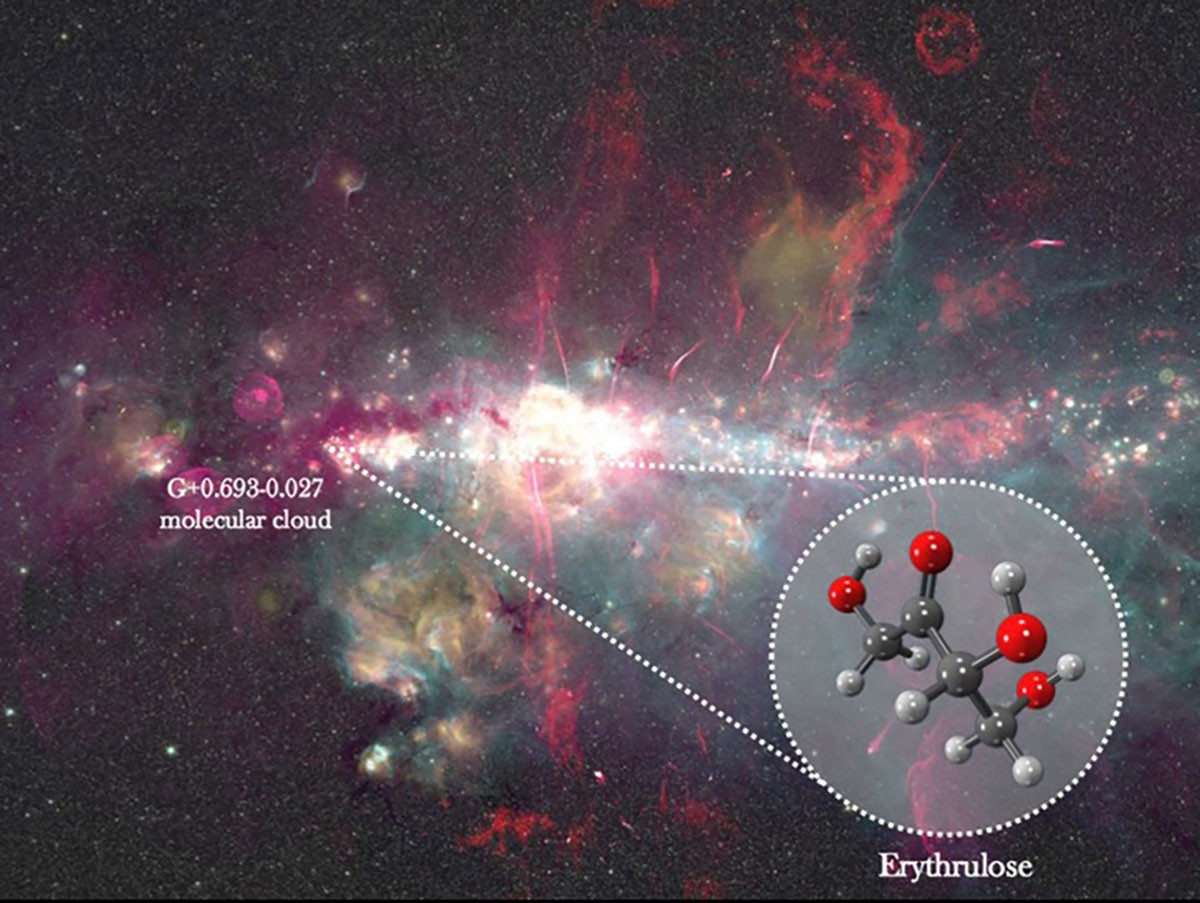
Not the granulated white stuff in your kitchen drawer. Erythrulose. A four-carbon sugar. It sits in a molecular cloud near the Milky Way’s center, specifically the region G+0.693-0.027.
This changes the story about how life started.
Sugars are the backbone of DNA and RNA. Without them, those molecules don’t hold together. But there is a hole in our current theory. Lab experiments say early Earth didn’t produce enough sugar on its own to kickstart life. So where did it come from?
Meteorites have shown us hints. Ribose and glucose were found in asteroid material. That suggested the raw ingredients formed in the ancient cloud that birthed our solar system. But until now, we never saw sugar directly in interstellar space.
Now we have.
How Scientists Detected Interstellar Erythrulose
The team didn’t guess. They listened.
Using the 40-meter Yebes radio telescope and the 34-meter IRAM telescope, researchers scanned the sky for spectral lines. These are chemical fingerprints. Light absorbed by molecules leaves a unique pattern.
They found twelve specific lines. They matched the laboratory signature of erythrulose perfectly.
Here is why this matters for anyone searching for erythrulose in interstellar space detection :
- It is a ketose. Specifically the only one with four carbons.
- It is at least eight times more common than comparable three-carbon sugars.
- Those three-carbon sugars? They weren’t even there.
The leading author, Izaskun Jiménez-Serra from CAB, admits it surprised them. The standard rule in astrochemistry says molecules grow by adding one carbon at a time. Sequentially. Step by step.
Erythrulose breaks that mold. It appeared bigger than expected.
Experiments with colleagues from the University of Extremadura and radboud University showed how it happens. Simple two-carbon alcohols and aldehydes mix in interstellar ice. They cook. Erythrulose forms.
It’s not magic. It’s chemistry. Cold, dark, efficient chemistry.
Where Does This Sugar Fit in Life’s Origins?
Why look for sugar in space?
Because Earth was under siege. Between 4.1 and 3.8 billion years ago, the Late Heavy Bombardment hit. Rocks. Ice. Comets. All slamming into our planet.
This study suggests those impacts delivered more than just water. They brought sugar.
Researchers calculated the abundance of erythrulose in that cloud. Extrapolating that to the bombardment period, Earth could have received anywhere from 500,000 tons to 50 million tons of erythrulose.
That is a lot of sugar for a young planet trying to build cells.
It provides an alternative supply line. Instead of waiting for Earth to cook up its own precursors, maybe the universe shipped them in. This fits the search intent for those asking how interstellar molecules contributed to prebiotic chemistry on Earth.
Carlos Briones, a co-author, sees it as a door opening. If erythrulose is there, ribose might be too. Ribose is the key component of RNA.
“The detection of erythrulose opens up the possibility of discovering in space other important molecules for the origin of life.”
Why This Challenges Previous Astrochemical Models
The prevailing view assumed growth was linear. Add carbon. Add carbon. Repeat.
This finding suggests shortcuts. Complex sugars can form from simpler two-carbon blocks without passing through the intermediate steps we thought were mandatory.
It challenges the idea that size equals time or complexity in the interstellar medium.
For those wondering which sugars are likely to be found in meteorites versus interstellar clouds, the distinction is sharpening. Meteorites have ribose and glucose. Interstellar space now has erythrulose. The distribution isn’t random. It reflects where and how these molecules formed before they ever touched solid rock.
What Happens Next in Origin of Life Research
This was published in Nature Astronomy. The authors list is long, spanning multiple institutions. The funding came from the ERC grant OPENS. The work is solid.
But it raises more questions than it answers.
If erythrulose is abundant, why is ribose so rare in these specific scans? Is it hidden? Is it destroyed? Or does it form only under different conditions?
We might find the rest of the recipe next.
The universe isn’t empty space. It’s a laboratory. And it has been cooking up life’s ingredients since before the sun rose. We’re just now learning to taste it.