You are not a bag of teeth and goo.
Well, technically, maybe. But if someone insults your lineage, don’t take it personally. Just tell them you’re missing the point by half a billion years. The real story of your ancestry doesn’t start with a monkey swinging from a tree. It starts with a microscopic blob that looked like a crumpled piece of plastic.
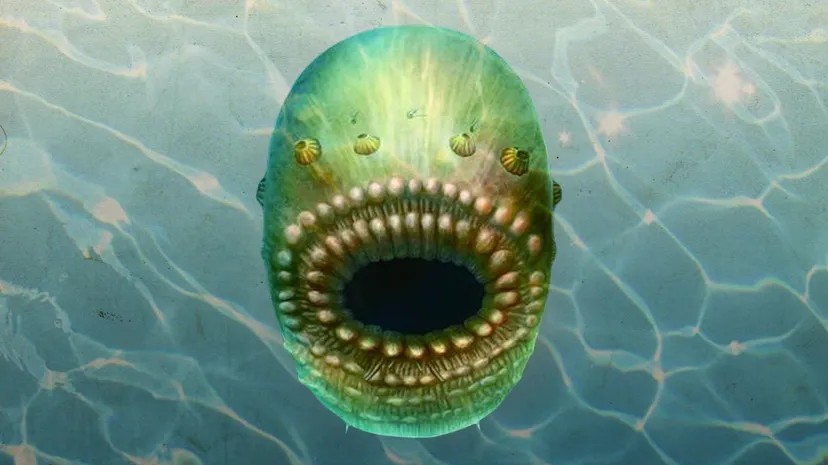
Scientists have found what might be the earliest verifiable ancestor of humankind. It is not human. It is not even close. It is Saccorhytus coronarius.
This organism is the common ancestor of deuterostomes. That is the biological group that includes all vertebrates. You. Me. Fish. Birds. That guy in the cubicle next to you. All of us trace our lineage back to this tiny, wrinkled creature. The findings were published in Nature, and they shift the timeline of human origins back by at least 20 million years.
Why This Micro-Fossil Matters
Most early deuterostome fossils we’ve found date to about 510 to 520 million years ago. By then, evolutionary lineages were already diversifying. The tree of life was branching out.
Saccorhytus predates those finds. It dates to the late Cambrian Period, roughly 540 million years ago.
This matters because it pushes the root of our family tree deeper into the past. It answers a simple question: how did complex creatures evolve from simple ones?
“We think that as an early deuterostome this may represent the primitive beginnings of a very diverse range of species, including ourselves.”
— Simon Conway Morris, University of Cambridge
The discovery helps explain the transition from simple sea creatures to the complex vertebrates that dominate the planet today.
The Search for the Ancestor
Finding Saccorhytus was not easy. The fossils are microscopic.
Researcher Jian Han from Northwest University processed enormous volumes of limestone to find them. About three tonnes of rock.
They used electron microscopes and CT scan technology. These tools allowed the team to see details that are invisible to the naked eye. The fossils look like tiny black grains from a distance. Up close, the detail is jaw-dropping.
The team had to ask a key question: Was this an early echinoderm? Or something more primitive?
The answer is the latter. It is more primitive.
What Did It Look Like?
Saccorhytus was small. At most 1.2 millimeters wide. That is 0.05 inches.
It likely lived between grains of sand on the seafloor.
Its body was symmetrical. It had a dominant pleated mouth. It had a skin-like covering with numerous openings.
The scientists theorize that small conical structures on its body allowed water to escape. These might have acted as a precursor to modern gills.
It had no anus.
If that sounds gross, it is. Waste material would have exited through the mouth.
“If that was the case, then any waste material would simply have been taken out back through the mouth, which from our perspective sounds rather unappealing.”
— Simon Conway Morris
All deuterostomes had a common ancestor. This is it. Or at least, the closest one we have found so far.
Where Was It Found?
The fossils were found in Shaanxi province in central China.
This region is rich in early deuterostome fossils. The same research team identified it as a key site back in 2009.
They have been studying deuterostomes there for a long time. In 1999, they found the world’s oldest fish fossils in the same area.
China has become a hotspot for understanding early animal evolution.
The Bigger Picture
Saccorhytus is not a direct ancestor of humans. It is a distant cousin. But it is the nearest known relative to the last common ancestor of all deuterostomes.
It shows us where it all began.
Simple structures. Pleated mouths. Tiny openings.
From this tiny blob, the diversity of life exploded.
Fish evolved. Amphibians crawled onto land. Reptiles dominated. Mammals appeared. Humans followed.
The chain starts here.
With a 540-million-year-old micro-fossil.
And a mouth that handled waste the only way it knew how.