There is a specific kind of magic to a mid-July afternoon. It’s the sizzle of hot dogs hitting the grate, the chlorine tang hanging in the air, and the laughter of friends scattered across a warm lawn. You are definitely not alone in craving this rhythm. Sixty percent of Americans are ready to fire up the grills this season.
The data backs up the nostalgia. Roughly 38 percent of all hot dogs sold in the U.S. vanish between Memorial Day and Labor Day. That window is the unofficial kickoff to summer. It’s also when we devour the third most popular grilling item behind cheeseburgers, which hold the top spot. Corn on the cob sits comfortably in second. But the food is only half the equation. The other half is the people. And the noise.
Summer days demand low-stakes entertainment. You want games that require zero athletic prowess and maximum social friction. Here are ten easy, do-it-yourself suggestions to fill the backyard hours.
10: Pickleball
Let’s address the name immediately. No, there are no pickles involved. There are no cucumbers. No vinegar. Just a paddle, a perforated plastic ball, and a net lowered to 34 inches at the center. It sounds like a prank. It plays like tennis on a sugar rush.
Why does it dominate the list? It is accessible. If you can hold a paddle, you can play. The court is smaller than a tennis court. The ball moves slower. This means less running and more standing around discussing whose serve was actually out. It is the perfect entry point for friends who claim they “hate sports” but will happily show up for beer and petty competition.
Grab a paddle. Leave the vegetables in the fridge.
9: Hopscotch
If you want a court that requires zero power tools and zero budget, look at hopscotch. It is the original low-effort backyard game. You don’t need to order a specialized net. You don’t need to hunt down perforated plastic spheres. You just need chalk and a flat patch of pavement.
The geometry is simple. Draw a rectangle. Subdivide it into a row of smaller squares. Number them one through ten. The rest is just physics and footwork.
Why does this matter? Because pickleball grew from scratch in the winter of 1967. Joel Pritchard, Bill Bell, and Barney McCallum built the first court in Pritchard’s Bainbridge Island, Washington backyard. They mixed badminton, tennis, and ping pong into something new. They used a wiffle ball. They stretched a badminton net across the width of the court. Today, you can buy portable pickleball nets for your own backyard if you want to replicate that 1967 experiment. You need paddles. You need the perforated ball. You need the specific court dimensions.
Hopscotch needs none of that. It is immediate. It is cheap. It works on concrete, asphalt, or even packed dirt if you are careful with your lines.
Is it a sport? Maybe. Is it a way to pass a Tuesday afternoon without spending a dime? Definitely. The rules are older than most of the players. You toss a stone or a beanbag into square one. Hop on one foot. Pick it up. Continue hopping until square ten. Turn around. Come back. If you step on a line, you lose your turn. If you miss the toss, you start over.
It is less about athletic prowess and more about patience and balance. Pickleball is fast. It is loud. It has a specific rhythm of dinking and driving. Hopscotch is quiet. It is meditative. It forces you to look down, not at your opponent.
The first pickleball courts were improvised solutions to a rainy winter. Hopscotch is an improvised solution to boredom. Both work. One requires a net. The other just requires a piece of sidewalk.
Which do you prefer? The chaos of a double rally or the solitary focus of a single hop?
It sounds simple, right? You toss a stone. You hop. You don’t touch the chalk lines. You don’t fall over. But underneath that childish rhythm lies a game of intense physical balance and spatial awareness. The goal is straightforward: get from point A to point B, then turn around and make the trip back. Fail to clear a square? Hop on a line? Lose your footing? You’re out until your next turn.
The beauty of it is the low barrier to entry. You don’t need a club membership or a league registration. Just a handful of people, a piece of sidewalk, and something small to throw—a pebble, a quarter, or even your car keys. In some neighborhoods, that little marker is affectionately called a “potsy.” The court itself? Chalk does the trick for a quick afternoon. For a semi-permanent setup, some folks lay down stone tiles.
How Big Is a Standard Hopscotch Court?
If you’re imagining a massive arena, think again. Sure, the Guinness World Record holder for the longest court stretches a staggering 18,064 feet—that’s over 5,500 meters. Try doing that in your living room. The court most Americans grew up with is far more modest. We’re talking about a 10-foot long by 3-foot wide rectangle. It’s divided into ten sequential spaces, usually ending in a semi-circle at the top. It fits in a driveway. It fits in a park. It fits in the collective memory of a generation.
But while hopscotch dominates the playground, it isn’t the only game testing precision and patience.
8: Horseshoes
Step away from the chalk. Head toward the grass. Horseshoes might look like a slow-motion version of bowling for adults, but don’t let the relaxed pace fool you. Like hopscotch, it’s about precision, but the mechanics are entirely different. You’re not balancing your weight; you’re aiming a weighted iron shoe at a stake.
The stakes (pun intended) are high for some players. While you might find a casual game in a backyard, competitive horseshoe pitching has a dedicated following with specific rules, distances, and scoring systems that rival more traditional sports. It’s a game of physics and luck, played out on a 40-foot rectangle of dirt or sand. If you can land your shoe closer to the stake than your opponent, or ring the stake entirely, you score points. Miss? You just walk over, pick up your shoes, and try again.
It’s a stark contrast to the frantic hopping of the pavement game. Horseshoes is deliberate. It’s quiet. It’s about the arc of the throw, the spin of the iron, and the satisfying clack when it lands perfectly.
The rules are simple, even if the skill ceiling is deceptive. You stand at one end of the pit, two heavy iron rings in hand, and aim for the stake buried in the dirt at the other end. It’s a ritual as old as the American backyard. There are more than 15 million horseshoe pitchers in North America alone. They play in organized leagues and casual pickup games alike. You can even set up your own court in the backyard with a DIY pit.
The official court dimensions are strict: 46 feet long by 6 feet wide. That’s about 14 meters by 2 meters. But most people don’t have that much yard space. Backyard courts are often smaller. Dirt or sand is the preferred surface.
Is Horseshoes Actually Good Exercise?
You might think tossing metal rings is sedentary. It’s not. A single game can involve up to 3,000 pitches. That’s a lot of repetitive motion.
Consider the weight. Each horseshoe weighs about 2.5 pounds. That’s 1.1 kilograms. If you play a standard game to 40 points, you’ll throw each shoe roughly 50 times. That’s 100 throws per round. Over the course of an hour, you could burn as much as 150 calories. Not enough to replace the gym, but better than sitting on the porch.
The physics are unforgiving. Miss the stake. The shoe bounces. You walk over, pick it up, and try again. Repeat until the sun goes down.
How to Play Horseshoes at Home
You don’t need a tournament-grade court. Start with a level patch of ground. Dig or rake out a pit. Two stakes at either end, spaced correctly. Throw the shoes. Keep score.
It’s social. It’s physical. And it’s surprisingly addictive.
7: Spikeball
What Is Spikeball?
Spikeball changed the backyard game landscape. It’s not just another lawn game. It’s a fast-paced, high-energy sport that blends volleyball, soccer, and handball into one chaotic loop. The game is played on a small, circular net stretched over a frame. The net sits just above the ground, hovering at a height that forces players to stay low.
Four players. Two teams of two. The ball is small, firm, and bounces unpredictably. That’s the point.
How Does Spikeball Work?
The rules are deceptively simple. One team serves the ball by hitting it into the net. The opposing team has three touches to return it to the net. They can use their hands, feet, or any body part except the arms above the elbow. The ball must bounce off the net and land in bounds. If it doesn’t, the serving team scores a point.
The first team to reach 21 points, winning by two, takes the game. Games are short. Fast. Intense. You’re sprinting, diving, and reacting in split seconds. It’s less about strategy and more about reflexes.
Why Spikeball Took Over
Spikeball exploded in popularity after being featured on Shark Tank. The investors saw the potential. The product saw the fun.
Spikeball. It’s basically volleyball if volleyball decided to get aggressive and play foursquare instead. Add in some loud trash talk and you’ve got the perfect recipe for a sweaty afternoon. Sure, you can drag this thing to the coast, but honestly? Your backyard is just as good. Maybe better. Less sand in your swimsuit, for one.
Here is the deal. You need four people. Two teams of two. No more, no less. The centerpiece is a taut, ankle-height net. It’s roughly the size of a Hula Hoop but acts like a mini-trampoline. There’s no jumping surface, just a net. That’s it.
Team A starts. They serve the palm-sized ball into that net. Team B has three hits max. Three. To get it back. They bounce it off the net, aiming for the opposing side. If you miss? Point for the other team.
The game ends when one team hits 21 points. But there’s a catch. You need to win by two. No 21-20 finishes. It drags on until someone pulls ahead. It’s tense. It’s fast. It’s weirdly addictive.
6: Two-liter Lawn Bowling
Now, let’s pivot. If Spikeball is high-energy chaos, this next idea is for when you want to pretend you’re sophisticated but still on budget. Two-liter lawn bowling.
It’s not official. There’s no governing body. But the concept is simple. Use empty two-liter soda bottles as the pins. Set them up in a triangle. Roll a ball. Try to knock them over.
Why two-liter bottles? They’re cheap. They’re everywhere. And they have that specific weight that feels satisfying when they topple. You don’t need expensive wooden pins. You don’t need a manicured green. Just some space and a few empty Coke or Sprite containers.
Is it as competitive as Spikeball? No. But it’s easier to set up. And if you mess up, you just pick up the bottles and try again. No arguing about net tension. No counting hits. Just roll. Knock down. Repeat.
It’s a different vibe. Less athleticism, more strategy. Or maybe just luck. Either way, it’s low stakes. High fun. Perfect for when you’ve burned through the Spikeball energy and need something slower. Something that doesn’t involve jumping.
The summer grill session is over, but the party doesn’t have to end. Those empty two-liter soda bottles cluttering your recycling bin? They’re actually the foundation for a legit backyard bowling alley. You need ten of them. Just the empties. No liquid.
Here’s how you turn trash into turf-ready pins. Wash them out. Dry them off. Then comes the physics part. Fill each bottle with gravel or sand. It doesn’t need to be precise. You’re just adding mass so the wind doesn’t turn your pins into frisbees before the first roll. If you want them to look less like garbage and more like game equipment, strip the labels. Paint them. White with red stripes is the classic look. Go wild with a rainbow palette—add white, brown, and black to hit that ten-pin count. Or, since the plastic is clear, fill them with beads or confetti for a flashy, see-through effect.
Mow a strip of grass. Set up the pins in a triangle. Grab a ball. Ideally, you want something the size of a real bowling ball, though a lighter backyard variant works just as well. Roll. Hope for a strike.
5: Cornhole
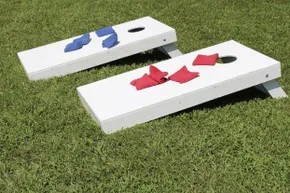
If lawn bowling feels a bit too stationary for your crew, pivot to cornhole. It’s the ultimate lawn game for a reason. You don’t need a commercial setup to get started. Two wooden boards with a hole near the top. A bag of corn or bean-filled sacks. The goal is simple: throw the sacks onto the board and into the hole. Points accumulate based on where they land. The first team to reach 21 wins. But honestly? The real win is the argument over whether that one bag actually touched the wood or just hovered above it. It’s competitive. It’s loud. And it uses the same outdoor space as your bowling lane.
Upgrade Your Lawn with DIY Cornhole
Cornhole, or Corn Toss as it’s sometimes called, is the undisputed king of backyard gatherings. It’s simple, it’s casual, and it adds just enough competition to any barbecue or summer party without demanding athletic prowess. You’re basically throwing small beanbags at a raised, rectangular wooden board with a hole in the middle. If you want to win, forget about brute force. Find a comfortable stance, keep your body relaxed, and focus on putting a flat spin on the bag as you release it.
You have two paths to getting this game into your yard: buy a ready-made set with the platform and bags, or roll up your sleeves and build your own. The latter saves money and gives you a sense of pride that a store-bought kit never will. If you’re building from scratch, the specs are specific. You’ll need half-inch plywood cut into a rectangle measuring 4 feet by 2 feet (1.2 by 0.6 meters).
The elevation is what makes the game work. Place the front of the board on risers that are 2.5 to 4 inches (6.4 to 10.2 centimeters) high. The back needs to be higher, elevated on 12-inch (30.5-centimeter) risers. This slope creates the challenge. The beanbags themselves should be 6-inch (15.2-centimeter) squares. Get the geometry right, and you’ve got a classic game ready for your next cookout.
4: Outdoor Tic-tac-toe
Speaking of turning empty lawn space into an interactive zone, why stop at beanbags?
3: Lawn Chess
Why stop at tic-tac-toe when the backyard is begging for a strategic showdown? Lawn chess is the ultimate upgrade for anyone tired of simple grid games. It takes that classic, cerebral battle of kings and queens and drops it directly onto the grass. You aren’t just marking squares anymore; you’re maneuvering oversized pieces across a full-sized board.
The setup is surprisingly low-effort. Grab six large, distinct markers for each side. Some people go all-in with professionally cast concrete figures, while others prefer the DIY route, painting old tires or using brightly colored patio stones. The key is visibility. You need pieces that stand out against the green so you can actually track the game from the porch.
The real charm of lawn chess isn’t just the game—it’s the conversation it starts with neighbors who wander over to watch.
It works best on a flat, mowed patch of lawn. Uneven ground turns a strategic move into an ankle-twisting hazard. If your yard slopes, find a level spot or just accept the tilt as part of the challenge. And unlike board games that get lost in the attic, these pieces stay outside. They weather the rain. They earn their place in the garden.
Want to make it harder? Play on a larger grid. Or try “blindfold” chess where one player can’t see the board. Or just play for keepsakes. The stakes are higher when the prize is bragging rights and the loser has to mow the lawn. Which piece do you move first? Usually white. Usually with a smirk.
Lawn Chess: Rules, Setup, and Where to Play
Chess isn’t just a parlor game for stuffy libraries anymore. The standard board has 64 alternating squares, and the setup is non-negotiable: each side starts with 16 pieces. That means eight pawns leading the charge, backed by two bishops, two knights, two rooks, one queen, and the king. It’s a specific hierarchy, and it stays that way whether you’re playing in a tournament or on a patio.
The rules don’t change because you’re outside. It’s still two opponents until checkmate. You keep going until the king has no escape routes left. No moves? Game over. Simple, brutal, effective.
Where do you actually set this up? You have options. You can have a giant chessboard mowed directly into your lawn, turning your yard into a literal board. Or you can lay down wooden or stone tiles for a more permanent fixture. If you want something you can pack away, look for sets with interlocking teak or plastic pieces. Those markers and boards are designed for patio-friendly games, meaning they won’t slip away every time a breeze picks up. 🌿
Outdoor Twister
Speaking of games that demand space, Twister has always felt like it was begging for an outdoor audience. Indoor carpets wear out fast under the stress of entangled limbs. Outdoors?
Forget the expensive equipment. Grab a can of spray paint and you’ve got your own backyard arena. Red for the left hand, yellow for the left foot. It’s Twister, but outdoors.
Turn that flexibility-challenging classic into a lawn game in minutes. Just pick four colors. Red, blue, yellow, green are the traditional picks. Green on green grass? It vanishes. So swap it for white if you want players to actually see where their limbs need to go.
You need 24 circles. That means four rows. One row per color. Six circles in each row.
If you want it to look less like a toddler’s art project and more like a professional setup, take the time to measure. Mark straight lines. Cut a cardboard stencil. Spray through it. Clean edges make the game feel serious.
Then decide who calls the first move. Or don’t. Chaos is part of the fun.
1: Crazy Croquet
“Spray 24 circles on your lawn… or make things a little more professional looking by measuring and marking straight rows.”
The beauty of this is the low barrier to entry. No wickets. No mallets. Just paint and a willingness to twist until you fall over.
If you’re worried about the paint soaking into the grass, let it dry completely before anyone steps on it. Sticky circles make for a slippery, and potentially awkward, exit.
Who calls first? The person who is most confident they won’t pull a hamstring. Or the one who wants to see their friends suffer. Either way, it works.
Crazy Croquet: The Obstacle Course Hybrid You Didn’t Know You Needed
Back in the day, traditional lawn games carried a bit of a stigma. Croquet was practically considered scandalous. Why? Because it was one of the first pastimes where men and women could mingle and play together without strict chaperones hovering over every stroke. Naturally, authorities panicked. They banned it. The fear was simple: couples getting too cozy in the bushes while trying to hit balls through hoops.
Times have changed. We aren’t worried about innocent winks turning into illicit affairs anymore. So, why keep the game confined to a flat, boring patch of grass?
Enter Crazy Croquet.
It’s exactly what it sounds like. Take the classic rules of croquet and smash them into a miniature golf course. The result is a chaotic, creative hybrid that demands more strategy and a lot more improvisation.
Here is how it works, stripped of the pretension.
How to Build a Crazy Croquet Course
You don’t need a pro shop. You don’t need a landscaper. You need a backyard and an attitude problem.
Start with a standard croquet set. You need the balls. The mallets. The wickets. The metal posts. If you are playing with a large group, you might need a second set just to keep the game moving at a decent pace. But the real magic happens in the terrain.
Flat ground is out. Boring is out.
You are building an obstacle course.
Use whatever junk you have lying around. Plywood sheets. Bricks. Rocks. Old patio tiles. Stack them. Arrange them. Create ramps that force the ball to jump. Build plateaus that reward precision. The goal is to make the path from start to finish unpredictable.
“Cross the game of croquet with a game of miniature golf and you get a hybrid called crazy croquet.”
Why Play Crazy Croquet Instead of Regular Croquet?
Regular croquet is about patience. It’s about waiting for your turn, watching the ball roll, and hoping you didn’t just ruin your friend’s shot. It’s slow. It’s polite.
Crazy croquet is about adaptation.
The ball doesn’t just roll. It bounces. It rolls uphill. It gets stuck in a gap between two bricks. You have to adjust your swing. You have to think laterally. It turns a game of skill into a game of resourcefulness.
It’s also better for parties. When you add physical obstacles, the stakes feel higher. Hitting a wicket straight on feels less impressive than banking a shot off a tilted plywood ramp to drop through the hoop.
What You Need to Get Started
You don’t need to go out and buy anything special. The beauty of Crazy Croquet is its accessibility.
- The Gear : One or more standard croquet sets. Balls, mallets, wickets, stakes.
- The Terrain : Flat grass is the base.
- The Obstacles : Plywood. Bricks. Rocks. Sandbags. Old tires. Anything that changes the trajectory of the ball.
- The Mindset : Be ready to rebuild the course. If a ramp is too easy, move it. If the ball always gets stuck in the same spot, add another layer of gravel.