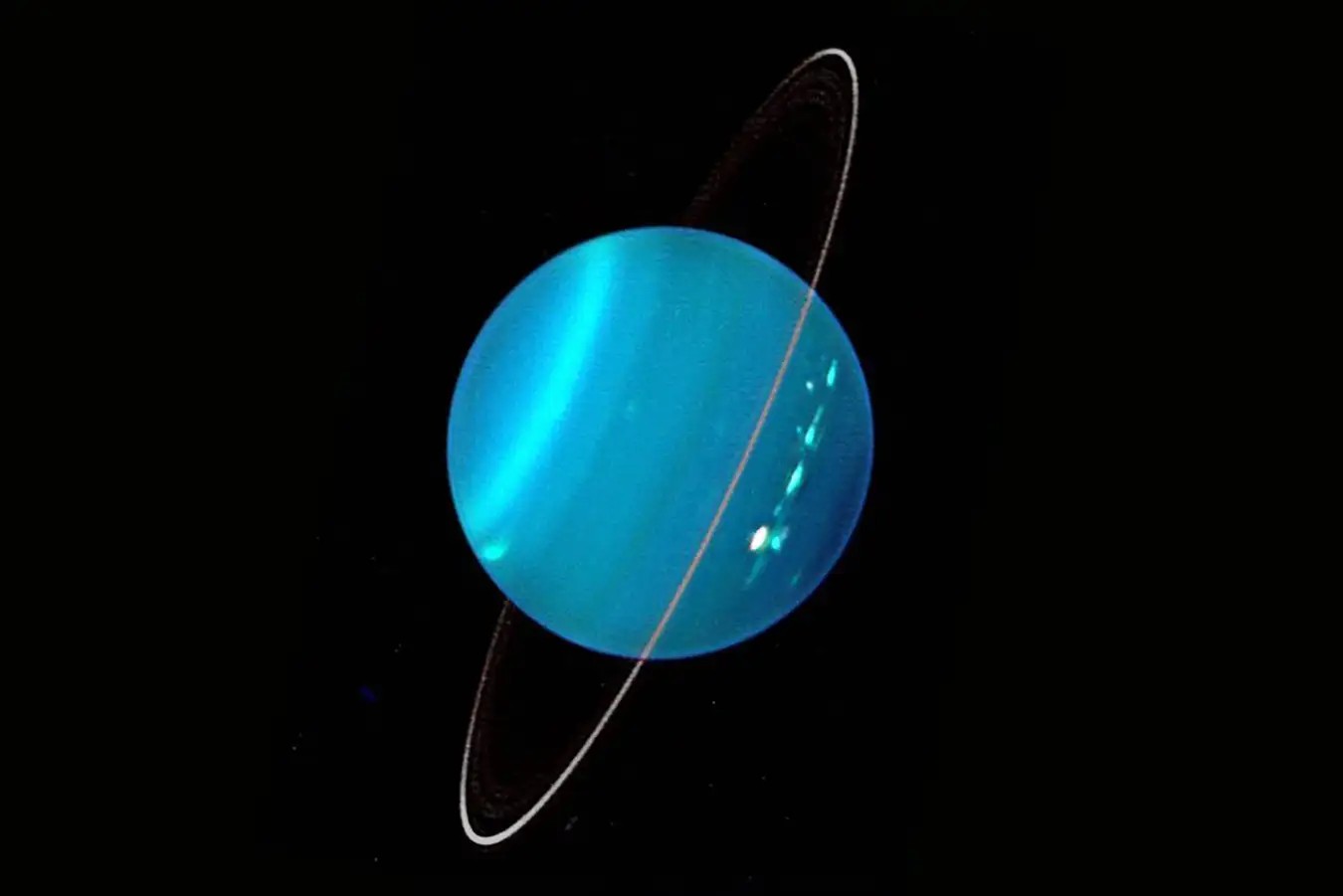
Ice giants are slippery things. Thick gas masks everything below. You can’t see inside, so you have to guess based on what floats on top. It’s an imperfect science, really. But sometimes the atmosphere tells the truth.
For a while, Neptune looked like it had an icy heart. It was full of carbon monoxide. A chemical marker that screams water-ice from the depths. Uranus, its twin neighbor, said nothing. No monoxide. No ice signals. Just silence.
Silence made people suspicious. Some astronomers decided Uranus must be different. Rocky, not icy. Maybe the twins weren’t twins after all. Maybe they formed in completely different corners of the early solar system, ending up with similar shapes but opposite skeletons. A long-running argument.
“This controversy is over now,” Thibault Cavalié said. He might be stretching. A bit. But he’s got the data on his side.
Cavalié works at the University of Bordeaux. He didn’t guess. He pointed a telescope at the quiet planet and looked. Specifically, he used the Atacama Large Millimiter/submillimeter Array in Chile. He watched Uranus between 2022 and last year.
He found it.
Carbon monoxide in the lower atmosphere. Significant amounts of it. The kind you get when there is deep water.
It wasn’t a fluke. His team ran the models. They tried rock-heavy versions of the planet. They failed. Only the ice-heavy models reproduced the numbers. The data demanded ice. A lot of it. So, apparently, Uranus is closer to the ice-giant label than the rock-giant one. It suggests the two planets are more similar than we hoped—or feared.
The upper atmosphere also has the gas, by the way. But that’s not from the inside. Probably a comet hit the planet a few hundred years ago. A splash in the soup. Easy to separate. The stuff in the deep air came from within.
Not everyone is convinced the mystery is solved. Not entirely. Vanesa Ramirez at Leiden University sees the noise in the signal. Interpreting these gases is hard. It relies on assumptions. Chemistry. Mixing rates. Internal structure. None of which are known for certain.
Ramirez says the models allow for a wide range of rock-to-ice ratios. The data fits the ice theory well, yes. But it doesn’t shut the door on the rocky argument completely. The math is fuzzy.
We have more evidence. Stronger evidence, certainly. But the interior of a planet is a black box. We peek through the cracks and fill in the blanks with code. Maybe Uranus is mostly ice. Maybe it’s something else entirely that looks like ice on a graph.
It feels settled, sure. But space has a way of waiting you out. 🧊