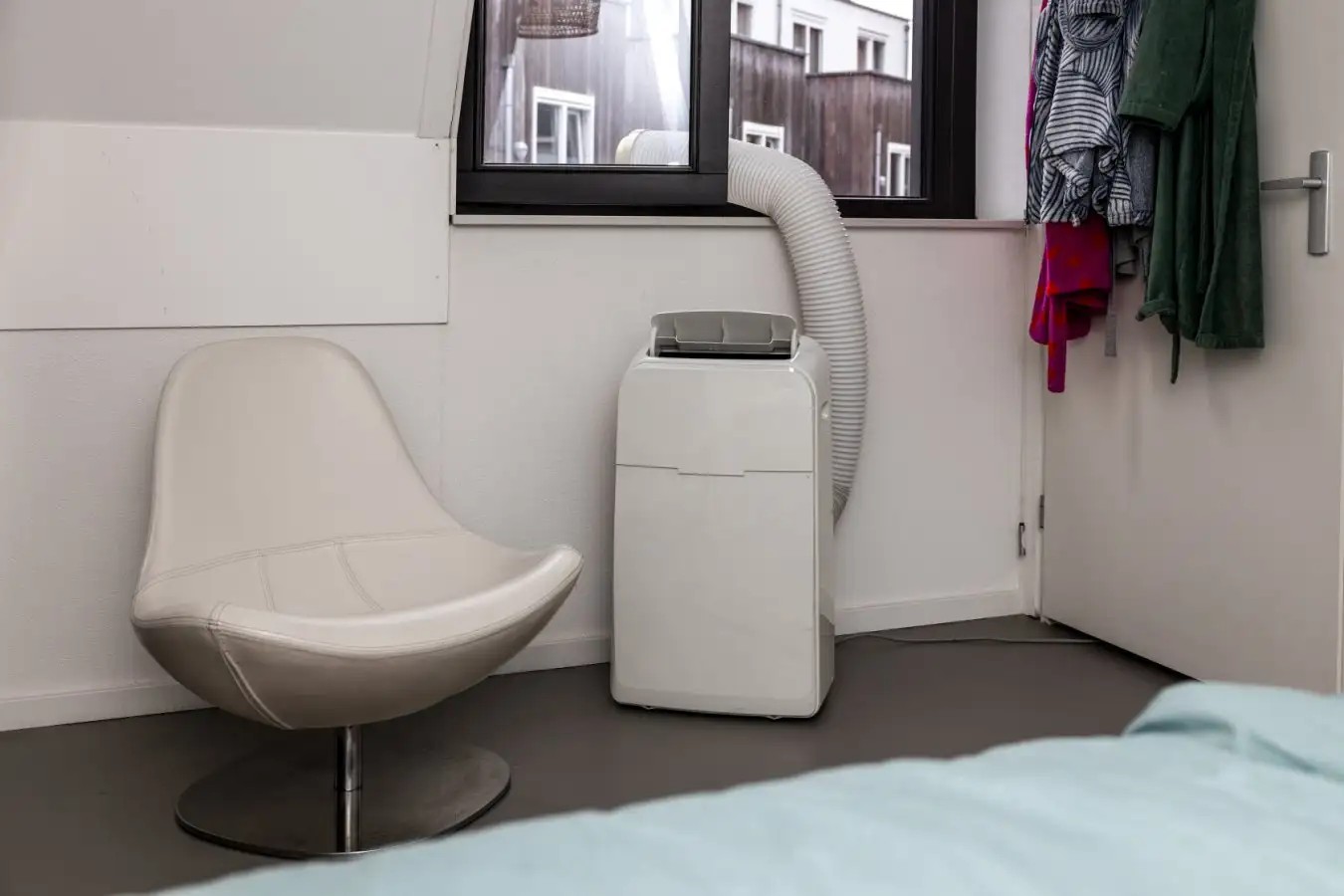
Portable air conditioners usually suck.
That’s not a critique. It’s physics.
And nobody tells you this at the checkout.
I didn’t know it when I bought mine. Shocking? Sure.
The fix is easy though. So easy that keeping single-hose units on sale without it feels illegal.
The guilt trip
First, ignore the moral panic. Especially the British one that suggests cooling your home is some sort of bourgeois sin.
If your home isn’t sweltering, good for you. Shut the blinds. Open a window. Be cool.
For the rest of us?
Houses trap heat. Even when you try, the sun wins. High temps hurt your health. Sometimes they kill. They also make it impossible to focus, to work, or to do schoolwork. We use electricity to heat homes in winter without flinching. Why is the inverse suddenly a crime?
As the planet cooks, AC will become mandatory for survival. Not a luxury.
So we have to minimize the carbon footprint of this new norm. Otherwise we get a loop. More AC, more heat, more demand. Bad outcome.
The flaw
You need to know the mechanism.
Split systems are the gold standard. Outside unit. Inside unit. The refrigerant cycles heat away. Outside air blows over the condenser to dump that heat into the atmosphere. Inside air blows over the evaporator to get cold. Room air stays in. Noise stays out. Perfect.
Too expensive? Mostly yes. And where do you put the box outside if you live on the third floor?
Dual-hose portable ACs try to solve this.
Intake hose brings in fresh air. Exhaust hose dumps out hot air. Room air still stays contained.
They’re less efficient than splits. The hot hose warms up the room if it touches things. If the intake and exhaust are too close, you just recycle the hot air back in. Wrap the exhaust hose in a blanket. Keep them far apart. It works.
Then there are single-hose ACs.
Most shops sell these. Why?
Here is the problem: There is no intake hose.
The unit uses room air to cool the condenser. Then it blasts that warm air outside.
Vacuum created? Yes.
So outside air rushes in. Through windows. Cracks. Gaps in doors.
You are fighting a losing battle against the atmosphere. The AC works overtime to cool new, hot incoming air. Efficiency plummeters.
It is like washing muddy clothes in fresh water while the river floods into your laundry basket.
When the external temp spikes? They fail.
They simply cannot keep up.
The labeling lie
Europe knows this. And says nothing.
Labels show cooling capacity in BTUs. But BTUs measure heat transfer within the machine. They ignore the thermodynamics of sucking in fresh heat. They assume your room is sealed. It is not.
The SEER (Seasonal Energy Efficiency Ratio) looks fine on paper too.
It divides cooling by electricity. By that math, a single-hose unit can look just as efficient as a dual-hose.
This is deceptive.
“Consumers find dealing with two ducts difficult,” Chris Michael of Meaco said. “Often they don’t have the space.”
People choose single-hose because they are easier to install. They are easier to sell.
But easier does not mean better. It means wasteful.
The US fixed this. Mostly.
They introduced SACC (Seasonally Adjusted Cooling Capacity). This number is lower. Brutally lower. Because it accounts for the heat gain.
Then there’s CEER (Combined Energy Efficiency Ratio).
This shows the real story. Dual-hose wins. Always.
Still? Not perfect.
US tests assume 28°C most of the time.
I don’t buy AC for 28°C. I buy it for 40°C. When the sky is on fire, the difference in performance between a single-hose and a dual-hose is night and day.
The fix is trivial
Here is the best part.
Most single-hose units are dual-hose units. They just ship with one hose.
Add an intake hose. Attach it. Done.
GE sells conversion kits for some models. They claim a 300% boost in cooling power.
Three times.
I tried a DIY version last May. Tape, cardboard, frustration.
The house cooled down instantly. The unit stopped screaming. I could finally think.
Reddit is full of 3D printed parts. YouTube is full of hacks.
Everyone says it changes everything.
What should happen?
Change the labels.
Make them reflect 40°C performance. Stop calling inefficient units “Class A” based on flawed metrics.
That seems logical.
Better? Ban the sale of bare single-hose units.
Sell dual-hose. Include the intake.
Give users the choice to run them in single-hose mode if they really cannot fit two vents.
Meaco might release a hybrid in 2027, according to Michael.
We should not have to wait that long.
I asked the Department for Energy Security and NetZero who regulates this. No reply.
I asked the Energy Saving Trust. Nothing.
Bureaucratic silence in a heatwave is its own form of negligence.
But maybe someone read this.
It’s an easy win for climate policy.
Plug the hole. Stop the heat leak.