Your mental image of Mars needs a software update. Forget the dusty, monotonous red ball. It looks boring. It’s wrong.
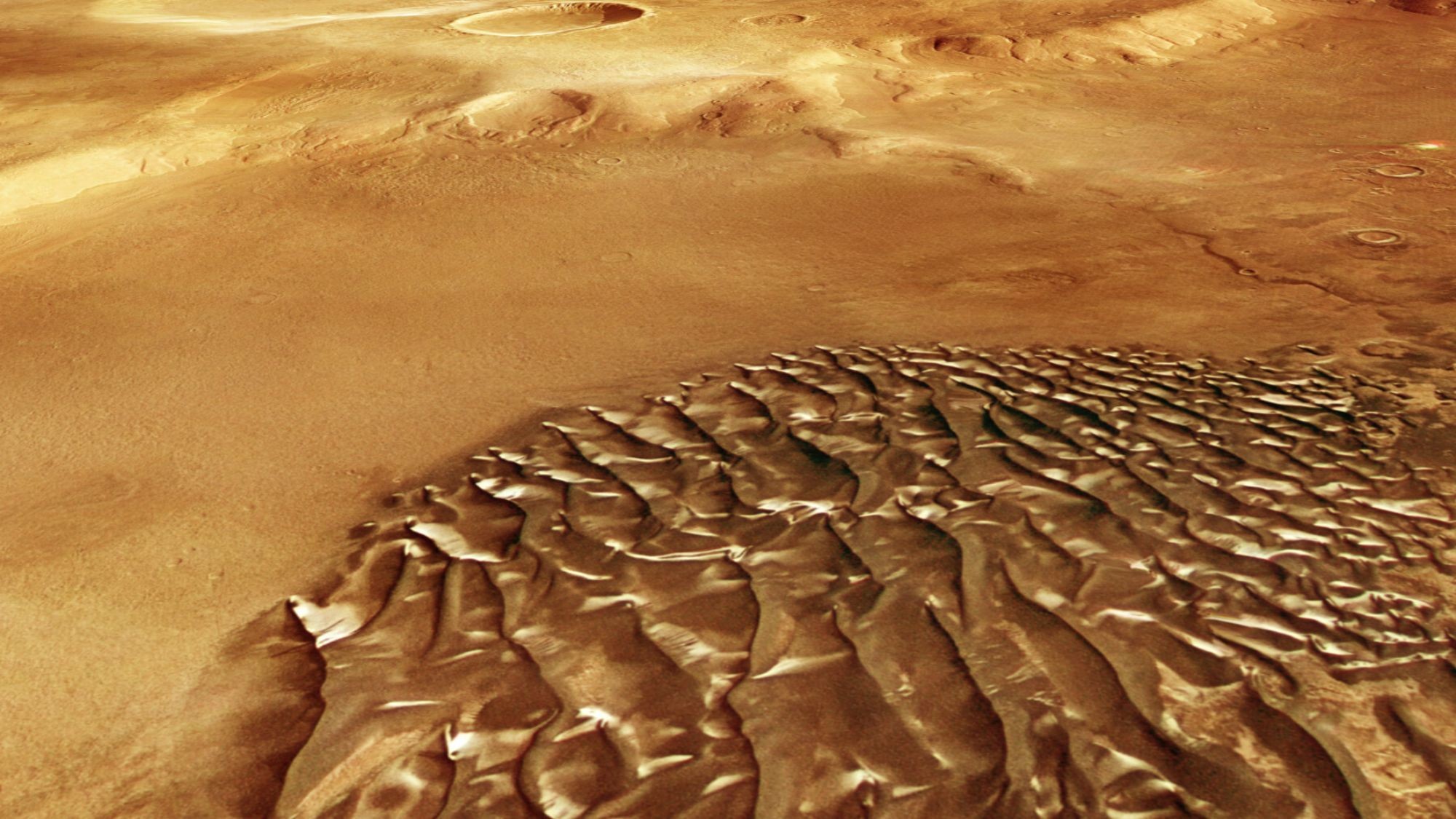
The European Space Agency’s Mars Express orbiter just dropped some seriously trippy imagery. We are talking about a sprawling field that looks less like a desert and more like molten chromium poured over an ancient impact crater floor. It screams science fiction. It demands questions.
What exactly are we looking at?
Spoiler alert: it is not metal.
These shimmering waves are dark sand dumes. But they are coated in seasonal frost. Mostly carbon dioxide. Or as we call it on Earth, dry ice.
How seasonal frost creates the chrome illusion
During the Martian winter, cold sinks into these highland basins. Dry ice settles on everything. It creates a stark, high-contrast scene. Here is the visual trickery at work. The sand underneath is black. Think basalt. It absorbs light aggressively. The frost on top? It reflects light. It bounces it right back at the camera.
The interplay between the light-void dark sand and the reflective white ice creates that metallic sheen. It’s an optical illusion born of extreme contrast. The landscape looks forged. It didn’t melt. It froze. And blew.
Which crater hosts this alien landscape?
Location matters. These dunes ripple across the bottom of Kaiser Crater. A massive 129-mile wide (207-km) impact basin. It sits in the southern highlands. NASA notes that this bowl shape acts as a giant sand trap. The wind pushes the sand in. It rarely lets it leave.
So the sand piles up.
Why is the sand black? Mars gets its name “Red Planet” from iron oxide dust. But not here. These dunes are built from fine, volcanic basalt. They contain pyroxene and olivone minerals. Darker. Sharper. They stand out against the rusted backdrop of the rest of the world.
Size wise, they are imposing. We’re talking kilometers of ridges. They tower over 100 meters—that is 320 feet—above the surrounding terrain. That is three-story-high dunes, but spread over a canvas the size of a small state.
Scientists estimate the sand supply is actually limited. You can still see the crater floor peeking through the gaps. So how do you build towers that big with so little material? Patience. Wind. And a very long time.
Why wind still rules on a dead world
This brings up a weird contradiction. Mars is thin. Its atmosphere is a ghost version of our own. One-hundredth the pressure. It’s slowly bleeding into space. You would think weak winds couldn’t lift anything heavy.
Yet, here are the dunes. Towering. Sculpted.
The prevailing theory suggests Martian winds have been punchy enough to move this stuff for thousands of years. Or maybe they were much punchier when the atmosphere was thicker billions of years ago. These formations are clues to a denser past. They are geological memory foam, remembering when Mars held its breath longer.
Mars Express isn’t new at finding cool stuff. It’s been circling since 2003 recently tracked 30 dust devils dancing through Mamers Valles. Earlier this year, it spotted Shalbatana Vallis—valleys carved by ancient floods 3.5 billion ago. That place stretches as far as Italy is long. Then there is the ash. Fresh volcanic ash covering large swaths, either redistributed or revealed as older dust blew away. Just in the last fifty years.
We call Mars desolate. It feels empty from afar.
But look closer.
There are floods that carved canyons the length of nations. There are winds that polish black volcanic rock until it gleams like a chrome bumper. The surface is busy. Quiet, but busy.