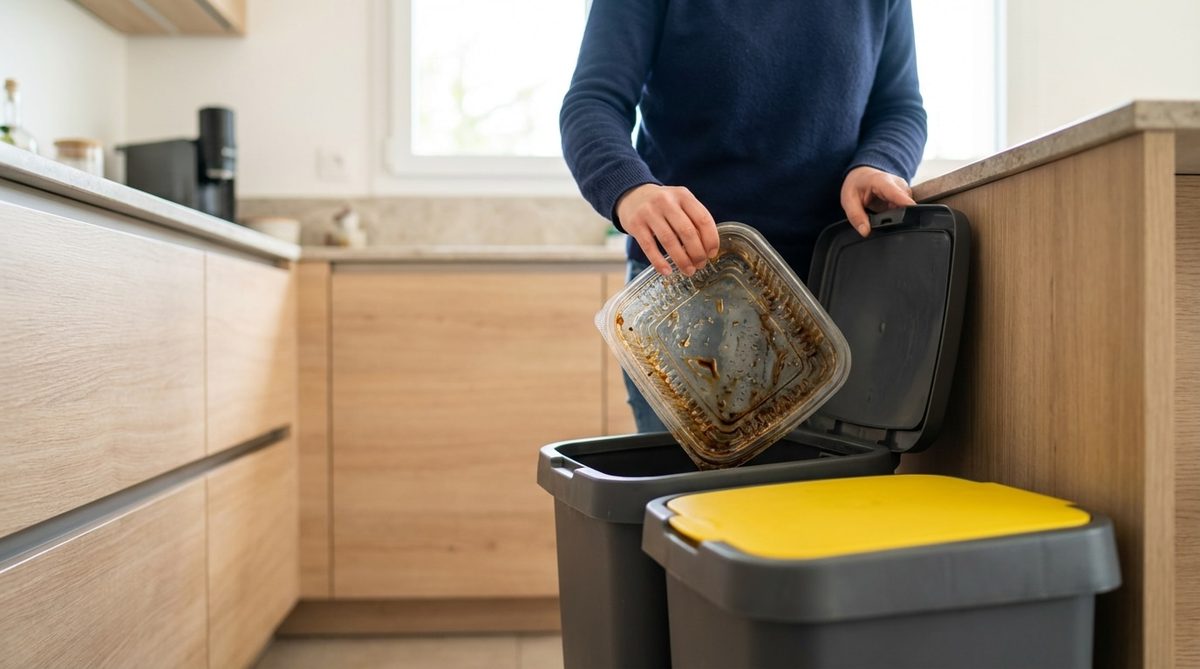
You just finished lunch. The plastic tray is dripping with sauce. You toss it into the yellow bin without a second thought. Logic says plastic means recyclable. Right?
Not always.
Every spring, when picnics return to our lawns, millions of us repeat this exact gesture. We think we are saving the planet. Instead, we are clogging the system. The “magic” yellow bin has hard limits. Pushing a greasy container into it doesn’t help the environment. It breaks the machinery.
The myth of the magic yellow bin
Selective sorting has been part of our routine for decades. Organizations like Citeo tell us the civic duty starts at home. We believe the bin is a giant cleaner. We think dirty items go in, get washed magically, melted down, and reborn.
That is a fantasy.
Industrial processes are precise. They do not tolerate heavy organic matter or residual liquids. The system relies on specific machinery. It is not a garbage disposal.
Why good intentions create bad problems
We want to divert waste from incineration or landfills. So we over-sort. We think a dirty container deserves a second chance rather than ending up in general waste.
This generosity backfires.
A container covered in food scraps cannot be recycled as is. Worse, it disrupts the entire factory. When you try to save an inappropriate package, you create cascading problems at the sorting center. Good intentions pave the road to operational hell.
The tolerance limit: a smudge vs. a flood
Here is the secret most people miss. Slightly dirty plastic is fine. Factories are built to handle minor impurities.
Floating tanks and integrated cleaning systems remove traces of pulp or cream effectively. The machines are forgiving. You do not need surgical cleanliness. A quick rinse or scrape is enough.
But there is a tipping point.
When residue becomes dominant, the item becomes contaminated. Plastic soaked in oil, liquid sauce at the bottom, or thick accumulations of food belong in the general waste bin. The industrial system lacks the resources or technical means to degrease these items deeply.
Everyday examples: the yogurt cup vs. the oily tray
Let’s look at real life. Think of those quick springtime breakfasts.
- Recyclable: A yogurt pot with a few traces on the walls. A ham tray with a light, dried residue. A milk or oil bottle that has been emptied properly.
- Not Recyclable: A french fry tray flooded with vinaigrette. A soft plastic container half-full of leftover soup. A prepared meal box coated in sticky tomato sauce.
The equation is simple. If the package has a lot of food, heavy fat, or liquid surplus, it goes to general waste. Trying to save it is a strategic error. The plastic material itself is swallowed by contaminants that cannot be handled at scale.
Raking a yogurt cup with a spoon? No problem for the operators. Tossing a dripping, oily tray into the yellow bin? That is a different story entirely.
The grease problem at recycling centers
One greasy clamshell ruins a whole batch. That is the reality of modern waste sorting. When a contaminated container makes it into the collection truck, it travels with hundreds of other items. During compacting, the fats and oils leak out. They coat the surrounding paper, cardboard, and clean plastics.
At the sorting facility, the problem gets worse. The machines rely on optical sensors to identify different plastic resins by reflecting light. A thin film of grease blocks that light. The sensors go blind. They cannot tell what the material is. The result? The machine rejects the item. It might be a perfectly good plastic bottle, but because it sits next to a greasy tray, it gets tossed out as unrecyclable waste.
This is not a minor annoyance. It is a domino effect. One dirty item can contaminate dozens of clean ones. Those rejected items are often mixed into a pile that is deemed too contaminated to process. The entire lot, potentially several tons of viable material, is sent to an incinerator.
The work of collection is wasted, the treatment cost explodes, and the natural resources you hoped to save are destroyed.
It is a financial and environmental disaster. The cost of managing this waste falls on the local municipality, which passes it on to taxpayers. Your sloppy disposal habit directly impacts the economic viability of the entire recycling sector.
Should you wash your trash before recycling it?
This leads to a common, well-intentioned mistake. Many people think the solution is to rinse their containers thoroughly. Some even run them through the dishwasher. They believe they are fixing the problem at the source.
They are wrong.
Washing trash is an ecological non-sense. You are using liters of clean drinking water. You are using electricity to heat that water. You might even be using dish soap. All of this energy goes into cleaning an object that will eventually be shredded and reprocessed. The carbon footprint of your home cleaning often cancels out the environmental benefit of recycling the item in the first place.
You are wasting a precious resource to solve a problem that can be solved with zero extra effort.
The golden rule: empty it, don’t scrub it
The actual requirement is much simpler. You do not need to scour your pots or boxes. You just need to ensure the contents are gone.
If you have scraped the bottom of your compote jar, the job is done. If you shook out the last drops of fruit juice from a bottle, the job is done. The goal is to remove the food, not to make the container look like it just came out of a factory.
- Container with light traces of food: Put it in the recycling bin.
- Empty oil bottles (even if the walls look shiny): Put them in the recycling bin.
- Tray filled with cooking grease or solid food scraps: Put it in the general waste bin.
That is the line. Anything with a heavy residue of grease or solids contaminates the stream. Anything with just a trace of food is fine.
Reducing problematic containers at the source
Knowing what goes where is a big step. But there is a better way. Stop buying the problematic containers in the first place.
If greasy trays are a recurring headache, the most effective solution is to avoid them entirely. Choose reusable containers. Buy food in bulk to avoid packaging. Ask the deli counter for flat cheese in a glass jar you brought with you instead of plastic film.
This is a radical approach, but it works. By reducing the number of single-use, grease-heavy packages entering the waste stream, you protect the planet more effectively than any amount of sorting can.
It is about adjusting your expectations. You don’t need to be perfect. You just need to be practical. By emptying your containers properly and avoiding the worst offenders, you help the recycling industry breathe easier. You save water. You save energy. You keep valuable materials out of the incinerator.
Why not start with your next meal?