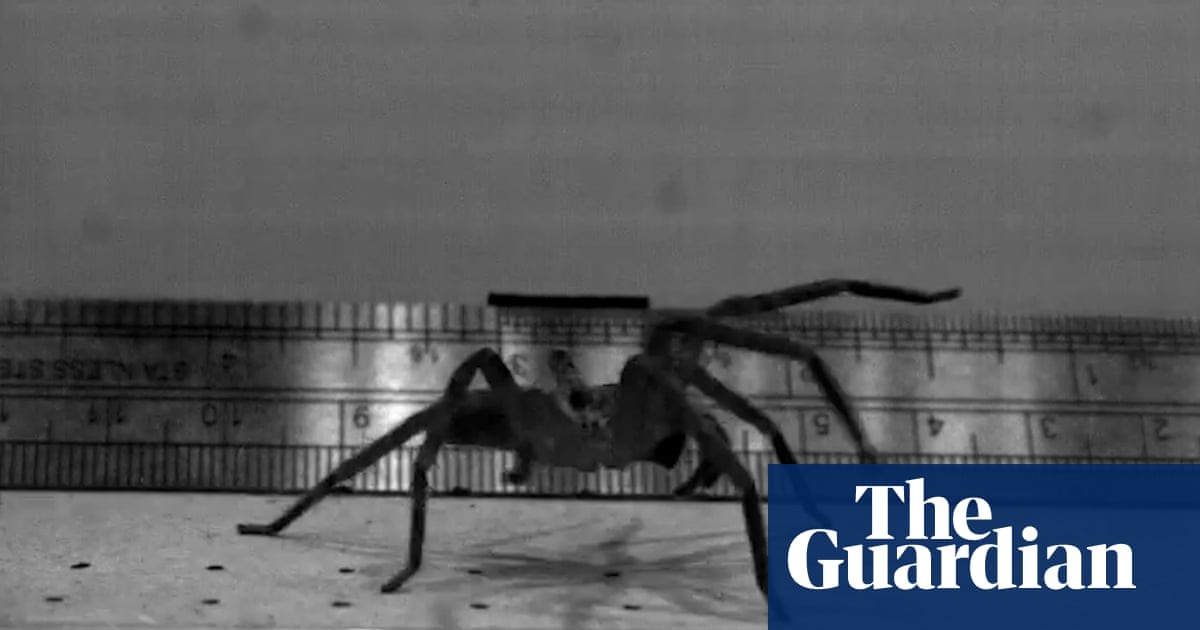
If arachnophobics weren’t terrified enough by the way huntsman spiders haul dead mice up fridge sides. Well. They have new reasons to lose sleep.
They are fast. Unnervingly fast.
A UK and German research team clocked Heteropoda jugulans. The brown huntsman. It obliterated records.
Of the 250-plus species analyzed? This hairy-legged arachnid took first place.
It hit 3.59 meters per second. That is roughly 8 miles per hour. To put that in perspective the former record-holder was the Moroccan flic-flac. Which reached 1.7 meters per second mostly by tumbling down a hill rather than actually running.
The scientists didn’t just guess. They collected 162 spider species from London, Greifswald North America Southern Europe and Australia. Then they measured sprint speeds on gridded paper using cameras. They combined this data with previous studies.
Including work by Dr. Christofer Clemente at the University of the Sunshine coast in Queensland.
Spiders don’t move using just muscle – they use hydraulic pressure.
Clemente’s earlier 2021 study focused on locomotion mechanics not speed records. He literally just grabbed spiders from his backyard. “I could go out with a head torch and see them,” he said.
It turns out casual backyard science yields champions.
The brown huntsman is endemic to Australia’s east coast. It’s hand-sized. Venomous yes but it rarely bites humans. And if it does the effect is mild.
The 3.59 meters persecond figure is a burst speed. A fraction of a second. Sustained running clocks in around 2 meters per second.
That is still impressive.
There is a “sweet spot” in biology. Legs that are long enough but bodies that aren’t so massive they become impossible to lift. Huntsmen might sit right in that zone.
Dr Jonas Wolff of the University of Greifswalk calls this the broadest comparative study on spider running speeds ever. Speed dictates survival. It determines ecological niche dispersal range and predator interactions.
Surprise twist: Big doesn’t mean fast. The largest spiders lagged behind smaller hunters. Even web-spinners weren’t necessarily slower than the hunters. There is a mass threshold where mechanics fail. Muscle physiology and body plan limitations kick in.
Is Heteropoda jugolans the undisputed king?
Maybe not.
“There are other huntsman species we haven’t tested yet,” Wolff said.
Nature has plenty of secrets.