Flight is often cited as one of evolution’s most spectacular achievements, but a growing body of evidence suggests that the first wings were not designed for aerodynamics. Instead, they may have evolved primarily as visual tools for communication and hunting.
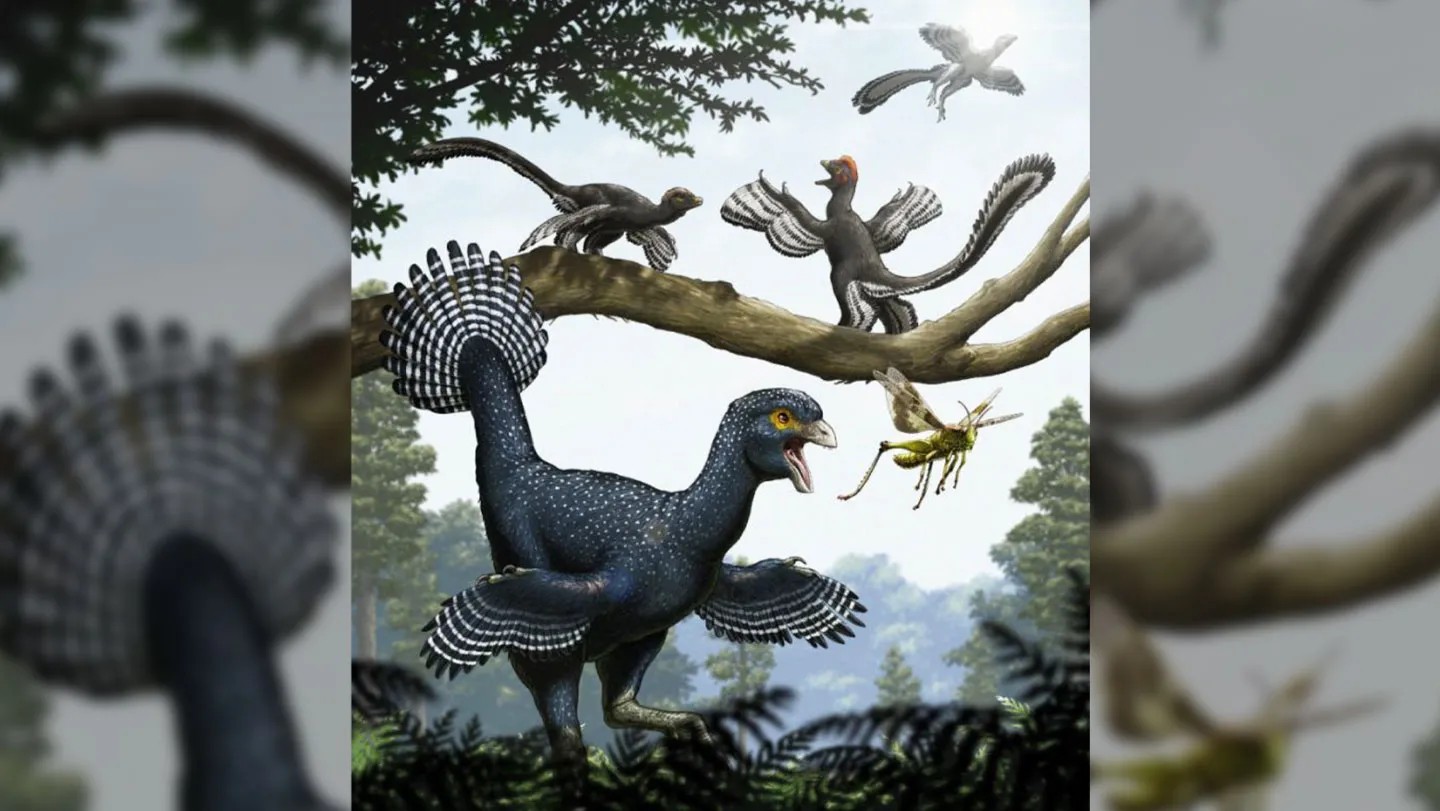
Zoologist Piotr Jablonski proposes that early winged dinosaurs used their proto-wings to lure prey or signal to mates long before they could lift off the ground. This theory challenges the traditional view that flight evolved directly from gliding or running mechanics, suggesting instead that visual signaling was the initial driver of wing development.
The “Flush Display” Hypothesis
The concept emerged from Jablonski’s observations of modern birds in the American West. He noted that certain species would suddenly spread their wings or fan their tail feathers to startle insects out of hiding spots—a behavior known as a “flush display.” Once the insects took flight, the birds would easily catch them.
Jablonski hypothesized that if modern birds use wings for this purpose, their dinosaurian ancestors likely did too. This idea gained traction among scientists studying pennaraptorans, a group of small, feathered dinosaurs that are considered close relatives of modern birds.
Why These Wings Couldn’t Fly
Before testing behavioral theories, researchers had to confirm that these early dinosaurs were physically incapable of flight. Minyoung Son, a vertebrate paleontologist at the University of Minnesota, points out several critical limitations:
- Insufficient Surface Area: The wings of pennaraptorans were too small to generate the lift required for flight.
- Joint Limitations: The range of motion in their wing joints was restricted, preventing the powerful flapping needed for aerodynamic lift.
- Feather Structure: Aerodynamic flight requires asymmetrical feathers (where the leading edge is narrower than the trailing edge). Fossil evidence suggests pennaraptorans lacked this specific feather morphology.
“Based on the fossil record, these dinosaurs don’t have the aerodynamic feathers yet,” Son explains.
Testing Prehistoric Behavior with Robots
To test whether these non-functional wings had a different purpose, Jablonski and his team turned to experimental paleontology. They built a robot dinosaur named Robopteryx, modeled after Caudipteryx, a turkey-sized pennaraptoran with well-preserved fossils.
The robot was equipped with detachable wings to simulate two scenarios: bare arms versus arms with proto-wings. Jinseok Park, an ornithologist now at the Max Planck Institute for Biological Intelligence, took Robopteryx to a natural area in Seoul, South Korea, to observe wild grasshoppers (Oedaleus infernalis ).
Over two summers, the team recorded how often grasshoppers fled when confronted by the robot’s “flush displays.” The results, published in Scientific Reports in 2024, were clear: the displays were significantly more effective at startling insects when the robot had proto-wings.
Neural Evidence from Locusts
To delve deeper into the mechanics of this behavior, the researchers moved beyond physical robots to computer simulations. They created animated clips of Caudipteryx flipping its wings and showed these to domesticated locusts.
The study employed an invasive but precise method: electrodes were attached to the locusts’ nerve cords and abdomens to record neural activity in real-time. The data, posted on bioRxiv in April 2024, showed that locusts had a stronger neural response to the movement of proto-wings than to bare limbs. This confirms that the visual stimulus of the winged display is more likely to trigger an escape response in prey.
Implications for Evolutionary Biology
While the study does not definitively prove that pennaraptorans used flush displays in the wild, it demonstrates that such behavior is biomechanically and visually plausible. Corwin Sullivan, a paleontologist at the University of Alberta, notes that the findings are “elegantly and persuasively” supportive of the hypothesis.
Furthermore, Sullivan emphasizes that multiple functions can coexist. Even if proto-wings were used for hunting, they could have simultaneously served other purposes, such as courtship displays to attract mates. This multifunctionality is common in evolutionary biology, where a trait may originate for one purpose and later be co-opted for another.
Conclusion
The evolution of flight may not have begun with a need to soar, but with a need to be seen. By using wings to startle prey or attract partners, early dinosaurs laid the groundwork for structures that would eventually conquer the skies. This research highlights how behavioral experiments can bridge the gap between static fossils and the dynamic lives of extinct animals.