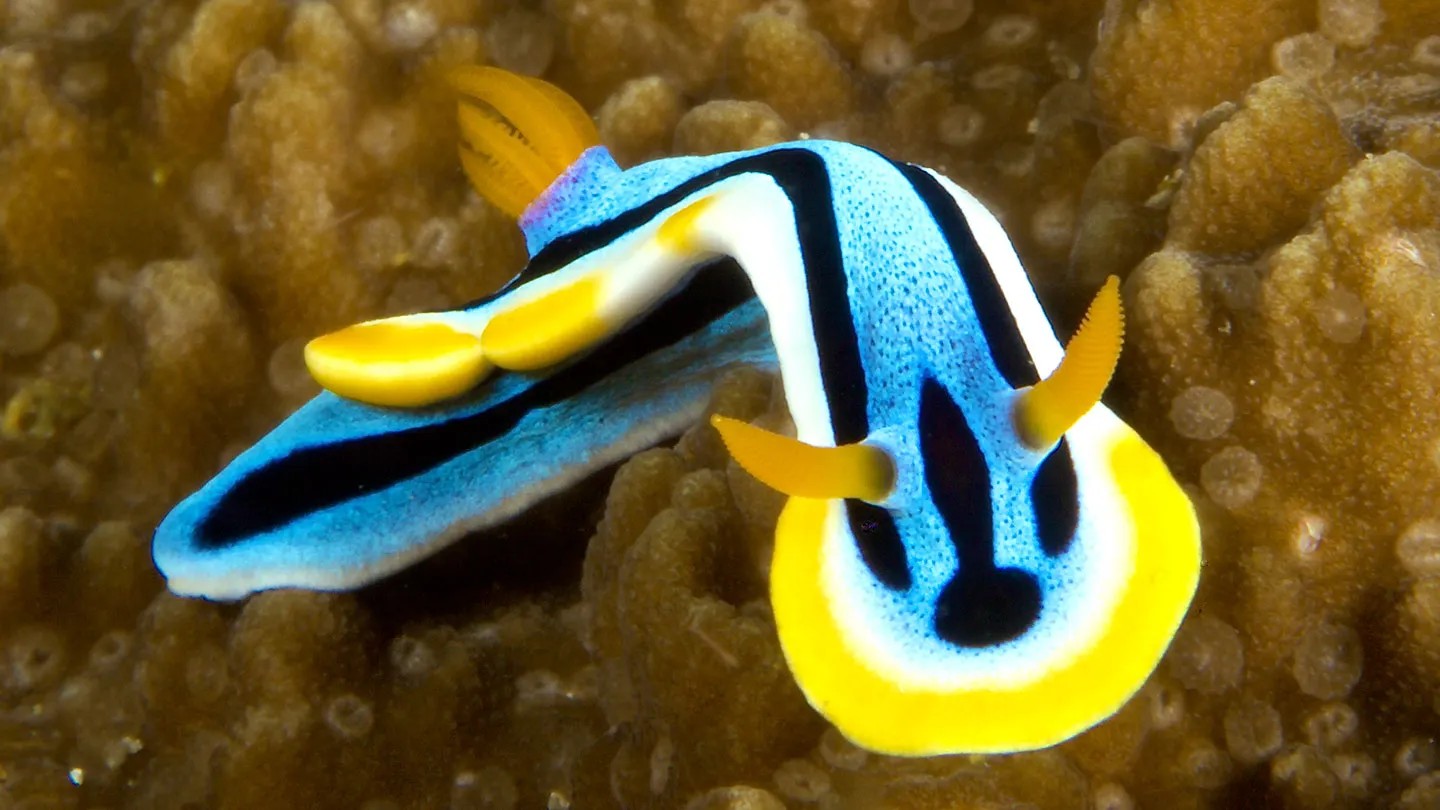
Birds are dinosaurs with feathers. They fly. They nest. They are the poster children for colorful evolution on land. But look at the ocean floor and you’ll find a creature that makes peacocks look boring.
It’s a sea slug.
More specifically, it’s a nudibranch. These shell-less mollusks are soft-bodied, slime-traveling, and incredibly vivid. But they aren’t just pretty. They’re chemical weapons disguised as jewels.
Here is how they get their flash—and why they need it.
Stealing the Palette
You might think a nudibranch is born with its vibrant red, neon green, or electric yellow skin. Wrong. Most nudibranchs are born nearly transparent or dull gray.
They get their hue through theft.
These slugs are predators. They eat things like sponges, algae, or even other small sea creatures. But they don’t just digest the food. They store the pigments —the natural colorings within the prey—inside their own tissues.
It’s a process called kleptoplasty in some cases, but broadly, it’s dietary camouflage and warning signage combined.
The slug absorbs the molecule structures that give the prey its color. These molecules alter the light reflected off the slug’s surface. A red sponge eater becomes a red slug. A green algae grazer turns green.
The materials scientist in me wants to say this is inefficient biology. But it’s brilliant engineering. The slug doesn’t need to expend energy making its own armor or coloring agents. It just eats the best and wears the loot.
It’s Not Just Paint
Here’s where it gets weird. Not all nudibranch colors come from pigments.
Some rely on structural color. This isn’t about chemicals absorbing light. It’s about physics.
The microscopic structure of the slug’s skin acts like a diffraction grating. It bends and scatters light waves in specific ways, creating iridescent blues and greens that shimmer when the slug moves. Think of the blue on a morpho butterfly’s wing. Same principle. No pigment required. Just nano-scale geometry.
This structural hue changes with the angle of light. It’s dynamic. It’s alive.
A nudibranch’s color isn’t always static; it can shift depending on the angle of view, a trick of physics rather than chemistry.
Why So Bright? (The Toxic Truth)
In nature, bright usually means dangerous.
This is aposematism —warning coloration. Predators learn fast. If a fish bites a bright orange nudibranch and gets a mouthful of poison, it won’t forget.
These slugs are toxic.
They concentrate toxins from their food. Sponges are often packed with foul-tasting, poisonous compounds. The nudibranch extracts these defenses and stores them in specialized sacs in its body. It becomes inedible.
So that flashy neon orange? It’s a neon sign that says: Do Not Eat. I Will Kill You.
It’s a survival strategy that works. The vivid range of colors among nudibranchs correlates directly with the toxicity of their diet and their environment. In reef systems, the more colorful the slug, the more likely it is packing a punch.
Evolutionary Flash
Evolution here isn’t about being “advanced.” It’s about adaptation.
These slugs lack a shell. Snails have shells for protection. Nudibranchs gave them up for mobility and flexibility. But without armor, they need another defense.
Chemical defense. And to make it effective, they need to advertise it.
If a nudibranch were camouflaged to blend in, a predator might not know it was toxic until after the bite. That’s a waste. Better to be bright, visible, and avoided.
Where to Find Them
You won’t see these guys in your backyard. Nudibranchs are marine invertebrates found in coastal oceans worldwide. They thrive in coral reefs, kelp forests, and rocky shores.
To see them, you need a microscope or a good underwater camera. They are small. Most are less than an inch long. Some are microscopic. But in their world, they are giants.
Their species diversity is staggering. Over 3,000 types have been described. And new ones are discovered regularly, often in deep waters or remote locations where the ocean is saltiest and clearest.
The Takeaway
Sea slugs are not just soft, slimy snacks. They are masterpieces of biological engineering. They use:
- Dietary pigments to mimic their environment or warn predators.
- Structural coloration for iridescent, shifting hues.
- Chemical toxicity stored from their prey as a primary defense.
- Visual signaling to communicate danger in a colorful world.
They are evidence that beauty and lethality can coexist. And they do it without a shell.
Next time you see a nudibranch, don’t just stare at the color. Look closer. That brightness is a warning. That sheen is a trick of physics. That body is a stolen treasure chest of toxins.
It’s nature’s boldest statement.
And honestly? It’s better than any dinosaur.