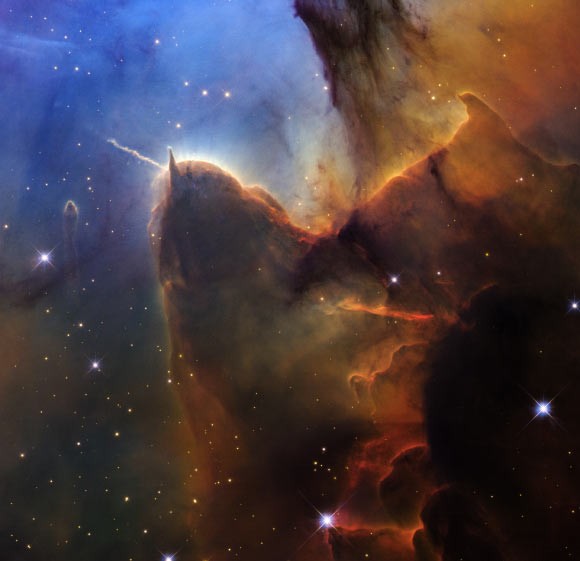
To mark its 36th anniversary, the NASA/ESA Hubble Space Telescope has released a striking new image of the Trifid Nebula, offering more than just a beautiful view. By comparing this new data with observations made decades ago, astronomers are witnessing stellar evolution occurring on a surprisingly “human” timescale.
A Cosmic Nursery in Motion
Located in the constellation Sagittarius, the Trifid Nebula (also known as Messier 20) is a vast region of gas and dust where new stars are being born. While these celestial processes often seem to take millions of years, Hubble’s long operational life has allowed scientists to observe tangible changes within this nebula over just a few decades.
The new image reveals a turbulent environment shaped by massive, unseen stars nearby. These stars emit powerful ultraviolet winds that create a massive “bubble” in space, compressing gas and dust to trigger new waves of star formation.
The “Cosmic Sea Lemon” and its Plasma Jets
The centerpiece of the new imagery is a rusty-colored cloud formation that astronomers have poetically dubbed the “Cosmic Sea Lemon” due to its resemblance to a sea slug gliding through an ocean. This structure provides a laboratory for studying how young stars interact with their environment:
- Herbig-Haro 399: On the left “horn” of the sea lemon, astronomers identified a jet of plasma—a stream of matter ejected by a young protostar. By comparing current observations to those from 1997, researchers can measure the speed of these outflows and calculate the energy being injected into the nebula.
- Counter Jets: To the lower right of the formation, jagged orange and red lines mark a “counter jet,” providing a symmetrical look at the protostar’s activity.
- Erosion by Light: A green arc near the head suggests a circumstellar disk (the ring of matter around a star) is being actively eroded by intense ultraviolet light from neighboring massive stars.
The Lifecycle of Dust and Light
The image highlights a constant battle between light and matter. Throughout the nebula, bright yellow gas streams upward where ultraviolet light is “plowing” into dark brown dust, stripping it away.
“Many ridges and slopes of dark brown material will remain for a few million years, as the stars’ ultraviolet light slowly eats away at the gas.”
While the densest dark regions hide protostars currently forming, the bright orange orbs scattered throughout the field represent stars that have already completed their formation, having successfully cleared the space around them.
Why This Matters
This anniversary release is not merely a celebration of Hubble’s longevity; it is a testament to the value of long-term astronomical monitoring. By revisiting the same coordinates with improved, more sensitive cameras, Hubble allows scientists to move beyond “snapshots” of the universe and instead create a “motion picture” of cosmic evolution.
As the stars continue to shine and their radiation dismantles the surrounding clouds, the nebula’s gas and dust will eventually vanish, leaving behind only the stars that were born from its depths.
Conclusion: Hubble’s latest view of the Trifid Nebula demonstrates that even the most vast cosmic processes can be observed in real-time, providing vital data on how newborn stars sculpt the universe around them.