Recent observations from the James Webb Space Telescope (JWST) have presented astronomers with a profound cosmic puzzle: supermassive black holes appearing much earlier than anyone thought possible. New research suggests that the answer may lie in the decay of dark matter, a mysterious substance that could have “supercharged” the early universe to accelerate black hole formation.
The Cosmic Timeline Problem
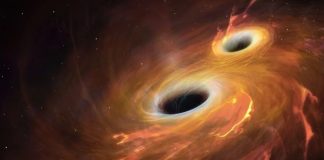
According to standard cosmological models, black holes grow through two primary methods: merging with other black holes or consuming vast amounts of surrounding gas and dust. Under normal circumstances, these processes are slow, requiring at least 1 billion years to produce the massive titans we observe.
However, since the JWST began delivering data in 2022, it has detected supermassive black holes existing as early as 500 million years after the Big Bang. This creates a significant “gap” between what our current theories predict and what we are actually seeing in the deep reaches of space.
A New Growth Mechanism: Direct Collapse
To bridge this gap, scientists have long investigated the theory of direct collapse. In this scenario, massive clouds of primordial gas and dust collapse under their own gravity to form a “seed” black hole instantly, bypassing the billions of years normally required for a star to be born, live, and die.
The challenge with the direct collapse model is that it requires a specific energy balance. Usually, starlight provides the energy needed to regulate these gas clouds, but in the very early universe, stars were too rare to provide sufficient, widespread energy.
The Dark Matter “Supercharger”
A research team led by Yash Aggarwal from the University of California, Riverside, proposes that decaying dark matter could act as the missing energy source.
Dark matter makes up approximately 85% of the matter in the universe, yet it remains invisible because it does not interact with light. While most dark matter models focus on its gravitational effects, this new theory explores how certain hypothetical dark matter particles might decay, releasing tiny amounts of energy in the process.
Why this matters for early galaxies:
- Sensitivity: The first galaxies were essentially pristine clouds of hydrogen gas, which are incredibly sensitive to even minute amounts of energy.
- Efficiency: Researchers Flip Tanedo and Aggarwal suggest that an energy release equivalent to just a billion trillionth of a single AA battery would be enough to “supercharge” these primordial gas clouds.
- Accelerated Growth: This injected energy could facilitate the direct collapse of gas clouds, creating the massive seeds necessary to grow supermassive black holes much faster than previously thought.
Hunting for the Particle
By analyzing these cosmic patterns, the team has narrowed down a potential mass range for these hypothetical dark matter particles—between 24 and 27 electronvolts.
This discovery turns the early universe into a massive laboratory. If this theory holds, the existence of supermassive black holes themselves becomes a “signature” or a piece of evidence that can help physicists identify the properties of dark matter, which has remained elusive for decades.
“The first galaxies are essentially balls of pristine hydrogen gas whose chemistry is incredibly sensitive to atomic-scale energy injection,” says Flip Tanedo. “The signature of these ‘detectors’ might be the supermassive black holes that we see today.”
Conclusion
By proposing that decaying dark matter provides the energy necessary for direct gas collapse, researchers have found a potential way to reconcile the JWST’s surprising observations with our understanding of cosmic evolution. If proven, this would not only explain the early existence of black holes but also provide a vital clue into the fundamental nature of dark matter.