A groundbreaking study has revealed how cyanobacteria—the organisms responsible for oxygenating Earth—have “recycled” an old genetic tool to build a new structural framework. Researchers have discovered that a system once used to organize DNA has evolved into a cytoskeleton-like structure that dictates the physical shape of the cell.
The Evolutionary Pivot
For decades, scientists understood that cyanobacteria were the pioneers of oxygenic photosynthesis, driving the “Great Oxygenation Event” 2.5 billion years ago. However, new research from the Institute of Science and Technology Austria (ISTA) shows that these organisms are also masters of biological repurposing.
The study, published in Science, details how the Anabaena species transitioned a specialized protein system from a simple DNA-sorting mechanism into a sophisticated structural network. This discovery provides a rare, real-time look at how evolution can take existing biological “machinery” and assign it an entirely new, vital function.
The Discovery: From Plasmids to Membranes
The breakthrough began with a “serendipitous observation” by researcher Benjamin Springstein. While reviewing literature, he noticed that the ParMR system —a mechanism typically used by bacteria to move plasmids (small, mobile pieces of DNA)—was located on the main chromosomes of Anabaena.
In most bacteria, such systems act like tiny mechanical arms that pull DNA to opposite sides of a cell during division. However, experimental testing revealed a radical departure from this norm:
- No DNA Binding: The protein component ParR no longer attaches to DNA. Instead, it anchors itself to the cell’s inner membrane.
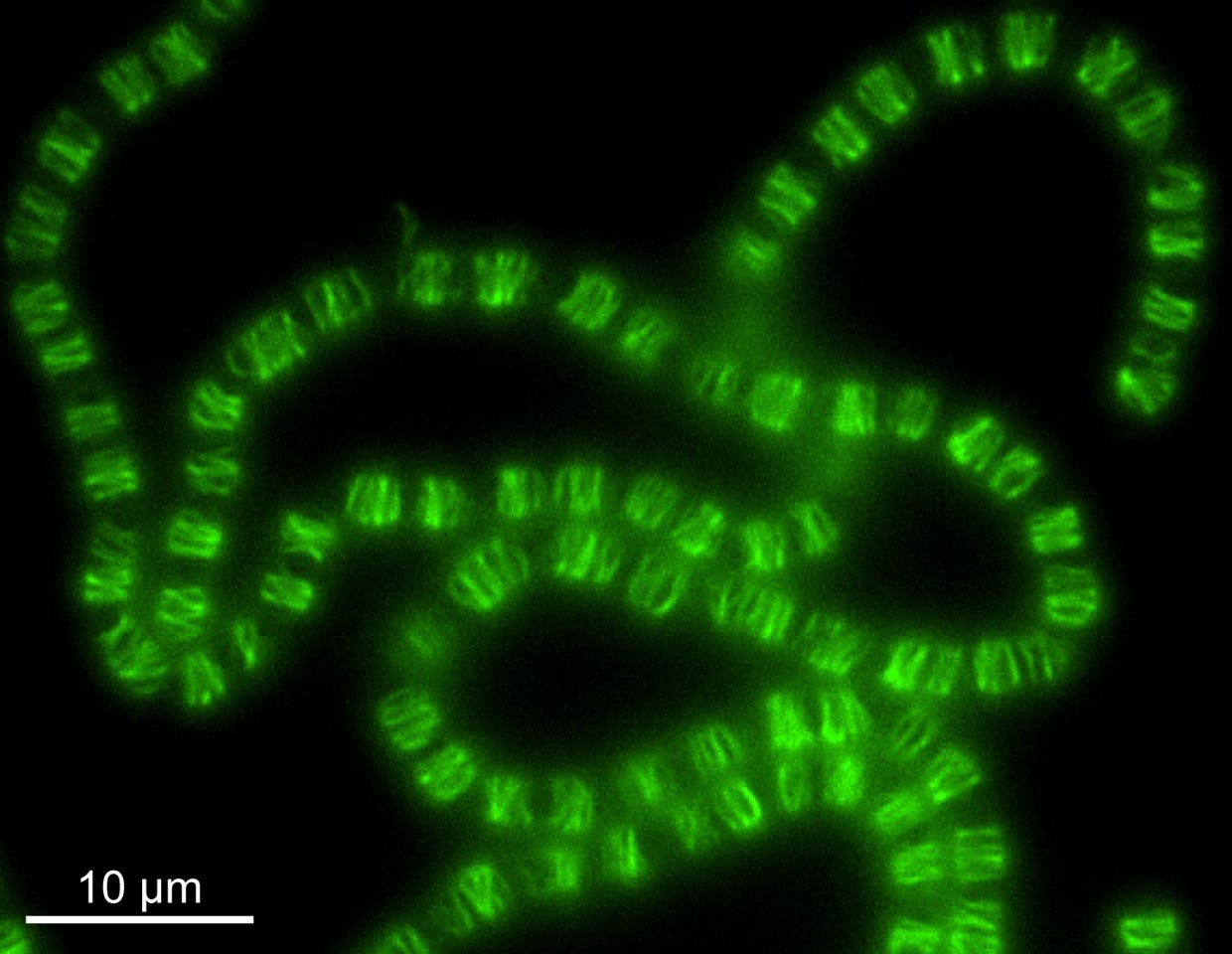
- Membrane Scaffolding: The protein ParM does not move through the cell’s interior; instead, it assembles into a network of filaments just beneath the cell membrane.
- Structural Support: Rather than acting as a “spindle” for genetic material, the system acts as a cell cortex, providing internal tension and shape.
Visualizing the “New” Skeleton
To confirm these findings, the research team utilized cryo-electron microscopy to observe the filaments at a molecular level. They discovered that these filaments exhibit “dynamic instability”—they rapidly grow and collapse, a behavior strikingly similar to the microtubules found in complex eukaryotic cells (such as human cells).
The importance of this system was most evident when it was removed. Without this protein network, Anabaena cells lost their characteristic rectangular shape, becoming round and swollen. This loss of morphology confirms that the system’s primary role is no longer genetic segregation, but structural integrity.
The Evolution of “CorMR”
Because of its new function, the researchers have renamed the system CorMR. Bioinformatic analysis suggests this wasn’t a sudden leap, but a stepwise evolutionary journey:
1. Relocation: The system moved from mobile plasmids to the main chromosome.
2. Modification: The proteins changed in size and physical structure.
3. Localization: The components gained the ability to bind to lipid membranes.
4. Integration: The system became integrated into the broader cellular control network.
Why This Matters
This research changes our understanding of how complexity arises in the natural world. It demonstrates that evolution does not always need to “invent” something from scratch; often, it simply reconfigures what is already there. By turning a DNA-sorting tool into a structural skeleton, cyanobacteria gained the ability to maintain complex shapes, a prerequisite for the multicellular life forms that eventually dominated the planet.
Conclusion: This study highlights the incredible plasticity of biological systems, proving that ancient genetic tools can be repurposed to drive the structural evolution of life itself.