For decades, planetary scientists have debated a fundamental question about the Red Planet: Was Mars merely a world of transient lakes and seasonal streams, or did it once host vast, stable oceans?
New research suggests the latter. By identifying a massive, continent-like geological feature beneath the Martian surface, scientists have found compelling evidence that a single, enormous ocean may have once covered up to one-third of the planet.
The Problem with Shorelines
While previous Mars missions identified features that resembled ancient shorelines, these findings were often inconclusive. On Earth, sea levels fluctuate significantly over time, making shorelines move. On Mars, these “shorelines” were found at varying elevations, making it difficult to prove they belonged to a single, consistent body of water rather than scattered, disconnected lakes.
Furthermore, Mars is an incredibly harsh environment. Any subtle geological signatures from billions of years ago have been subjected to relentless wind erosion and volcanic activity, effectively “smearing” the evidence of ancient coastlines.
The “Bathtub Ring” Strategy
To solve this, Professor Michael Lamb (Caltech) and Dr. Abdallah Zaki (Caltech and the University of Texas at Austin) shifted their focus from shorelines to something more permanent: the continental shelf.
To find a reliable indicator, the researchers used computer simulations on Earth. They virtually “drained” Earth’s oceans to see what geological fingerprints remained. They discovered that while shorelines disappear or shift, a continental shelf —a wide, flat band of land where the ocean meets the continent—remains relatively stable.
“The shelf is a new observation that ties together evidence of what the coastal zone would have looked like,” noted Dr. Zaki.
A Massive Northern Basin
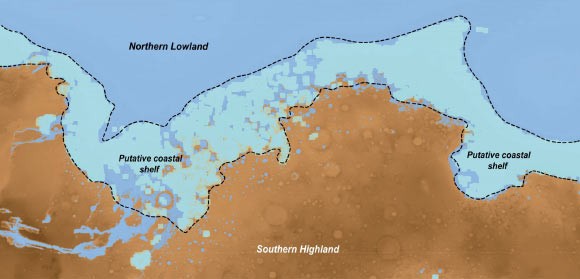
Applying this “bathtub ring” model to Martian topographic data, the researchers identified a massive, ring-like band in the northern hemisphere. This feature suggests a stable ocean that could have existed for millions of years.
Key supporting evidence found in the data includes:
– Scale: The shelf wraps around a vast area, suggesting an ocean covering roughly one-third of Mars.
– River Deltas: Researchers observed triangular sediment plains—river deltas—that align perfectly with this newly identified shelf. This indicates that rivers were flowing into a large, standing body of water rather than just into isolated basins.
– Stability: Unlike lakes, which can form and disappear quickly, a landform of this scale requires a long-term, stable environment to develop.
Why This Matters
This discovery changes our understanding of Martian history. If Mars hosted a massive ocean for millions of years, the planet was once far more hospitable to life than a world of mere puddles. It suggests a complex climate system capable of sustaining large-scale water cycles.
However, this ocean is a ghost of the past. As Professor Lamb points out, if this ocean existed, it dried up billions of years ago—potentially more than half the total age of Mars.
Next Steps
While the satellite data provides a strong structural argument, the scientific community is now looking toward the next phase of exploration. Future rover missions will be essential to examine specific sediment deposits and confirm the chemical composition of these ancient coastal zones.
In summary, the discovery of a massive continental shelf provides a new, stable geological anchor for the theory that Mars once possessed a vast northern ocean, significantly shifting our perspective on the planet’s watery past.