It turned on eight years ago. It is still blinding us with radio waves.
This is not how the script works.
Usually, these cosmic events are brief stints of extreme behavior. A black hole gets fed, it screams out energy in a flash, then it goes quiet again over days or months. But the black hole at the center of galaxy SDSS J11046.07+1152024 (located 1.8 billion light years away in Leo) is doing something else entirely. Its radio output spiked by more than twenty times. And it has stayed there. Sustained. Loud.
Astronomers think we are looking at a prototype for a whole new class of active galaxies.
“We are dealing with the prototype of a long duration radio changing look galaxy” Phil Edwards CSIRO coauthor
The object itself is a narrow line Seyfert 1 type galaxy. These are generally known for having low mass black holes that are hungry and eating material fast. But they don’t usually throw long lasting radio parties like this one did. It was a relatively quiet source before it flipped the switch. Now it is one of the most radio loud sources in that volume of sky.
The Mechanics Of The Scream
Black holes do not emit light themselves. They are voids. The light comes from everything they eat.
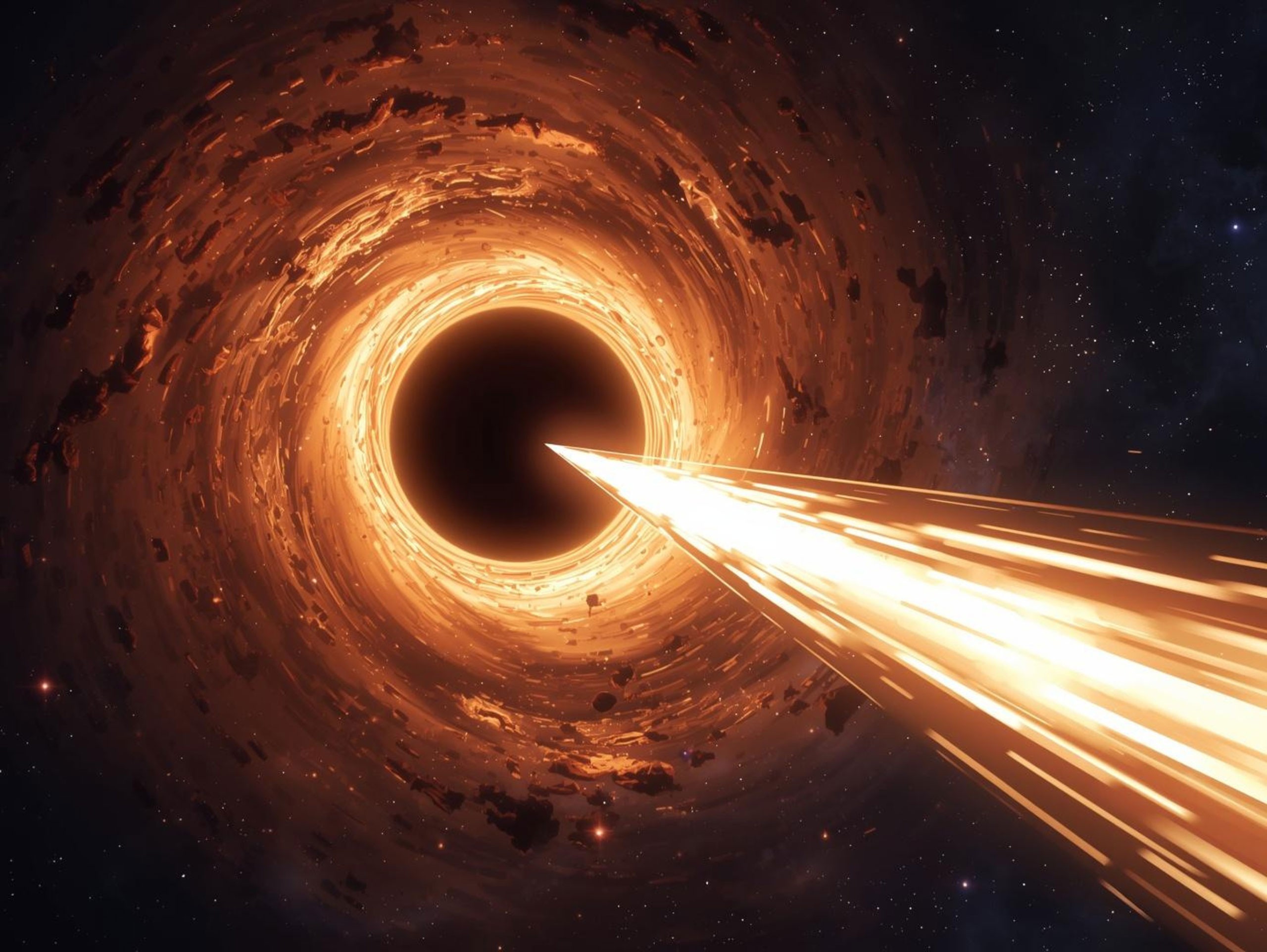
As gas and dust spiral inward they form an accretion disk. The friction is insane. The compression heats the material to incredible temperatures. Magnetic fields can whip some of that infalling matter into narrow jets. These jets race away at near light speed. They act like cosmic nozzles shooting particles out into the void.
Stefanie Komossa led an international team looking at data spanning the entire electromagnetic spectrum from X-rays to radio. Published in The Astrophysical Journal their analysis points to one likely trigger: a sudden increase in matter flow onto the black hole.
This influx likely triggered the jet.
That jet is currently pumping out radio emissions ten quadrillion times more intense than our Sun.
Think about that for a second.
“Luminous radio radiation from lightweight rapidly growing black holes is already rare. Their transition to this long lasting bright state has never been observed before.”
So we are watching a historical event in real time.
A Puzzle Without Pieces
Here is where it gets weird.
The galaxy went from quiet to screaming in the radio spectrum. But researchers looked for a match in visible or infrared light. They found nothing. No comparable surge in other wavelengths. This isolation makes the transformation bizarre. It rules out the easy answers. This probably wasn’t just a star being shredded by the black hole (a common source of short flares). It also doesn’t behave like a blazar where jets point directly at us and create variable light.
Follow up observations used heavy hardware to confirm this weirdness.
- The 100 meter radio telescope in Effelsberg
- CSIRO Australia Telescope Compact Array
- Multiple satellites in space
All the data aligns on the same strange fact. The source is unique.
So what caused the binge? Did the black hole stumble into a fresh cloud of gas? Did the conditions inside its accretion disk change geometry to allow a persistent jet to form?
Nobody knows.
Why did it start? Why does it continue?
“We still do not know.”
Why The Past Matters To The Present
We care because this local example gives us a proxy for the early universe.
Back when the cosmos was young the universe was filled with black holes growing rapidly. They were common then. Today they are distant faint ghosts difficult to study in detail. This nearby galaxy offers a laboratory. A close up look at how these engines launch jets and sustain them without burning out.
Kovi Rose from the Sydney Institute for Astronomy sees the potential here clearly.
“High energy events provide a wealth of insights. Observing these outbursts lets us study physical processes in some of the extreme environments of the universe.”
The next step requires even more eyes.
The Very Long Baseline Array VLBA could help resolve the structure. By combining signals from antennas spread across continents it acts like one giant telescope. This might let astronomers see how the jet actually changes shape near the core.
Then there is the Square Kilometre Array SKA coming online soon. It will scan the sky for similar objects. If this galaxy is just one outlier then we found a weird accident. If the SKA finds a population then we have uncovered a previously hidden class of changing look galaxies.
“This is crucial for filling gaps in our understanding” Komossa says.
We wait for the array. We watch the beacon.
It keeps burning.