


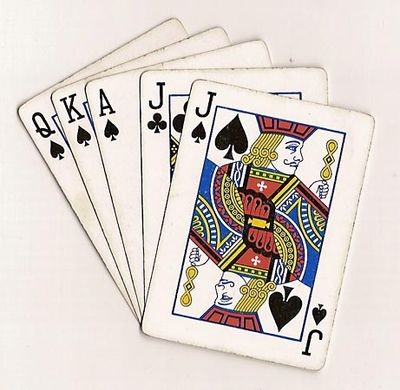
Playing cards aren’t just for poker nights. They are numbered or illustrated rectangles used for games, education, divination, and even magic tricks. It’s a dense little industry built on paper and plastic.
Traditionally, Western playing cards are rectangular layers of paper or thin cardboard pasted together. The result is a flat, semirigid material. Uniform in shape. Uniform in size. Small enough to fan out in one hand so you can see the identifying marks. The front—the face—is marked to distinguish it from the rest. The back is blank or patterned. Corners are rounded to stop fraying. Then, in the second half of the 20th century, manufacturers started adding plastic coatings to resist wear. Eventually, they made all-plastic cards.
Card games exploit a simple fact: you know your cards. You don’t know your opponent’s. This hidden information mechanic applies to dominoes and mah-jongg tiles too. British domino players actually call their tiles “cards.” Mah-jongg might even be the ancestor of the rummy family of games. In China, the line between cards and dominoes is blurry. The latter are often made of lacquered paper.
Where Did Playing Cards Actually Come From?
The origin and spread of these decks is a messy, fascinating trail. It didn’t start in Vegas.
The Royal Roots of Card Games
It’s a weird linguistic quirk. In 10th-century China, the same word meant both playing cards and dominoes. We don’t know what those early tiles looked like. Or what games people played with them. The literature mentions them. The details are missing.
Europe had to wait until the 1370s. That’s when cards showed up. Probably in Italy or Spain. They weren’t local inventions. Merchants brought them back from the Islamic Mamluk dynasty in Egypt.
Cards were imports. Luxury goods. Hand-painted masterpieces.
Only the rich could afford them. Take King Charles VI of France. His lost account book tells a specific story. He paid Jacquemin Gringonneur 56 sols parisiens. Why? To paint a deck of cards “pour le divertissement du roy.” For the king’s amusement.
By the 15th century, the upper class was hooked. Cards traveled inland along European trade routes. A favored pastime for the elite.
Then came the tech shift.
How Wood-Block Printing Changed Card Design
German printers invented wood-block printing in the early 1400s. Costs dropped. Fast.
France followed up in the 1480s with stencils. This method simplified the design. It created the suit marks we recognize today. Technically French. Now international.
You know the four:
– Pique (spades)
– Coeur (hearts)
– Carreau (diamonds)
– Trèfle (clubs)
These symbols replaced complex painted scenes. They were cheaper to make. Easier to read. And they stuck. The transition from royal luxury to mass-produced entertainment started here. With a stencil and a block of wood.
Why women loved cards (and why the church hated it)
Cheap production changed everything. Suddenly, cards weren’t just for the elite. They were cheap enough to slip into the pockets of anyone with a few spare coins. This price drop didn’t just sell more decks. It exploded the social utility of the hobby. Traditional indoor games? Stuck in a rut. You had chess for two people. Or you had dice for a rowdy group. Cards sat right in the middle. They worked for any number of players. Two. Six. Ten. It didn’t matter.
The versatility was insane. You could play a mindless gamble that required zero skill. Or you could dive into trick-taking games that demanded actual brains. Still, almost everything was played for money. The idea of playing strictly for fun? That’s a modern luxury. Back then, if you weren’t betting, you weren’t really playing.
But the real shift was gender. Cards appealed to women in a way chess and dice never did. This broke social norms. And it terrified authority figures. Art and literature started linking card tables to seduction. Intimate. Dangerous. Unregulated.
The church and city councils saw the threat immediately.
They denounced card playing constantly. They banned specific games. The logic was simple. If women are gambling and flirting over cards, society crumbles. The proliferation of gambling variants just fueled the fire. Civic authorities cracked down. Church leaders preached against it. Yet the decks kept spreading. The appeal was too strong. The mechanics too perfect for the era’s social chaos.
Governments taxed the decks to fill their coffers
The link between cards and gambling made rulers greedy. Why leave money on the table? In 17th-century France, King Louis XIV’s finance minister Cardinal Mazarin turned the Palace of Versailles into a massive state-run casino. It wasn’t just a game. It was a revenue stream for the royal purse.
Other nations were less subtle. They turned card manufacturing into a state monopoly. The penalties for forging? Fines. Imprisonment. Even death. Some places just slapped a tax on production. That’s why the ace of spades in British decks looks so ornate. It used to carry the tax authorization stamp. A literal receipt for the government. Now defunct, but the design stuck.
Printing tech got better. Games stayed popular. But the market didn’t explode. It stayed tight. Highly specialized. Fiercely competitive. Through the 20th century, traditional makers vanished. Absorbed by giants. Or shut down entirely.
The international deck standard
One deck won. The 52-card standard. Four suits. Thirteen ranks. Every card is unique. You know exactly what it is by suit and rank. No ambiguity. This is the most successful design in history. Universally recognized. If you play poker, bridge, or just mess around with friends, you are using this structure.
Why are there four suits?
The marks tell a story. Two black. Two red. Spades, clubs, hearts, and diamonds.
Where did they come from? The word spade likely traces back to the Old Spanish spado. Meaning sword. Club translates directly from basto. This suggests Spanish suits hit England before the French ones did. Around 1490. The French style eventually took over. But the roots are Spanish.
You might wonder why the symbols look so different across regions. In Germany, you might see acorns and bells. In Italy, batons and coins. But the French model became the global default. Why? Trade. Influence. The British Empire pushed it everywhere.
How Jokers Changed the Deck Game Forever
You think you know your cards. You know the ace swings high or low depending on whether you’re playing rummy or blackjack. You know the king sits at the top of the numeric hierarchy, right below that elusive ace in trick-taking games. But then there’s the outlier. The wildcard. The joker.
Originally, these cards didn’t exist. They were added to standard 52-card decks in the United States around the 1860s, specifically to play a game called Euchre (or more accurately, a variant called Prisoner’s Base where they were used as a trump card). Before that? Just the suits and the numbers.
So why did they stick?
Because chaos is fun.
Jokers serve no inherent numerical value in most traditional games. They are blank slates. In Poker, they often act as the ultimate wild card, able to substitute for any other card to complete a hand. In Canasta, they carry massive point values, often 50 or 100 points, making them dangerous weapons. In Gin Rummy, they might be banned entirely.
It depends on the house rules. Always check.
The design of jokers varies wildly. Some decks feature a single joker, others have two—one colored, one black-and-white. Modern decks sometimes include themed jokers or multiple variations. This inconsistency is part of their charm, but it also means you can’t assume anything.
The joker is the only card in the deck that doesn’t belong to a suit. It is truly independent.
This independence makes them perfect for games that require flexibility. When you’re stuck, the joker saves you. When you’re winning, it helps you crush the opposition harder. It’s the ultimate equalizer, or the ultimate disruptor, depending on who holds it.
In digital formats, jokers are often rendered with bright, distinctive graphics to distinguish them from the standard court cards. They pop off the screen. You always know when a joker hits the table.
So next time you shuffle, remember: the 52 cards are the rules. The jokers are the exception. And sometimes, the exception is the only thing that matters.
What actually counts as a standard deck?
Here is the thing about those two extra cards hanging out in the box. The jokers. They look like jesters. They feel important. But honestly? Most games ignore them.
When a game does use them, the rules shift. Take Canasta, a rummy variant that loves chaos. There, the joker isn’t just a card. It is wild. It becomes whatever you want it to be. A natural Ace? Sure. A missing Queen? Works too. It bends reality for your hand.
But where did this chaos card come from?
Forget the tarot deck myths. People love to say the joker is the Fool from tarot cards. It isn’t. That’s a fun story, but it’s wrong.
The joker actually started in Euchre. Way back when, players needed a way to beat the highest trump card. So they added one. It was essentially a super-charged Jack. A glorified court card meant to ruin your opponent’s day. It wasn’t called a joker then, but the function was there. Highest trump. Game over for whoever held the regular Jack.
So why do we have them now? Mostly for games that like wild cards. For most of the rest of poker or bridge, they sit in the box. Useless. Until they aren’t.
How European decks broke away from the Mamluk roots
The 52-card deck didn’t just appear out of thin air. It evolved in Europe from the original 52-card Mamluk deck. Some of those ancient specimens still exist. The suits were swords, polo sticks, goblets, and coins. Each held ranks 1 to 10 plus three court cards. Top down? King, upper viceroy, lower viceroy.
As cards spread through Europe in the 15th century, local makers got creative. They adapted the designs. This gave rise to national decks still used today.
Why Spanish, Italian, and Swiss decks look so different
Not all systems use the same numbers or faces. The numeral ranges vary. Most French games use 32 cards. They used to use 36. Spanish and Italian games usually play with 40. Sometimes 48. Rarely 52.
Here is the kicker. Most Spanish and Italian games omit the 10s. Swiss cards replace 10s with “banners.” These show a pendant or a flag. In Spanish and Italian decks, an ace is just a 1. The Swiss ace? It’s actually a 2. It bears two suitmarks.
The history of court cards and gender shifts
The oldest court cards were all male. Caballo in Spanish. Cavallo in Italian. Both mean horse. But they refer to the riders. Better to call them cavaliers.
Germanic decks use ober and unter. These mean superior and inferior officer. Originally they referred to the position of the suitmark on the card. Latin suits and courts feel military. Germanic ones feel rustic. Anglo-French ones feel courtly.
Historically speaking, the international deck is the English national version of the French national deck. And here is a twist. People think the French replaced the upper viceroy with a queen first. They didn’t. The Germans did. Then the Germans changed back to the male upper viceroy.
how playing card backs evolved from plain to patterned
Originally, the back of a card was boring. Just blank paper or cardboard. But players get messy. Or maybe they get smart. Marks appeared. Scratches, stains, deliberate nicks to remember which cards were in play.
Card makers hated this. It ruined the game. So they printed patterns. Fine dots. Tartan designs. The French called it taroté. It hid the wear and tear. Better yet, it hid the cheats.
Then came the 19th century. Color printing got better. Registration improved. Suddenly, the backs of cards weren’t just functional. They were art. You’ve got a vast array of attractive designs now. Pick your poison.
why double-headed court cards exist
Ever play cribbage? You know the phrases. “One for his nob.” “Two for his heels.”
That’s because royal figures used to be full-length. Heads at the top. Feet at the bottom.
Here’s the problem. Observant players noticed something. People turn their cards the “right way up.” If you see a face, you know it’s a court card. You know the rank. Game over for the other guy.
The solution? Double-headed courts. Invented in the 19th century. Two heads. No heels to give it away. It spread fast. Most regional patterns adopted it. Some resisted. Old habits die hard. But mostly, you can’t tell if you’re looking at the top or bottom of a King anymore.
the origin of card indices and the letter J
Another 19th-century fix: indices.
Before this, you had to fan your cards wide to read them. Too wide, and your opponents see everything. Not ideal.
So printers put the rank and suit in the corner. Top left. Top right. Now you can squeeze the cards together. Tight fan. These were called squeezers. You could actually squeeze them.
This caused a linguistic problem in English.
King starts with K. Knave starts with K.
If you put a K on the corner, how do you tell them apart? You don’t.
So they changed Knave to Jack. J for Jack. K for King.
Wait, where did Jack come from? It wasn’t always the standard. In the old game of All Fours, the knave of trump was already called the Jack. It was popular. Easier to say than “knave,” which sounds archaic and stiff. The name stuck. It migrated to the indices.
Sweden? They didn’t get the memo. Or they just didn’t care. They still use K for köning (king) and Kn for knabe (knave). It’s awkward. But it works for them.
So next time you hold a deck, look at the corner. That little J isn’t random. It’s a fix for a printing limitation. It’s history in your hand. Simple. Efficient. A bit weird.
Beyond the Standard Deck: A Global Look at Niche Playing Cards
The standard 52-card deck? It’s hardly the whole story. While Europe and America lean heavily on that familiar rectangular shuffle, the rest of the world plays by different rules. Different cards, different cultures, entirely different vibes.
Take Jewish kvitlach (or kvitlech). These aren’t just playing cards; they’re prayer slips folded and tucked away for good luck. Then you’ve got the Scandinavian gnav cards. Older than the standard deck in some regions, these feature unique suits that most modern players wouldn’t recognize.
American rook cards deserve a mention too. Before poker took over the bar scene, rook was the game. The cards are distinct, with their own hierarchy and symbols. It’s a ghost of a game past, but the deck still exists.
Cross the Pacific and the deck gets weirder. Chinese money cards and domino-cards blend gambling with traditional numerology and imagery. They don’t look like French-suited cards at all. Over in Japan, hanafuda (flower cards) bring poetry and seasonal beauty to the table. The art is stunning. The gameplay? Strategic and steep.
And then there’s the modern explosion. Trading card games changed everything. Magic: The Gathering and Pokémon didn’t just borrow the concept of a card; they industrialized it. Collectibility, rarity, secondary markets. These aren’t just tools for a parlor game anymore. They’re assets.
So, why stick to the standard deck when the world is full of specialized options? Maybe you’re looking for how to play hanafuda or curious about the history of rook cards. The variety is endless. You just have to look past the blue back of the Bicycle deck.


