


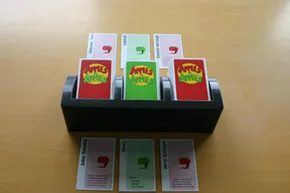
The standard rules for Apples to Apples are fine. They work. They’ve sold millions of copies. But let’s be honest: after the tenth round of “My Hair” winning because the judge had a bad hair day, the novelty wears off. You want chaos. You want strategy. You want to see if your friend can pick the most terrible match for “Appetizing” while you’re trying to sabotage the player on your left.
The community has spent years tweaking the formula. From the official Party Box add-ons to late-night house rules born of too much wine, here are the variations that actually change how the game plays.
Shake Up the Setup
Start by flipping the script on the deal. In Apple Turnovers, you don’t hand out Red Apple Cards (the adjectives) to everyone. Instead, deal out Green Apple Cards (the nouns) to players and flip one Red Apple Card for the clue. It changes the pacing. You’re holding the answers before you know the question. It’s faster, but it requires a different kind of bluffing.
Then there’s Mr. Nobody. This is the cheat code for small groups. When everyone lays down their Red Apple Card, the judge pulls a fresh one from the top of the deck and shuffles it into the submissions. Why? Because the judge can’t judge fairly if they just played the winning card themselves. And honestly? You’ll be shocked how often that random, unchosen card takes the win. It keeps the deck dynamic and prevents the judge from having an unfair advantage.
Change the Goal
Want to break your friends’ brains? Try Crab Apples. The goal isn’t to find the best match. It’s to find the worst. If the adjective is “Appetizing,” you don’t pick “Hot Fudge.” You pick “A can of worms.” The judge awards the point to the most inappropriate match. It turns the game into a test of absurdity rather than wit.
If you prefer logic puzzles, go for 2 for 1 Apples. The judge flips two Green Apple Cards at once. Players have to craft a Red Apple Card that fits both adjectives. It’s harder. It’s more satisfying when you pull off a double match.
Social Sabotage and Blank Slates
Apple Traders adds a layer of betrayal. Between rounds, you don’t just pass your hand. You actively sabotage your neighbor. Give one card to the player on your left. Keep the garbage. Hope they draw bad. It turns the game into a social strategy session.
For total customization, there are Wild Apples. Toss blank cards into both the Green and Red decks. If the judge flips a blank Green card, they write their own adjective. If a player pulls a blank Red card, they write their own noun. Leave these in the deck for future games. You’ll build a library of inside jokes that only your group understands. The cards last forever. The memories last longer.
The Alter Ego Rule
The standard rule says the judge picks based on personal preference. If the card says “My love life,” it’s the judge’s love life. Boring.
In Apple’s Eye View, the person to the judge’s left assigns an alter ego. It can be a celebrity. It can be your uncle. It can be the judge’s worst enemy. The judge must then pick the winning card as if they were that person. Suddenly, picking a card about “Bad Back Pain” makes sense if your alter ego is a 70-year-old librarian. It forces empathy. It forces you to think outside your own head.
The Basics (And Who Actually Plays)
If you’re just getting started, here is the bare minimum. Each player gets seven cards. That’s it. The objective is simple: match nouns to adjectives. Be the judge. Pick the best match. Collect the cards. Repeat until someone wins.
But who is this for? The original Apples to Apples is not for kids. The jokes are sharp. They’re mean. They’re about sex, drugs, and politics. It’s designed for ages 12 and up.
If you have younger players, or if you just want a lighter experience, there is Apples to Apples Junior. It’s the same mechanic. Different tone. Designed for ages 9 and up. The cards are cleaner. The jokes are safer. It’s a distinct product, not just a filtered version of the main game.
You can play the original with your college roommate and the Junior version with your niece. They occupy different spaces in your life. You don’t need to choose one over the other. You just need to know which one fits the room.
The game works because it’s empty until you fill it. Add a blank card. Change the judge’s identity. Swap the goal.


