The number of wind turbines in Germany has nearly doubled in two decades. 2025 set a new record for building permits. But there is a catch. Getting a turbine from idea to electricity takes forever.
It usually takes seven years. Four to five years just for planning and permits. Then two more years for construction. By the time the blades start spinning, the world has moved on.
The Renewable Energy Sources Act (EEG) is helping. Things are getting slightly faster. But the process is still a grind. It involves location scouting, environmental checks, financing, and finally, the physical build.
How long does it take to build a wind park in Germany
The timeline is the biggest hurdle.
Planning and permitting average four to five years. Construction adds two more. Total: seven years from start to finish.
This isn’t guesswork. It is the reality on the ground. The EEG is showing results, speeding up approvals, but the clock is still ticking.
Every phase requires expert reports. You need coordination with authorities. You need to talk to neighbors and municipalities. Laws dictate how this happens. Key regulations include the EEG, the Onshore Wind Act, and the Federal Immission Control Act (BImSchG).
Since 2023, acceleration rules apply. In designated wind areas, complex environmental assessments are skipped. That saves time. But you still need solid data. Wind measurements and site analyses determine the wind class and terrain type. This data tells you which turbine fits where.
What determines a wind farm location
Location isn’t just about wind. It is about distance.
You need to stay away from settlements. Minimum distances matter. Nature protection and bird migration routes are checked meticulously.
There is a rule of thumb for spacing. Turbines are placed at about five times the rotor diameter apart. This means each turbine needs 12 to 20 hectares.
But here is the surprise. The ground footprint is tiny.
The foundation takes up only 350 to 600 square meters. The rest of that 12 to 20 hectares stays usable for farming. Cows don’t mind the wind.
You also need expert reports on noise, shadow flicker, landscape impact, and wildlife. Since 2023, wind energy is legally considered a prevailing public interest. This outweighs some protection goals for the energy transition. If a park is approved, compensation measures might be required.
Citizens need info. Municipalities need to agree. Long-term lease contracts secure the land. Developers often work with local governments. Sometimes they even let residents profit financially.
How wind farm permits and financing work
Once planning is done, permits begin. Financing happens at the same time.
Any turbine over 50 meters needs a formal immission control procedure. This includes public and authority participation. Depending on the area, an environmental impact assessment is needed.
Economics must make sense.
EEG tenders set the feed-in tariff. Approved projects bid in cents per kilowatt-hour. For 2026, the Federal Network Agency set a maximum of 7.25 cents per kWh.
Demand has been high. Supply low. This drove down average prices.
Financing is a mix of equity and debt. Banks and investors scrutinize every document. If they say yes, construction starts.
Building, mounting, and grid connection
Money is secured. Permits are in hand. Now comes the heavy lifting.
Access roads are built first. They must handle heavy transport. Then the foundation is dug. Depending on the soil, this means pits 2 to 4 meters deep and 20 to 30 meters wide.
Concrete foundations need days to cure. Under ideal conditions, rough construction finishes in days.
A small substation and cable lines are built simultaneously. This prepares for the grid connection.
But wait.
Grid connection is a bottleneck. Many regions in Germany have long waiting lists for available connection points. You can build the turbine. You can spin the blades. But if the grid is full, the power stays trapped.
The technology works. The process does not.
Turm hoch, Rotor drauf, Strom raus
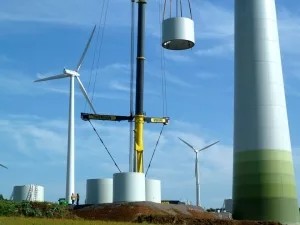
Die Vorbereitungen sind im Kasten. Jetzt geht es ans Eingemachte. Baufahrzeuge mit riesigen Armen stapeln Turmsegmente übereinander. Schrauben halten die Segmente zusammen. Eine gewaltige Konstruktion wächst aus dem Boden.
Dann kommt die Gondel. Drin steckt der Generator. Die Kranoperatoren heben die Last auf die Spitze. Präzise Arbeit. Ein Millimeter zu viel, und es kracht. Als letztes kommen die Rotorblätter dran. Je nach Modell sind diese Flügel über 80 Meter lang. Länger als ein Fußballfeld.
Sobald Turm, Gondel und Rotor sitzen, ist das grobe Handwerk vorbei. Jetzt kommt die Feinarbeit. Inbetriebnahme. Testläufe. Sachverständige prüfen alles. Wenn das Gutachten positiv ausfällt, geht die Anlage an das Netz.
Wie lange läuft eine Windkraftanlage wirklich?
Nach einer intensiven Testphase unter verschiedenen Windbedingungen steht die offizielle Inbetriebnahme an. Aber wie alt wird so ein Turm?
In Deutschland rechnen die Betreiber mit einer Lebenserwartung von 20 bis 25 Jahren. Das klingt nach einer Ewigkeit. Ist es aber nicht. Technologie entwickelt sich schneller.
Wenn die Zeit abgelaufen ist, stehen zwei Wege zur Verfügung. Man ersetzt die alte Anlage durch eine moderne Turbine am selben Standort. Mehr Leistung. Bessere Effizienz. Oder man baut ab.
Rückbau ist kein Wegwerfen. Die demontierten Komponenten werden recycelt. Der Beton wird zerkleinert. Der Stahl wird eingeschmolzen. Die Fläche bekommt einen neuen Zweck. Vielleicht Landwirtschaft. Vielleicht ein neuer, größerer Windpark.
Warum Windenergie für Kommunen Gold wert ist
Windkraft ist nicht mehr nur ein Nischenthema. Die Windparks in Deutschland speisen aktuell etwa 31,5 Prozent des gesamten Stroms ein. Ein Drittel. Das ist kein Klacks.
Doch der Nutzen geht über Megawattstunden hinaus. Geld.
Kommunen profitieren massiv vom Betrieb der Windparks. Die Gewerbesteuer bleibt vor Ort. In der Regel verbleiben rund 70 Prozent der Gewerbesteuern im Standort. Das fließt nicht in eine zentrale Staatskasse. Es stärkt den lokalen Haushalt.
Schulen werden saniert. Straßen werden gepflastert. Die Infrastruktur profitiert direkt. Für viele Gemeinden ist das ein wichtiger Pfeiler der eigenen Einnahmen.
Der lange Weg zum grünen Strom
Der Blick zurück zeigt ein komplexes Bild. Vom ersten Windmessmast bis zur ersten Kilowattstunde Strom ist viel passiert.
Es ist kein simpler Prozess. Standortplanung. Genehmigungsverfahren in zwei Stufen. Ausschreibungen. Bau. Netzanschluss. Jede Phase erfordert sorgfältige Planung. Fehler haben Konsequenzen. Verzögerungen kosten Geld.
Trotzdem oder gerade deswegen funktioniert es. Die Energie kommt an. Die Kommunen kassieren. Die Luft wird ein kleines bisschen klarer.
Was kommt als Nächstes? Wahrscheinlich noch höhere Türme. Noch längere Blätter. Und wieder neue Diskussionen über den Standort. Der Kreislauf beginnt von neuem. 🌬️