


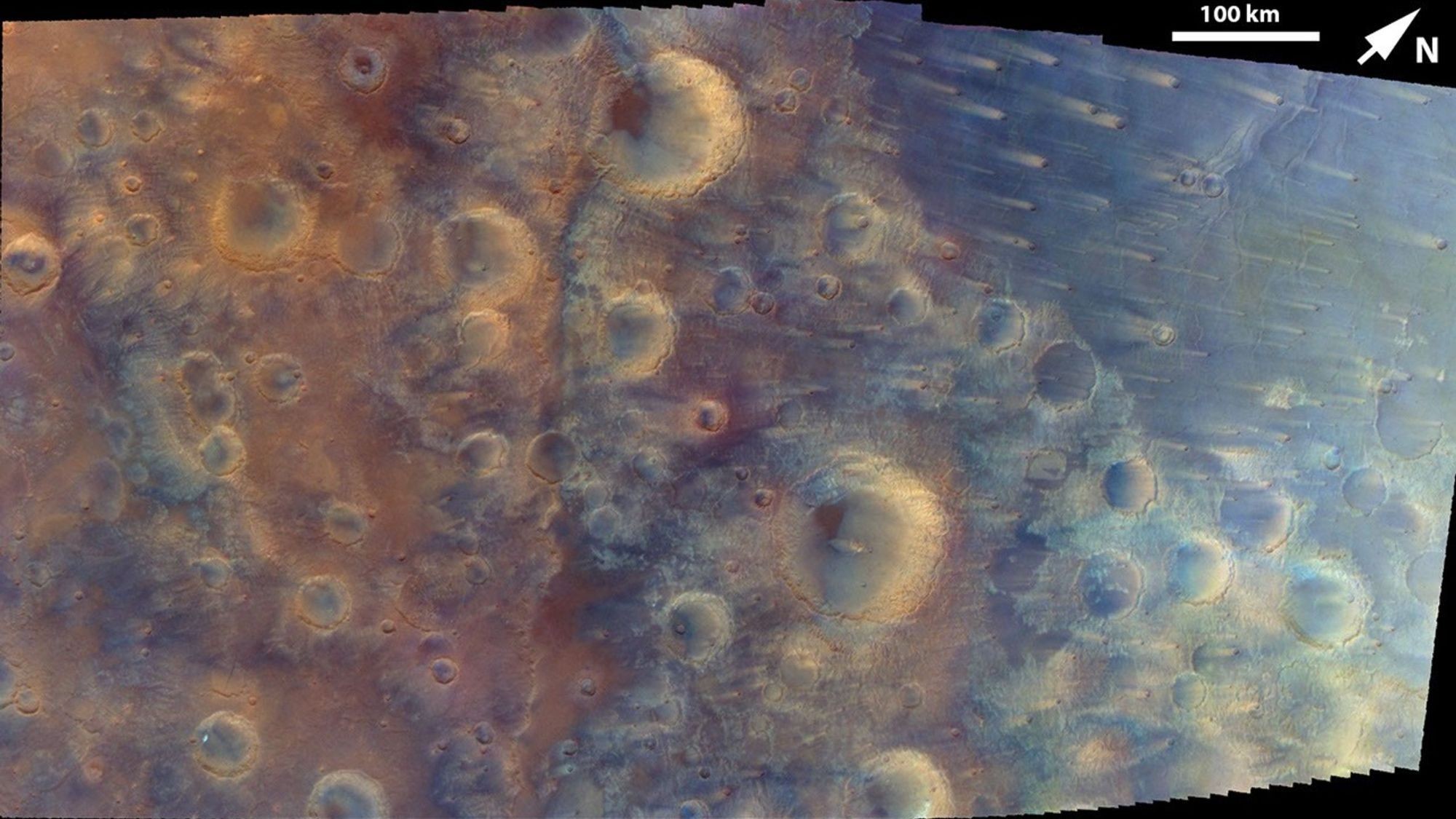
It was a razor-thin sliver of light at first. Then, it ballooned into the red planet. Then, it vanished back into the dark.
That is what Mars looked like to NASA’s Psyche spacecraft this past May. A new time-lapse video stitched together from images taken over the month shows the probe doing exactly what it was designed to do: using a planet as a giant slingshot.
Mars gave Psyche more than just a pretty view. It gave it a kick. A 1,000-mile-per-hour boost to be exact.
The gravity assist, executed on May 15 when the craft passed within 2,864 miles of the surface, tweaked Psyche’s speed and trajectory. It set the stage for the main event—a rendezvous with asteroid Psyche, the iron-rich world in the main asteroid belt where the spacecraft is scheduled to arrive in 2029.
“This gravity assist was years in the making… Psyche flew by Mars on exactly thetrajectory we needed.” — Bob Mase, Psyche project manager
The approach was steep. Scientists call it a “high phase” angle relative to the sun. Psyche didn’t see the whole disk of Mars. At first, only 4% of the surface was illuminated. The planet appeared as a slender crescent. Its thin atmosphere glowed in scattered sunlight, faint and eerie.
Hannah Zigo, a team member from Arizona State University, captured the visual shift in a NASA video. As Psyche closed the distance, Mars steadily expanded in the field of view. Craters appeared. Punctured the surface like bullet holes in tin. Then came the ancient, double-ringed Huygens crater. Finally, the south polar ice cap.
All of it receded into the spacecraft’s rearview mirror.
Why fly past Mars? It’s not just about speed
The flyby wasn’t just about physics. It was a test drive.
By aiming its suite of instruments at a well-known world, engineers could calibrate and validate the scientific payload. They needed to know the hardware worked before it reached the unknown metal asteroid.
Did they find alien life on Mars? No.
Did they make a groundbreaking discovery? Not exactly.
“We didn’t anticipate big discoveries… but we did complement Mars science,” said Lindy Elkins-Tanton, the principal investigator at the University of California, Berkeley. “We collected data through Psyche’s unique perspective.”
The value was in the calibration. Every instrument performed as expected.
The science instruments passed the test
The spacecraft is carrying three main tools. They all worked.
First, the gamma-ray and neutron spectrometer. This device is designed to determine the elemental makeup of the asteroid. During the closest approach, it detected a predicted surge of escaping neutrons from Mars. The signal matched the model. The instrument is operational.
Second, the magnetometer. Its job is to look for evidence that asteroid Psyche used to be the metallic core of an early protoplanet. Since the launch in 2023, this had been dormant in terms of planetary data. During the Mars flyby, it recorded its first magnetic signature. It detected the bow shock—the boundary where the solar wind crashes into Mars’ magnetic environment.
Third, the twin multispectral cameras. These cameras passed their calibration tests. They captured the frames used to build the viral time-lapse video. They also spotted two tiny dots.
Phobos. Deimos. Mars’ moons.
Seeing them from distance served as practice. The Psyche mission will search for its own satellite when it arrives. Specifically, it will look for moonlets.
“Spotting the moons… was a practice for the satellite search,” said Jim Bell, a planetary scientist at ASU who leads the imaging team.
What’s next for the mission
With Mars behind it, Psyche is back on course.
The spacecraft is in good health. The trajectory is set for a summer 2029 arrival. There are no major deviations. The navigation team nailed the flyby.
The next major operational step will come later this fall. The team will resume sustained thrusting. They will engage the solar-electric propulsion system to begin the long haul across the asteroid belt.
It will take five years. But for now, the probe is just flying. Silent. Dark. Headed for the iron heart of a broken planet.


