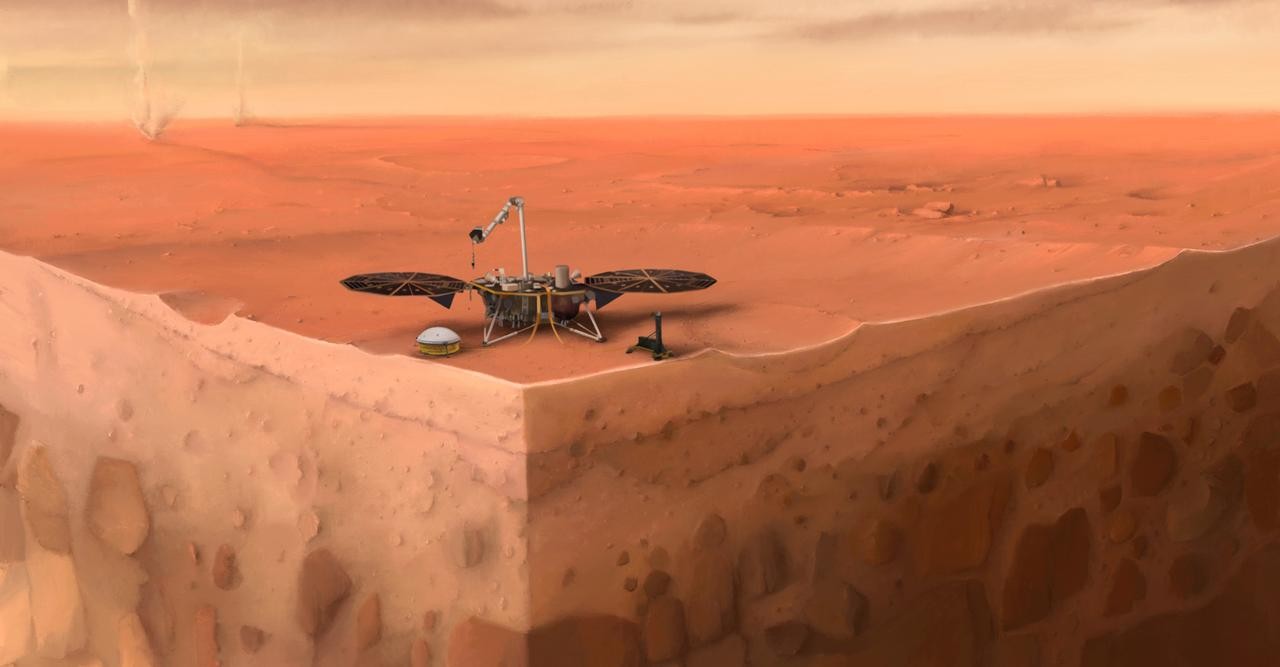
The knocking stopped. Silence returned to the Martian surface after the robotic arm of the InSight lander delivered 500 precise blows to the head of the self-hammering probe. The goal is simple. The idea is to bury the equipment deep enough to obtain clear seismic data. result? Failure.
- “We tried our best. Mars and our mole just didn’t get along,” said Tilman Spohn, a project scientist for the mission. The struggle to install Heat Flow and Physical Properties Package (affectionately known as “”The Mole””) has become one of the most well-known obstacles in modern planetary exploration. But this failure was more than just a technical failure. It reveals something profound about the Red Planet’s crust.
The Impossible Mole: Battle of Friction
Engineers have been working on the HP3 instrument for over a year. It is designed to drill 5 meters underground and its task is to measure the heat flow the planet’s internal. Why is this important? Because heat tells us how the planet cooled, how its core solidified, and ultimately how terrestrial planets like Earth formed.
The problem is not technology. It’s dirt.
Mars is known for being dusty and loose. You might think that would make digging easier. This is not true. The mole is held in place by friction, and the internal hammer pushes the mole down. If the soil is too loose, the whole unit will rotate out of place. If it is too hard, the hammer will not be able to penetrate it.
It turns out that the regolith surrounding Insight is neither soft nor hard. It was patchy. gravel. Unpredictable.
“Hammer” Strategy: A Desperate Act
When The Mole’s self-hammer mechanism stopped working, NASA engineers came up with a dangerous workaround. They didn’t use the lander’s robotic arms to manipulate the soil, but to push the mole’s head.
The idea is that when you push down, the normal force increases and the friction increases. This prevents the “mole” from rotating and allows the hammer inside to strike deeper.
It worked. Sort of.
The team performed several presses over several months. The mole moved. But slowly. Between March 11, 2020 and May 30, 2020, it advanced only 7 centimeters. It’s only 1.5 inches. That’s painfully slow for a device designed to go 5 meters deep.
“We learned a lot that will help future missions that try to dig beneath the surface of Mars.”
The last spurt and the arrival of winter
By June 2020, the situation had turned serious. The robot arm can only reach so far. When you reach your physical limit, you can’t push it any further. You have to dig the mole out of the jam yourself.
Engineers hope that eventually the surrounding sand will compact enough to produce enough friction. They need “The Mole” to anchor themselves and continue digging independently.
But time is running out. Winter is in the northern hemisphere of Mars. Solar energy is decreasing. All operations require valuable energy. Teams must be strategic. They can’t just keep pushing. They had to let the mole do the work.
In August 2020, NASA announced that the mole had been buried. Only a few centimeters of the rear cap and a few centimeters of its casing stick out. Apparently they won. Or is it?
What we know about Martian soil
The InSight mission didn’t just fail to bury the probe. It succeeded in mapping a complex geological reality.
Previous rovers took samples from the Earth’s surface. The orbiter scanned it from above. But InSight sitting right on the ground, providing data you’ve never seen before. The soil wasn’t uniform. This is not the fine dust you see in the movies. It is a mixture of particles and rock debris, creating a mechanical environment that defies simple models.
Because of this complexity, future missions will require new tools. The standard “drill and go” approach may not work everywhere. If you want to explore the subsurface of Mars, you need tools that can adapt to varying friction and densities.
The Legacy of the Struggle
The mole never reached the 5 meter target. It stops at about 40 cm. However, the information collected is valuable. Helps calibrate seismometers by reducing noise caused by wind and temperature changes. It gives engineers a plan of what not to do next time.
The battle against “The Mole” on Mars highlights a harsh truth about planetary science. Assumptions based on Earth and previous missions can be fatally wrong. Mars is not Earth. It’s not even a coherent version of itself. Can vary from square meter to square meter.
The InSight lander will finally went silent in 2022, but the question of how to drill into Mars remains unresolved. New missions are already in development. They also face the same challenges. The soil is different. different temperatures. Different risks.
But they too will benefit from the InSight experience. They learn that friction is a fickle companion. the hardest part of going deeper isn’t the drill. It’s the ground beneath it.
After more than a year plunging into the unforgiving Martian crust, the HP3 spacecraft’s self-hammering mole prepares for its final assault. It encountered completely unpredictable resistance during ground tests and struggled to penetrate more than 5 meters below the Martian surface. Currently, NASA is moving towards a high-risk strategy. Instead of the mole operating alone, it is physically pushed by the lander’s robotic arm.
The goal is simple, but dangerous. Push the mole into the loose, crumbly soil layer to remove the mole. The catch? The hydraulic line of the arm runs directly along the power line of the mole. it could sever that connection if the arm is pushed too hard or at the wrong angle. Cutting the cable means silence. The experiment is over. But without this intervention, the mole might never go deeper, leaving the mystery of Mars’ internal heat flow unsolved.
Why digging on Mars is harder than expected
This failure was not unusual. It’s a recurring theme in the planetary exploration. During 40 years of robotic missions to Mars, no spacecraft has managed to penetrate deep underground. The difficulty lies in the soil mechanics. Martian regolith behaves differently than Earth’s soil or lunar dust that we are used to.
Past missions offer a cautionary tale. During tests on Earth, NASA’s deep ice drilling mission encountered serious technical problems and was canceled. The Phoenix lander, which landed near the north polar cap in 2008, was equipped with a robotic arm designed to drill down to a depth of 50 centimeters. it managed just a few centimeters before giving up. Curiosity’s drill can drill holes about 5 centimeters wide. It succeeded, but there were frequent blockages and mechanical problems.
“Mars has hard skin.”
The HP3 Mole (simply called the Mole) is designed to hammer itself down to five meters. For months, it hit the same wall. Engineers from the German Aerospace Center (DLR) and NASA followed. It moved forward an inch before it suddenly bounced back and expelled by the very ground it tried to enter.
Strategy: Push instead of hammer
The new plan was tested extensively at NASA’s Jet Propulsion Laboratory (JPL). The assumption is that the top layer of soil is too friable or loose, so the ropes inside the mole are unable to provide the friction needed to pull it deeper. Without this grip, the action of the hammer only causes the mole to spin and bounce.
Engineers hope to use a robotic arm to locally compact soil by on the mole while it hammers, This increased pressure should create the friction needed for the mole to dig into the ground and pull itself downward. It is a risky maneuver. The arm must apply precise force without crushing delicate instruments or snapping the power tether.
If it succeeds, the mole will eventually be able to reach its target depth. If it fails, the data collection window is permanently closed.
Looking to the future: what’s next for Europe?
The European Space Agency ESA is closely monitoring the result of InSight’s last attempt. Their Rosalind Franklin rover, scheduled for launch this summer, carries a more robust drilling solution. Its drill bit is designed to drill up to 2 meters deep on Mars and is divided into four 50 cm sections.
ESA’s mission includes special safeguards to prevent getting stuck. The two-meter depth will only be attempted at the end of the rover’s primary mission. This conservative approach recognizes the unpredictability of the Martian soil. Unlike the stationary InSight, the Rosalind Franklin rover can be moved to another location if ground conditions become too difficult.
The Scientific Stakes
Why is this important? The HP3 instrument isn’t just digging for fun. It has sensors designed to measure heat flow from Mars’ interior. By recording temperatures at different depths, scientists can calculate how much heat escapes from the planet’s core.
This information is important for understanding the thermal history of Mars. It helps answer fundamental questions about how the planet formed, why its magnetic field collapsed, and what their internal structures look like today. Without deep soil data, our model of Mars remains incomplete. This is a planet we’re orbiting and landing on, but we still know little about its internal engine.
The mole showed that progress can be made. On Sol 373, almost its entire length is embedded in the ground. It seems to be effective. Then, as announced in early November, there was a drop. The friction that was supposed to hold it in place failed. Soil properties are different than expected.
Now, with a robotic arm as a backup, the team risks everything to try again. The soil is very hard. The stakes are high. The clock is ticking.
The Martian truth problem
It’s not just about landing. It’s all about staying down.
Mars is a mechanical nightmare for engineers. The atmosphere is too thin to offer any meaningful drag or lift. Gravity is weak. The soil, regolith, is a puzzle with missing pieces. We do not know its true mechanical properties. We base our conclusions on data from orbiters and rovers orbiting millions of kilometers away. When you’re trying to build a habitat that has to withstand wind, dust and time, it’s dangerous to guess.
New evidence suggests that this task is more difficult than we thought. The soil behaves differently than the model predicts. Why? The answer lies in the intersection of low pressure, low gravity, and unknown soil mechanics.
Engineers are currently investigating the situation. They are looking for solutions. The mission cannot continue until this issue is resolved.
Why soil matters
You might think that soil is just dirt. On Mars, it is an active variable.
Regolith is not static. It shifts. It compacts. It resists. But how much? In a low-gravity environment, all interactions with the surface are magnified. The wheels of the rover sink deeper than on Earth. The anchor slides more easily. The foundation of the habitat settles unevenly.
A thin atmosphere offers no cushion. There is no air resistance to slow descent. No weather system can reliably predict soil erosion. The dust is fine. It permeates everything. The feel of the ground under your feet, or rather the feel of the tread, changes.
The shear strength of deep soil is unknown. We do not know how it reacts to vibration. We do not know how it will perform under constant load for many years. Lack of information is a gap. It’s big.
How Engineers Are Responding
They don’t expect perfect information. They work with what they have.
Current research focuses on adaptive design. Rovers are being tested with shape-changing wheels. The anchors have been re-evaluated for different soil densities. Habitat foundations is modeled using several scenarios.
One way is to use the regolith itself. Using local soil for 3D printing is a popular concept. But you can’t print with soil that behave unpredictably. If the soil under the print head moves, the structure fails.
Another way is to use redundancy. More contact points. More anchors. More sensors. Each sensor adds weight. Each anchor adds complexity. It’s a delicate balance.
“The ground is not just a base, it is a participant in the mission.”
Engineers study telemetry data from existing rovers. Curiosity. Perseverance. Opportunity. Each provides clues. But hints are not answers. There is little data. The scenarios are limited.
The Unknown Unknowns
The biggest risk is not knowing what you don’t know.
Soil can be cohesive than you think. Maybe it would be fluid. It probably contains ice that sublimates over time and creating voids. Cavities are dangerous. A sinking foundation is a nightmare.
Maybe the regolith is abrasive. There is more wear and tear than expected. Tool wear. Wheel deterioration. Maintenance is not possible.
These are not hypotheticals. They are possibilities. And they slow down progress.
Moving Forward
Solutions do not arise from a single breakthrough. it will come
Stay on top
Digital silence is the enemy of curiosity. If you forget the latest developments in science and technology, the gap is growing day by day. The solution is simple. Join the conversation directly on WhatsApp or Google News.
These platforms are more than just newsletters. These are live feeds from Futura, the leading source of detailed scientific reports. Skip the noise of the algorithm and order Selected updates directly to your device by ordering here.
Why is this important?
Science is developing rapidly. Discoveries in quantum computing and new advances in medicine can change our understanding in hours, not years. The lack of original coverage means you’re reacting to old news instead of focusing on the present.
The convenience of using a direct channel
WhatsApp Groups provides instant alerts. No app switching. No more clutter in your inbox. When something big happens, Just a ping Ideal for breaking news that needs to be understood quickly.
Google News offers a larger Searchable archive. You can dig deeper into attention-grabbing topics. You can set up specific alerts for niche technologies and follow Futura’s dedicated science section without leaving the Google ecosystem you already use.
Don’t miss a thing
The possibilities for innovation are vast. From the ethics of artificial intelligence to solutions to climate change, details matter. Relying on casual social media browsing alone is unreliable.
- Direct access to expert analyses.
- Avoid information overload and use carefully selected filters.
- You will receive updates in real time.
It’s about control. You decide what, when and how you watch. Don’t miss the next big news. Connect with Futura today on WhatsApp and Google News. The future awaits, and it does not wait for late readers.