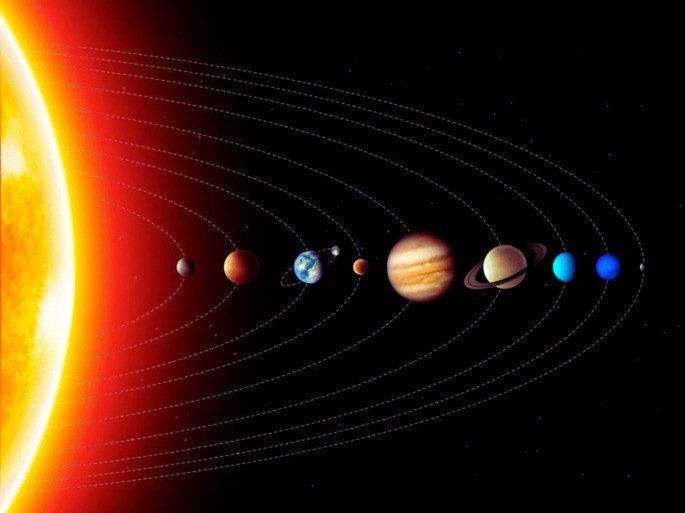
The solar system isn’t just a random scattering of rocks and gas. It’s a gravitational family tied together by one massive anchor: the Sun. Every planet, every chunk of dust, every wandering comet has one job. Orbit.
The name itself gives it away. Sol. The Sun. It’s the central axis. It spins. It holds the line. And everything else? It has to dance around it.
The solar system is the collection of celestial bodies and stars that gravitate around the Sun.
Think of it like a cosmic gravity well. The Sun’s mass is so dominant that it bends space-time just enough to keep Mercury, Venus, Earth, and the rest in check. Without that pull, we’d be flying off into the dark.
It’s not just planets either. You’ve got asteroids. Kuiper Belt objects. Dust clouds. Even the probe sent by humans years ago is still caught in that web. It’s a chaotic, messy, beautiful system held together by pure physics.
Why does this matter? Because we live inside it. We’re stuck in the goldilocks zone of the third rock from the Sun. If that central balance shifted—even slightly—our whole reality would change.
The Sun doesn’t ask for permission. It just pulls. And we just fall.
We live inside a cosmic neighborhood that looks simple enough at first glance. Planets. Moons. Rocks. Ice. But the reality is messier, older, and stranger than most textbooks let on.
For centuries, humanity convinced itself it stood at the center of everything. It was a comforting thought. The Earth stationary, the stars rotating around us. Then came Nicolaus Copernicus. Between 1473 and 1543, he dismantled that ego-driven geometry. He placed the Sun in the middle. We stopped being the center of the universe and became just another stone orbiting a burning ball of gas.
The term “solar system” is often used as a generic placeholder for any star surrounded by its own retinue of bodies. There are thousands of these systems scattered across the Milky Way galaxy alone. But ours? Ours has specific quirks.
How Our Solar System Actually Works
Our local cluster formed roughly 4.6 billion years ago. It’s not static. It’s a dynamic, violent, gravity-driven machine.
It sits in the Milky Way galaxy, a spiral arm of stars that we’re just barely scratching the surface of understanding. The central engine, the Sun, is an average-sized star in terms of mass and temperature. It’s not special. It’s just there.
But its reach is immense. The Sun’s gravitational pull extends out to about 2 light-years. That’s a vast distance. To put it in perspective, that’s roughly one-quarter of the distance to the nearest star system, Proxima Centauri.
Within that gravitational sphere, everything moves. The heliosphere is the bubble created by the Sun’s magnetic field and solar wind. It protects us from cosmic rays. The edge of that bubble is the heliopause. Voyager 1 crossed it in 2012. It’s the boundary between our neighborhood and interstellar space.
And the motion? Nothing moves in a perfect circle. Planets and asteroids trace elliptical orbits. They speed up when they’re closer to the Sun and slow down when they’re farther away. It’s Kepler’s first law in action, simple physics that keeps us from flying off into the dark.
Why Pluto Isn’t a Planet Anymore
The count of major bodies changes. It always has.
Currently, we recognize eight planets and five dwarf planets. That’s it.
But this wasn’t always the case. The definition of a planet is fuzzy. It’s political as much as it is scientific. In 2006, the International Astronomical Union (IAU) had to draw a line. They decided that to be a “planet,” a body must clear its orbital neighborhood.
Pluto failed that test. It shares its orbit with other Kuiper Belt objects. So, it was demoted. It’s now a dwarf planet, alongside Ceres, Eris, Haumea, and Makemake.
This shift matters because it forces us to look at the data differently. We stopped classifying based on familiarity and started classifying based on physics.
The Giants and The Dwarfs
Size differences in our system are staggering.
Jupiter is the king. It’s so massive that it accounts
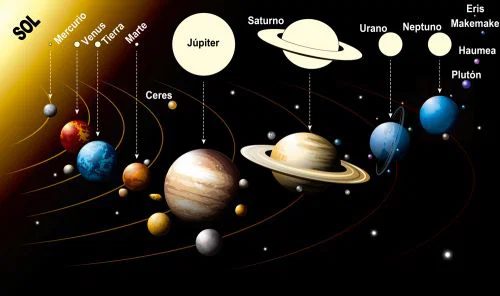
The hierarchy of our solar system is simple but vast. It starts with proximity to the Sun. Mercury holds the throne as the closest planet. Venus takes the second spot. This distance dictates gravity, temperature, and orbital speed.
But looking at just the order misses the chaos. The planets differ wildly in composition. You have the rocky inner worlds. Then you have the gaseous giants. Their rotation speeds vary too. Some spin fast. Others take centuries to turn once. Their years? Even more extreme. A single year on Neptuno lasts 164.8 Earth years. Mercury’s day? It spans 59 Earth days.
Here is how the eight major bodies stack up against each other. We are excluding dwarf planets for now. We get to them later.
The Inner Rocky Worlds
Mercury is first. It is the smallest planet. It has no moons. Its day is long and its year is short—just 88 Earth days. It’s hot, dry, and barren.
Venus comes next. It is rocky too. But it is the hottest and brightest planet in our sky. It has no satellites. Its day is bizarrely long at 243 Earth days. Its year is 225 Earth days. It rotates backward compared to most planets.
Earth is third. We know this one well. It has life. It has one satellite, the Moon. Our day is 24 hours. Our year is 365.25 days.
Marte is fourth. It is rocky. It hosts the tallest mountain in the solar system, Olympus Mons. It has two moons. Its day is 24.6 Earth hours. Its year is 1.88 Earth years.
The Outer Gas Giants
Jupiter is fifth. It is a gas giant. It is also the largest planet in the system. It has 79 known moons. Its day is short, just 9.9 hours. Its year is 11.9 Earth years.
Saturn is sixth. Another gas giant. It is famous for its rings. It has 82 known moons. Its day lasts 10.7 hours. Its year spans 30 Earth years.
Uranus is seventh. It is gaseous. It has rings too, though fainter than Saturn’s. It has 27 known moons. Its day is 17.2 hours. Its year is 84 Earth years.
Neptuno is eighth. The most distant giant. It is gaseous. It has rings and 14 known moons. Its day is 16.1 hours. Its year is 164.8 Earth years.
The Dwarf Planets
Beyond the eight giants, there are five identified dwarf planets. They are smaller. They are rocky. Except for Ceres, they all reside beyond the Kuiper Belt.
Ceres sits between Mars and Jupiter. It has no moons. Its day is 9 hours. Its year is 4.6 Earth years.
Plutón is after Neptuno. It has five known moons. Its day is 6.4 hours. Its year is 248 Earth years.
Haumea follows Pluto. It is oval-shaped. It has two moons. Its day is extremely fast at 3.9 hours. Its year is 285 Earth years.
Makemake comes next. It has one known moon. Its day is 7.7 hours. Its year is 310 Earth years.
Eris is last among them. It has one known moon. Its day is long—11 Earth days. Its year is 558 Earth years.
The Debris Fields and The Center
The solar system isn’t just planets. There are two major concentrations of rocky bodies.
The Asteroid Belt lies between Mars and Jupiter. Ceres is its largest object.
The Kuiper Belt starts 4.5 billion km from the Sun. It extends over 4 billion km further out. All dwarf planets except Ceres live here.
At the center is the Sun. It is a medium-sized yellow star. It is 4.6 billion years old. The surface temperature hits 5,500 °C. Its light takes nine minutes to reach Earth.
“The Sun is the axis of our solar system.”
We think we know our neighborhood. We know the order. We know the names. But the scale of time involved here… a day on Mercury isn’t a day. It’s nearly two months. A year on Neptune is a lifetime for us.
Does the distance matter? Yes. It determines everything. Temperature. Pressure. Possibility of life.
We map the orbits. We count the moons. We measure the years. But the space between them? That’s where the silence is. And the vastness.
The data is clear. The objects are real. The numbers don’t lie. But the feeling of being here, on the third rock, spinning for 24 hours while the rest of the cosmos turns at its own pace… that’s a different story.
We keep looking up. We keep measuring. The list grows longer with every telescope. New dwarf planets. New moons. The order stays the same. The distance grows.