While the viral image of Pope Francis in a white puffer jacket recently shocked the world, the phenomenon of “fake news” through visual media is far from a modern invention. Long before generative AI tools like Midjourney, photographers were already mastering the art of deception, exaggeration, and surrealism through manual manipulation.
A new exhibition at the Rijksmuseum in Amsterdam, titled FAKE! Early Photo Collages and Photomontages, reveals that the impulse to distort reality is as old as the camera itself.
The Art of the “Impossible” Scale
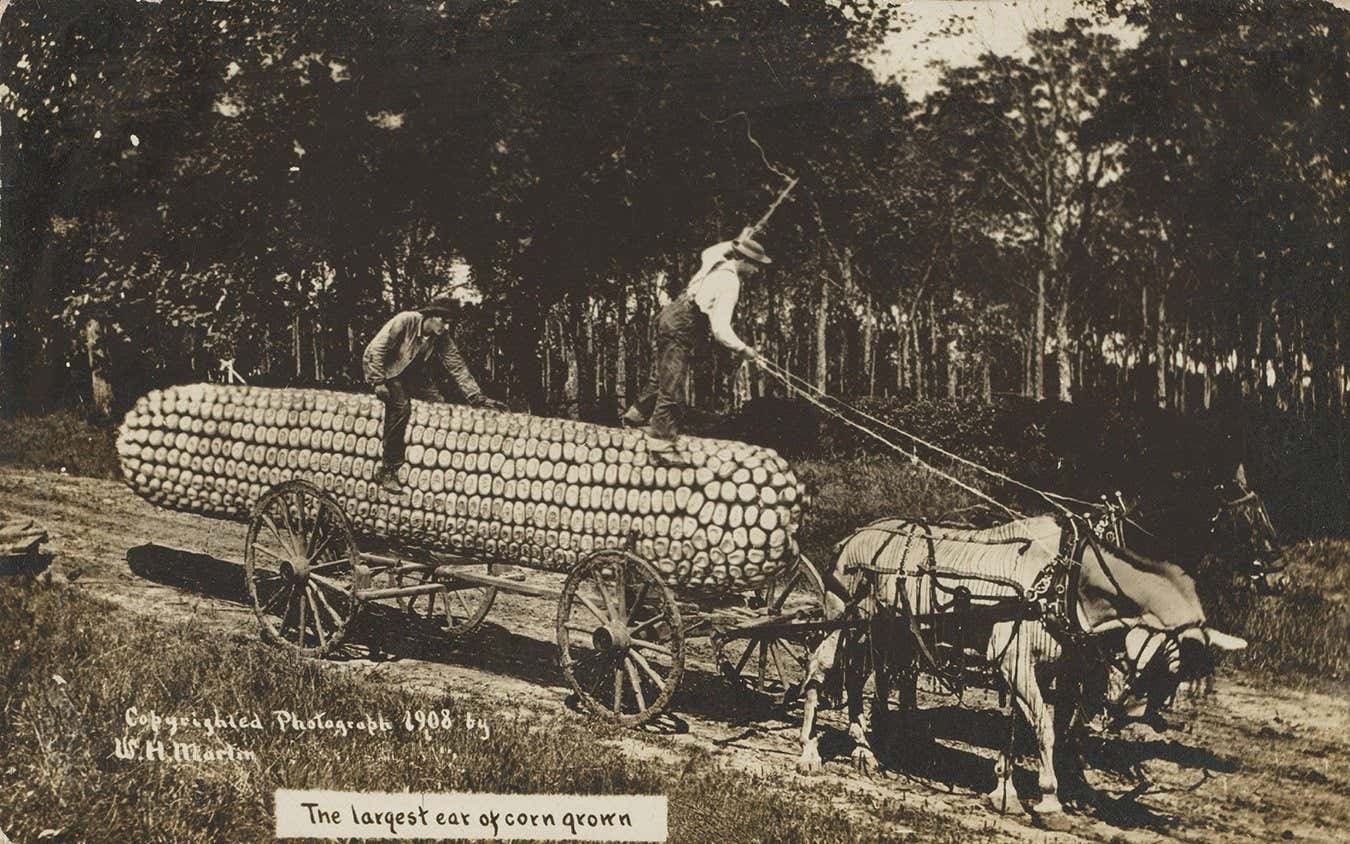
One of the most enduring ways humans have manipulated images is through the distortion of scale. In the early 20th century, a popular trend involved creating postcards that depicted outlandishly large produce or livestock—a visual precursor to today’s “clickbait” imagery.
A notable example from 1908 by W. H. Martin showcases this technique:
– The Process: Martin would photograph individual elements separately.
– The Assembly: He then physically cut and pasted these pieces together to create a composite scene.
– The Final Step: The assembled collage was re-photographed to create a single, seamless, yet entirely fraudulent image.
This method was used to create “startling” visuals, such as ears of corn that defy biology or geese so massive they dwarf their human handlers. These images weren’t meant to deceive for political malice, but rather to entertain and amaze a public hungry for the spectacular.
From Photography to “Drawing”
The exhibition also highlights how the line between photography and illustration has historically been blurred. Early photomontages often underwent significant post-production:
– Colorization: Colors were frequently added manually during the printing process.
– Retouching: Outlines were often touched up by hand, giving photographic compositions the aesthetic of a drawing.
This is evident in early visions of the future, such as postcards depicting flying cars over New York. These images represent an early form of “concept art,” using the perceived “truth” of photography to make fantastical, science-fiction ideas feel grounded and possible.
A Century of Deception
The history of image manipulation is much deeper than many realize. According to the Rijksmuseum, the practice of cutting and pasting photographic elements dates back as far as 1860. The exhibition traces this evolution from those early experiments through to the end of the Second World War.
This historical context is crucial because it reminds us that the medium of photography has never been a purely objective record of reality. Whether through the physical cutting of paper or the digital layering of pixels, the ability to alter the truth has always been a tool available to those with the technical skill to do so.
The evolution of “fake” imagery shows that while our tools have changed from scissors and glue to algorithms and neural networks, the human desire to reshape reality remains constant.
Conclusion
The FAKE! exhibition demonstrates that visual misinformation and surrealist manipulation are not new problems caused by technology, but are deeply rooted in the history of the photographic medium. Understanding this past helps us realize that skepticism toward images is a necessary skill that has been required for over 160 years.