For decades, artificial intelligence has dominated the world of strategic board games. From IBM’s Deep Blue defeating Garry Kasparov in chess to Google’s AlphaGo conquering the complex game of Go, machines have proven they can outthink humans in digital environments. Now, that dominance is moving from the screen to the physical arena.
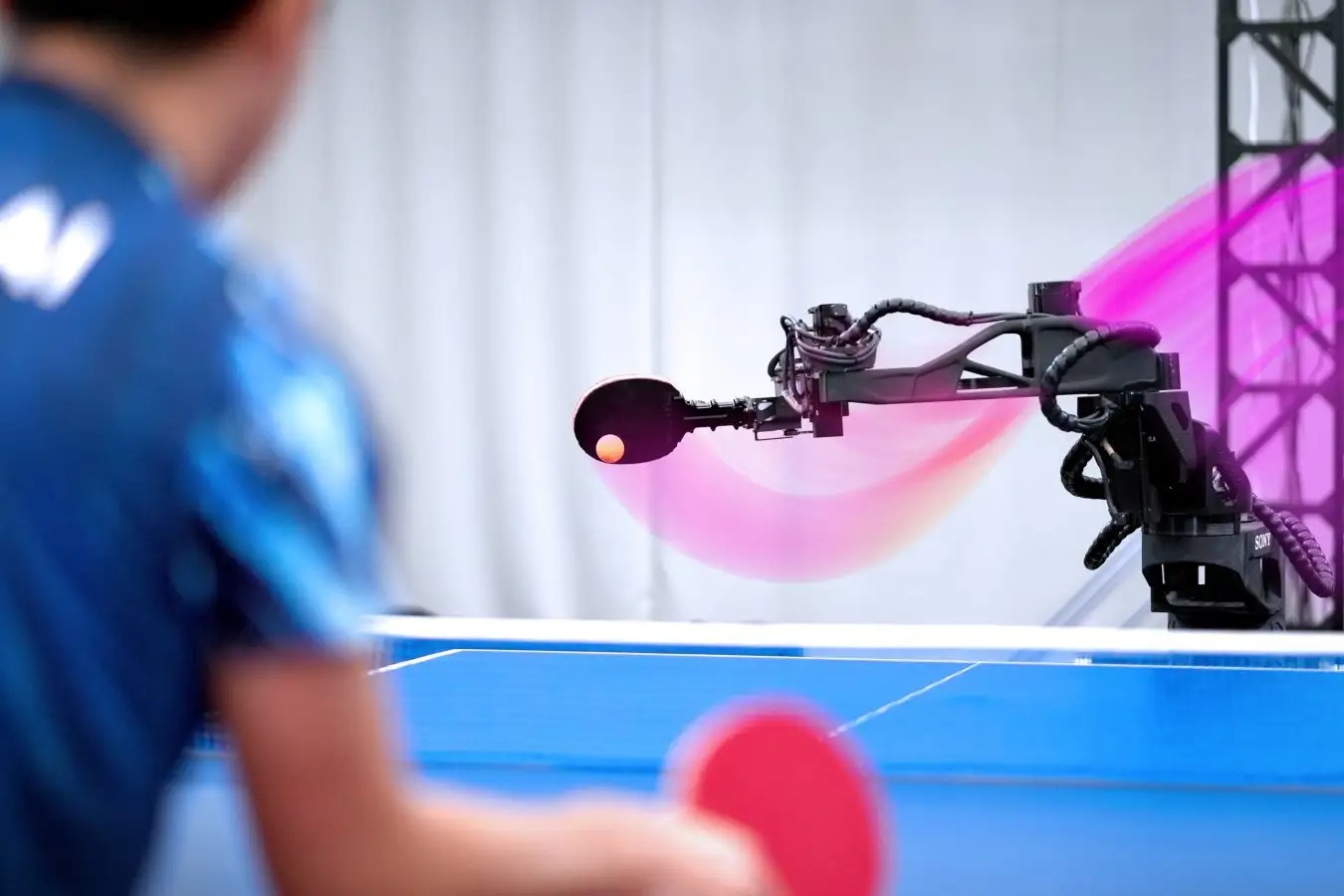
Ace, an autonomous robot developed by Sony AI, has officially entered the realm of high-speed physical competition. Unlike previous AI breakthroughs that operated in virtual spaces, Ace competes in the real world, facing elite human athletes in a sport that demands extreme precision, rapid reflexes, and complex physics.
The Technology Behind the Speed
Ace is not merely a programmed machine; it is a sophisticated fusion of advanced sensing and self-taught intelligence. To compete at a professional level, the robot utilizes three core technological pillars:
- Event-Based Sensors: Rather than processing entire video frames, Ace’s sensors focus specifically on changes in motion and brightness. This allows the robot to track the high-speed trajectory of a table tennis ball with much higher efficiency than standard cameras.
- Model-Free Reinforcement Learning: Ace did not learn by being told the “rules” or “techniques” of table tennis. Instead, it underwent thousands of hours of training in a simulated environment—essentially playing a high-speed digital version of the game—to learn through trial and error.
- High-Speed Hardware: Ace features an eight-jointed arm capable of “human-like agility.” In fact, it holds a significant physiological advantage: while a top-tier human athlete requires roughly 230 milliseconds to react to a stimulus, Ace’s total latency is only about 20 milliseconds.
Testing Against the Best
The true test of Ace’s capabilities came during a series of matches against highly skilled players. The study compared the robot against two distinct groups:
- Elite Non-Professionals: These players had over a decade of experience and trained 20 hours per week. Ace proved dominant here, losing only two out of five matches.
- Professional Players: While Ace initially struggled against full-time professionals, it managed to win individual games, proving it could compete at the highest levels of the sport.
Interestingly, the matches revealed both the robot’s strengths and its current limitations. Ace has no “tells”—it cannot be intimidated or tricked by psychological warfare. However, it also lacks the ability to read human body language. Professional players noted that they often rely on watching an opponent’s face to predict a move, a biological cue that Ace cannot interpret.
Conversely, Ace’s ability to detect complex ball spin—even when players attempted to hide it—surprised both the athletes and its own creators. The robot even demonstrated “emergent” skills, such as successfully returning balls that bounced off the net, a technique it had never explicitly been trained to perform.
The Path to World Championship Status
The development of Ace is accelerating. Since the initial study, the team has achieved significant milestones:
* December 2025: Ace secured its first full victory against a professional player.
* March 2026: The robot defeated three more professionals, including Miyuu Kihara, who is ranked in the top 25 globally.
As the technology evolves, the researchers aim to move Ace from its current industrial-looking setup into a humanoid form. The goal is no longer just to compete, but to outperform the reigning world champions.
“With further improvements, it should be possible to outperform even the world champion,” says Peter Dürr of Sony AI.
This evolution suggests a symbiotic future for sports. As former Olympian Kinjiro Nakamura noted, seeing the superhuman shots executed by Ace may actually provide new inspiration, showing human athletes techniques they previously thought were physically impossible.
Conclusion
Ace represents a pivotal shift in AI development, moving from digital strategy to physical mastery. As robotics and reinforcement learning converge, the line between human athletic excellence and machine precision continues to blur.