Legend has it. That’s what you hear about the Tarkine. Or Takayna. It matters who you ask, but the place remains one of the few true wildernesses left in Australia. Freshwater crayfish near a meter long hide in the shadow of 2000-year-old Huon Pines. And every so often, the rumor returns. Thylacines are still out there, prowling the dense Gondwanan rainforests of north-west Tasmania.
65 million years of history here. But the deepest stories don’t involve animals walking on land or trees pumping out oxygen. They start before all that. Before complex life even knew how to begin.
“People often say fungi grow in the forest,” says Dr. Alison Pouliot. A mycologist. She tells this to me as the air cools, sharp with sassafras spice. “There wouldn’t be a forest without fungi. They are the ecosystem engineers.”
The foundation.
We’re on a three-day workshop with her. Toxicologists, botanists, ecologists. All different backgrounds. Same stare when the dirt gives something up. Wonder, mostly. Easy to see why, really.
For decades taxonomists lumped them with plants. About 50 years ago they got their own Kingdom. Still, they are ignored. Understudied. We estimate 2 to 3 million species exist. Humans have identified maybe 205,000. Mushrooms are just the fruit. The show. The real body is the mycelium—vast webs underground, threads connecting everything.
100 quadrillion kilometers of thread.
These networks let fungi form symbiotic relationships with nearly 70% of the planet’s plant species.
“Fungi can be microscopic,” Pouliot notes. Or impossibly huge. She cites a specimen in Oregon, US, that covers 9 square kilometers and weighs 30,000 tons. Big enough to break the mind. But she isn’t here just to drop size facts. She wants to explore the role fungi play in fixing broken ecosystems.
We read Sylvia Plath. We make “sporeprints,” creating photonegatives of gills on paper. We dissect language itself. Why do we say love blooms but crime mushrooms? The words stick. They reveal how we see things. Or don’t.
Afternoons mean foraging. We start at Corinna Wilderness Village. It was a mining town. Now an eco-haven tucked deep in the rainforest.
We follow the Pieman River. The water flows slow enough to be black ink, a perfect mirror for the sky. Huon pines bow over it, ancient and tired. Then comes the physical part. Giant ferns block the path. You have to push through them. The stand ahead is majestic leatherwoods and celerytop pines. Trunks buried under glistening cloaks. Moss. Lichen. Liverwort. Wet. Dark. Alive.
Then the shouting.
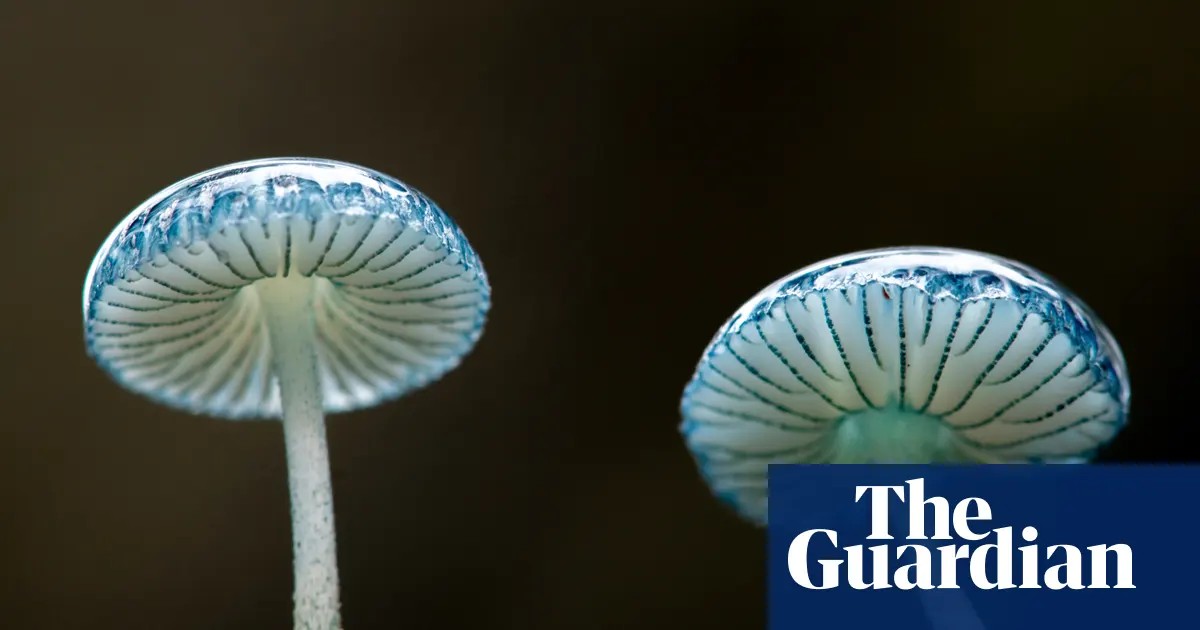
Joyful cries interrupting birdsong. A blue Pixie’s Parasol spotted. A field of Ruby Bonnets looking like red berries spilled across the floor. Slime-covered Earth Tongues that resemble worms surfacing from the mud. Giant Bracket fungi wide as dinner plates. Echidna fungi hiding thousands of spiky teeth under their caps.
The density is staggering.
We cover less than 200 meters an hour. Sometimes slower.
“It’s hard to believe there is so much diversity in such a tiny space,” Liz Davis says. She’s been foraging for thirty years. Started a Mycology Festival in Orange, New South Wales. She says hunting elsewhere just doesn’t compare. Pouliot agrees. Add the invisible underground life to the visible caps and brackets? We could return 100 times. Find new species every single time.
It’s intoxicating.
Finding these weird, wonderful things feels like an addiction. I got “fungally infected” early on, as the group puts it. The architecture of the rainforest is suddenly visible. Held up by threads I cannot see. But there’s anger there too, under the joy. Anger at how little we value this kingdom.
They hold the planet together. Almost every ecosystem relies on them. And yet we don’t even have a collective noun for the group itself. Just for the mushrooms.
I keep thinking back to Plath’s Mushrooms. Resilience. Strength. She sees a metaphor for gender equality in their quiet, unstoppable advance.
“We shall by morning / Inherit the earth / Our foot’s in the door.”
Three days in. Walking on fungal foundations. The earth isn’t being inherited so much as borrowed. And the creditors are already here, waiting in the soil, invisible and vast. 🍄