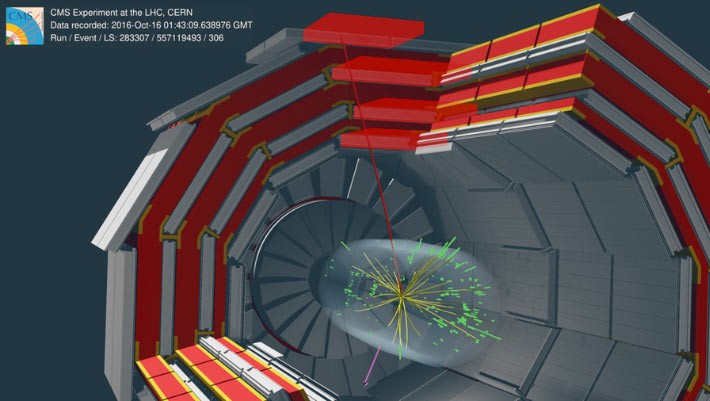
Physicists working with the Compact Muon Solenoid (CMS) experiment at CERN have achieved a landmark measurement of the W boson’s mass. By analyzing data from over one billion proton-colliding events at the Large Hadron Collider (LHC), the team has provided a high-precision value that aligns closely with the predictions of the Standard Model of particle physics.
The Role of the W Boson in Our Universe
To understand why this measurement is significant, one must look at the fundamental forces that govern reality. The W boson is one of two elementary particles responsible for the weak force —one of the four fundamental forces of nature.
Unlike gravity or electromagnetism, the weak force is responsible for particle transformation. It allows particles to change their identity, such as a proton turning into a neutron. This process is the engine behind:
– Radioactive decay, which drives various natural processes.
– Nuclear fusion, the very mechanism that powers the Sun.
Because the W boson is a cornerstone of how matter behaves at its most basic level, any deviation in its mass could signal that our understanding of the universe is incomplete.
The Challenge of “Invisible” Particles
Measuring a W boson is an immense technical challenge because the particle is incredibly unstable. It decays almost instantly, making direct observation impossible.
In the specific decay process studied by the CMS team, the W boson splits into two particles: a muon and a neutrino. While the muon is relatively easy to track, the neutrino is “ghost-like”—it passes through detectors without leaving a trace. To solve this, physicists must use sophisticated modeling to calculate the total mass of the parent W boson based solely on the detectable muon and the missing energy left behind by the neutrino.
Resolving a Scientific Tension
This new measurement arrives at a critical moment for particle physics. In 2022, the Collider Detector at Fermilab (CDF) released a measurement that shocked the scientific community. Their result suggested the W boson was significantly heavier than the Standard Model predicted, hinting at the existence of “new physics”—undiscovered particles or forces that might be influencing the measurement.
The new CMS results provide a necessary counterweight to that tension:
– The Result: The mass was determined to be 80,360.2 ± 9.9 MeV.
– The Alignment: This value matches the Standard Model’s predictions.
– The Precision: The level of accuracy is comparable to the CDF measurement, but the outcome is different.
By producing a result that aligns with the established “rulebook” of physics, the CMS experiment suggests that the previous anomaly at Fermilab may have been a statistical outlier rather than a sign of a new physical reality.
“This new measurement is a strong confirmation that we can trust the Standard Model,” noted Dr. Kenneth Long, a physicist at MIT.
Conclusion
By successfully measuring the W boson with unprecedented precision, CERN researchers have reinforced the validity of the Standard Model. This finding provides much-needed stability to the field, suggesting that the fundamental laws of physics as we currently understand them remain intact.