


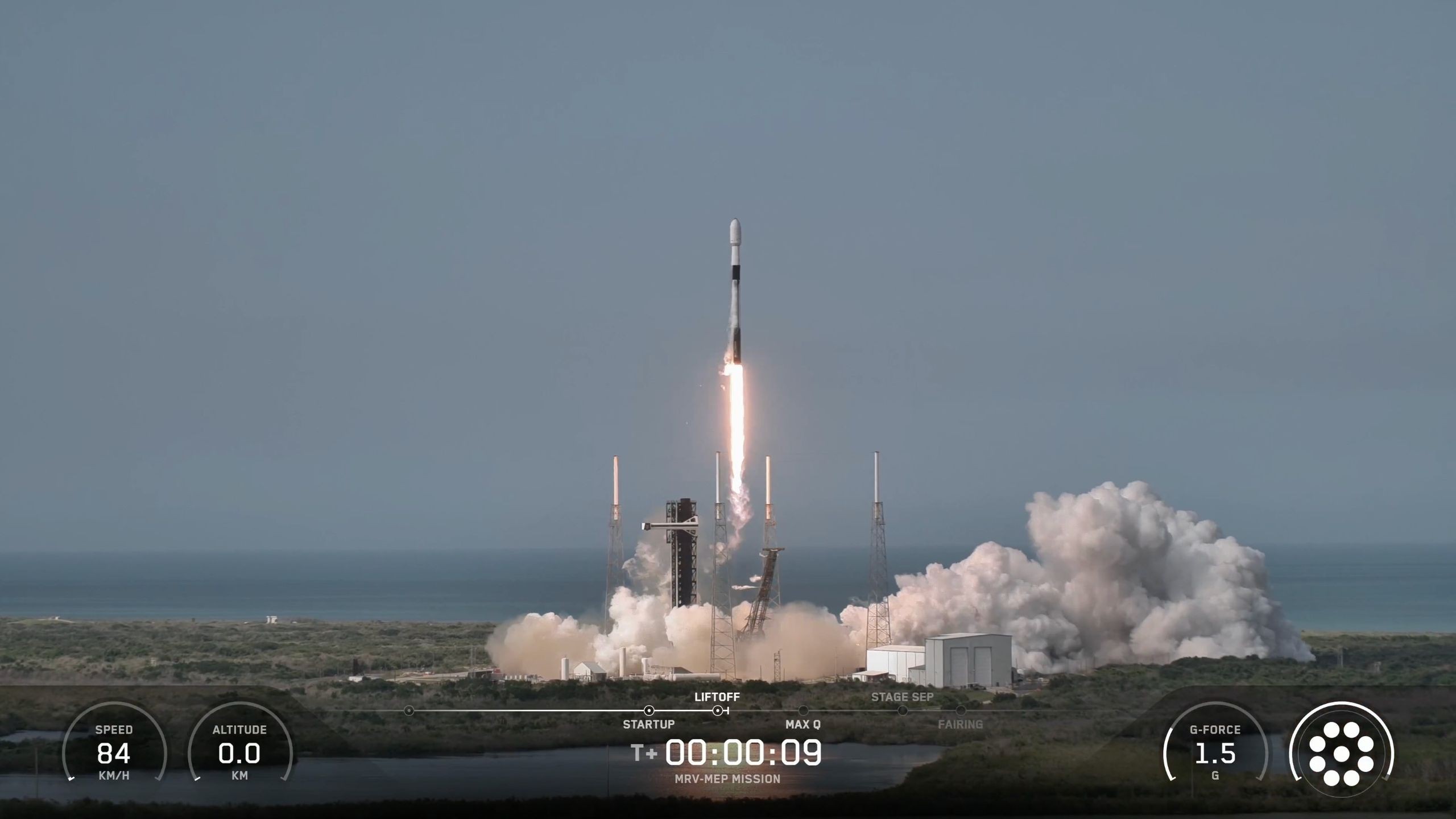
SpaceX lifted off again.
On July 21, a Falcon 9 rocket clawed its way out of Florida’s Cape Canaveral Space Force Station at 5:15 p.m. EDT. But this wasn’t just another launch. It was the debut of MRV-MEV. A trailblazing mission sending a satellite repair drone into Earth orbit.
The payload is heavy with potential. The launch vehicle carried a Mission Robotic Vehicle (MRV) and three Mission Extension Pods (MEPs. These spacecraft belong to Northrop Grumman’s space logistics subsidiary. They are headed to geostationary orbit. That is 22,236 miles up.
At that altitude, satellites “hover” over the same point on the ground. They match the Earth’s rotation. It makes GEO ideal for spy gear, comms, and weather monitoring. But these satellites are expensive. They run out of fuel.
The new mission changes that.
The MRV is equipped with two robotic arms. They are ten feet long. Built by the U.S. Naval Research Lab, these arms will do the dirty work. They will grab the MEPs. Then they will attach them to three separate client satellites.
Think of it as a space jetpack.
“Once installed, the MEP uses electric propulsion… capable of providing up to eight years of time extension.”
The MEPs act as external fuel tanks. They use electric propulsion to control orbit and unload momentum. Northrop Grumman says the MEP handles its own navigation via C- or Ku-band telemetry. The customer stays in charge. A typical 2,000kg satellite in GEO gets eight extra years of life.
Who is paying for the ride?
Optus, the Australian operator, booked one pod. Intelsat took the other two. That leaves the MRV alone in GEO after the third installation. It stays there. It waits for the next batch of jetpacks to arrive. It can relocate. It can inspect. It can repair. It can upgrade.
The MRV also features something new. The Passive Refueling Module (PRM. It is the first refueling interface standard approved by U.S. Space Force. This means the robot itself can be refueled in space. That adds another layer of longevity to an already complex system.
This isn’t Northrop Grumman’s first time in the servicing ring.
Mission Extension Vehicle-1 launched in October 2019. It docked with Intelsat 901 in 2020. MEV-2 followed, docking with Intelsat 10-2020 in 2021. But those were different beasts. They were single-craft missions. One ship, one satellite. Dock, service, done.
The MRV-MEV approach is modular. Separate parts launch together. The robot assembles the solution in orbit.
If today’s flight plan holds, the Falcon 9’s upper stage will deploy the MRV first. Thirty-five minutes after liftoff. The three MEPs will follow in ten-minute intervals.
Here is the kicker.
There was no booster landing today.
The extra delta-v required to push these payloads into geosynchronous transfer orbit burned too much fuel. The first-stage booster is now retired. This is its 32nd and final flight. It previously carried CRS-24, Eutelsant HOTBIRD 13F, one Web 1, SES-19, and Starlink missions. It has seen action. Now it sees the void.
SpaceX’s reuse record stands at 36 flights. Set earlier this month by a Starlink launch. The hardware is pushing limits. But performance dictates sacrifice. Sometimes the booster stays in space. Or falls into the ocean. It doesn’t always come home.
MEV-MEV was not the only Falcon 9 launch today. The company sent 24 Starlink satellites to orbit from California in the morning. Two rockets. Two different jobs.
The future of space maintenance is modular. It is remote. It is robotic. And it is launching.
We might wonder what happens when the arms break? Or when the MEPs run dry? The system is designed to evolve. To adapt. But out there in GEO, the stakes are high. One mistake and the jetpack stays attached. Permanently.


