


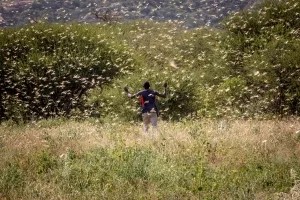
Locust swarms are not just an inconvenience. They are a biological disaster. Imagine hundreds of millions of individuals moving as one entity, stripping entire landscapes bare of vegetation in a matter of days. It is a spectacle of consumption that defies logic. Yet, there is a strange irony at the heart of this destruction.
These creatures are not naturally gregarious. In their quiet, low-density phases, locusts are solitary creatures. They prefer solitude. They avoid each other. The transformation into a swarm is not a choice. It is a hormonal reaction triggered by environmental pressure.
The Trigger for Transformation
The shift begins at the end of the rainy season. Conditions change rapidly. Resources become scarce. Population density spikes as eggs hatch in concentrated areas. This crowding is the catalyst. Physical contact between individuals stimulates a hormonal cascade. Neurotransmitters like serotonin surge through their systems.
This chemical shift alters their behavior fundamentally. The solitary instinct vanishes. Aggression increases. They seek out others. They move in unison. The individual disappears into the collective.
Why It Matters
Understanding this mechanism is crucial for agriculture and food security. Locust swarms threaten crops across Africa, the Middle East, and Asia. Knowing that the swarm phase is reversible offers hope. Scientists are studying these hormonal pathways to develop targeted interventions. Instead of spraying broad-spectrum pesticides, future solutions might focus on disrupting the specific signals that trigger the swarm.
The paradox remains stark. The same insect that once hid in the grass can now blot out the sun. The line between a pest and a plague is drawn by biology, not malice.
The transformation from solitary insect to swarming entity is driven by hormonal changes triggered by population density.
This duality defines the locust. It is a reminder that nature’s balance is fragile. One environmental shift can turn a harmless neighbor into a devouring storm. The science behind this change is still unfolding. But the impact is immediate and visible. The question is no longer just how these swarms form, but how we can outmaneuver them before they reach critical mass.
Australia burned. East Africa is choking on dust. And in China, a new outbreak is spreading. It feels apocalyptic. But if the locusts falling on Africa terrify you, remember: this isn’t new. Humans have lived under the shadow of these swarms for millennia.
The sheer scale of the East African crisis
The Bible made them famous. But today, they cycle back every few years, dominating headlines. Since early 2020, East Africa has been crushed by the voracious appetite of desert locusts. It is the worst infestation in 70 years. Kenya, Ethiopia, and Somalia are on the front lines.
For these nations, it is a total disaster. A single small swarm can eat enough food in one day to feed 2,500 people. They do not pick and choose. They devour everything. Millet. Rice. Grain. Sugar cane.
Each locust eats its own body weight daily. That sounds small. About two grams per insect. But the math changes when you multiply that by hundreds of millions of individuals. The swarms stretch for hundreds of square kilometers. In Kenya, observers saw clouds larger than the entire state of Saarland.
Locusts are not just pests. They are a moving, eating mass that erases livelihoods overnight.
This is not merely an agricultural issue. It is a hunger crisis. When crops vanish, prices spike. When prices spike, people starve. The biology is simple. The consequence is complex. And it is unfolding right now.
Why do these swarms grow so large? The answer lies in weather patterns. Rain. Warmth. Wind. These factors create perfect breeding grounds. The locusts multiply exponentially. Then they move. And when they move, they eat.
We often treat these events as isolated disasters. But they are part of a longer history. A history of human struggle against nature’s most relentless consumers. The tools we use today are better than those of ancient farmers. But the threat remains. Real. Immediate. And growing.
How Locust Swarms Survive the Ocean Crossing
When a region is stripped bare, the collective moves on. Hunger drives them toward new grazing grounds. This migration is not just local. Historical records show swarms crossing the Atlantic Ocean. They traveled from North Africa to the Caribbean. The journey was brutal.
They didn’t just fly over the water. They stopped.
Some landed on passing ships. Others touched down directly on the surface. The water claimed the first layers of the swarm. Many drowned. Their bodies did not sink away. Instead, they floated. They formed a living raft. A floating mat of dead insects.
This mass of carcasses served a purpose. It became a platform. The next wave of locusts could rest on it. They could wait out the crossing. They did not have to exhaust themselves swimming. The dead made survival possible for the living.
Why does this matter? It explains the persistence of pest outbreaks. It shows how biological machinery adapts to extreme geography. A swarm is not a single animal. It is a machine that consumes resources and discards the rest. But even in death, the material has value.
This phenomenon highlights the sheer scale of locust behavior. We usually think of them as land pests. We forget they are capable of oceanic transit. This changes how we view their spread. They are not contained by borders. They are not contained by water.
The dead locusts formed a floating carpet, allowing the living to rest and continue their journey.
This detail often gets missed in general reports. People focus on the destruction of crops. They ignore the mechanics of movement. Yet the survival strategy is key. Without those temporary rafts, the crossing might have failed. The loss rate would have been higher. The population would have thinned.
Instead, the swarm persisted. It reached new continents. It found new food. The cycle continued.
Does this sound like science fiction? It is documented. It is part of the natural history of the desert locust. Understanding this helps in predicting their paths. It informs quarantine zones. It explains why certain islands are vulnerable.
The ocean is not a barrier. It is a obstacle to be navigated. Sometimes by flying. Sometimes by floating. The locusts use whatever means are available. Even if that means using their own bodies as bridges.
The serotonin trap: Why lonely grasshoppers turn into swarming monsters
It sounds like a biological glitch. Grasshoppers are supposed to be introverts. They prefer the solitude of a single blade of grass, not the chaos of a crowd. But put them in the right conditions—abundant food, sudden rain—and the rules change. They gather. They multiply. And then, something snaps.
When the population explodes, density becomes the trigger. These insects are forced into close quarters, and their physiology flips. The color shifts from protective green to a warning brown-yellow. The mood shifts from passive to restless. Eventually, they form massive swarms, traveling up to 150 kilometers a day, stripping the land bare as they go.
The culprit? Serotonin.
That’s right. The same “happy hormone” linked to human mood regulation is the chemical switch for locust devastation. When these grasshoppers smell their neighbors and feel their legs bumping against theirs, their brains flood with serotonin. This chemical surge doesn’t just make them feel good. It rewires their behavior. It turns solitary creatures into social tolerators, capable of living in dense, frenetic groups without fighting each other.
They become socially adapted locusts.
Yet, for all the talk of serotonin, the exact mechanics remain a mystery. We know the hormone drives the change. We know the smell and touch trigger the release. But the precise neural pathways? The exact moment the solitary brain decides to join the swarm? That part is still largely unknown.
We have the headline. The subtext is missing.
Why does a chemical that promotes well-being in humans drive destruction in insects? Is it a fluke of evolution? Or does the “happiness” of the collective require the starvation of the individual?
We have the key ingredient. But the recipe is still incomplete.
Why desert locusts thrive as the climate shifts
For farmers in East Africa, the nightmare is likely to repeat. Locusts are emerging as unexpected winners in a warming world. They lay their eggs in moist soil to prevent drying out. This biological need ties them directly to weather patterns. Populations explode after the rainy season ends or when tropical cyclones bring heavy, lingering rain.
The changing climate alters these weather events. Warmer waters in the Indian Ocean drive more frequent storms in the region. Rainy seasons are becoming longer and more intense. These conditions create an ideal breeding ground for rapid multiplication. The fear of future swarms is not just anxiety—it’s a logical response to shifting ecosystems.
The connection between ocean warmth and plagues
The heat radiating from the Indian Ocean does more than raise temperatures. It fuels stronger and more persistent storm systems. When these systems hit East Africa, they saturate the ground. For desert locusts, wet soil is safety. It keeps eggs viable during incubation.
Longer, heavier rains mean more breeding cycles. This accelerates population growth. Swarms become larger and more destructive. Farmers are left dealing with a pest that seems to grow stronger with every storm.
Preparing for a new normal
The question is no longer if another plague will strike. It is when. The link between a warming ocean and locust breeding grounds is clear. As storms become more common, locusts will continue to thrive.
This shift demands a new approach to agriculture and disaster response. Ignoring the connection between climate patterns and insect behavior leaves communities vulnerable. The locusts are adapting. The question remains whether human systems can keep up.
Why conventional pest control fails against locust swarms
Traditional methods simply do not stack up against the sheer biomass of a desert locust invasion. Fire? Useless. Traps? Ineffective. The scale is just too massive for manual containment to make a dent.
You might wonder if we could just eat our way out of the problem. Locusts are protein-rich, after all. Theoretically, harvesting them as a food source makes sense. In practice, it fails. You cannot catch and process insects fast enough to offset the destruction they cause in the fields. The math doesn’t work when the swarm moves faster than the supply chain.
Biological and chemical interventions
There are niche biological solutions, but they come with significant caveats. Certain fungi can infect locusts, boring through their chitinous exoskeletons to kill them. This is a natural predator, essentially. But it’s slow. It takes up to two weeks to eliminate 90% of the population. By then, the damage is usually done. This method only works if deployed in the very early stages of an outbreak, before the swarm consolidates.
Researchers once explored a more elegant solution: reversing the swarm mentality. Locusts switch between solitary and gregarious phases. A compound called phenylacetonitrile was found to regulate serotonin levels, effectively turning aggressive swarmer locusts back into harmless, solitary individuals in lab tests. The idea was seductive. Restore the peace with chemistry. But the reality is harsh. This substance is toxic to the environment. It’s not a viable option for open-field agriculture in vulnerable regions.
The pesticide trap
This leaves farmers in East Africa with one grim choice: conventional insecticides.
It’s a blunt instrument. These chemicals kill locusts, yes. But they also wipe out other organisms. Crucially, they eliminate potential natural predators of the desert locust. You’re not just solving an immediate problem; you’re degrading the ecosystem’s natural immune system. The cycle becomes harder to break next time.
We are fighting a biological force of nature with tools that often do more harm than good.
The result is a fragile balance. Farmers are forced to use broad-spectrum poisons because there are no fast-acting, environmentally safe alternatives ready for mass deployment. The locusts keep coming. The chemicals keep falling. And the soil keeps losing its biodiversity.
What happens when the predators are gone? The next swarm might be even harder to control.


