The 2026 FIFA World Cup presents a logistical and scientific challenge unlike any tournament in recent history. For the first time, the games will not be played in stadiums built specifically for the event, but rather in 16 existing venues scattered across the United States, Mexico, and Canada. This geographic dispersion creates a massive variable: climatic diversity.
While fans and players will focus on the match results, a team of turf scientists from the University of Tennessee (UT) and Michigan State University (MSU) has been working with FIFA for years to solve a critical problem. Their goal is to ensure that natural grass pitches—ranging from indoor arenas to outdoor stadiums—provide consistent performance across a continent. The insights gained from this effort are likely to reshape how athletic fields are maintained worldwide, offering solutions for everything from professional soccer to community parks.
The Challenge of Consistency
Soccer places unique demands on turf that differ significantly from other major sports. In baseball, much of the action occurs on dirt base lines, while football requires a firm surface for traction but does not rely on ball roll. Soccer, however, depends entirely on the ball’s interaction with the ground.
Consistency is paramount. The ball must roll and bounce identically whether it is kicked in Toronto or Atlanta—a span of over 3,100 miles (5,000 km). By comparison, the stadiums in the 2022 Qatar World Cup were within a 48-mile radius, making climatic variations negligible.
John Rogers, a turf scientist at MSU, compares soccer fields to golf putting greens. The grass must be dense, uniform, and free of gaps. If the turf is too soft, the ball loses bounce; if it is too long, it slows down. Elite players rely on predictable physics; if the field behaves unexpectedly, it not only affects performance but also increases the risk of injury. Players need to trust that the ground will support sudden stops, cuts, and turns without giving way.
Testing the Terrain: The fLEX System
To guarantee uniformity, researchers cannot rely on visual inspection alone. John Sorochan, head of the turfgrass program at UT-Knoxville, developed a testing machine called fLEX (Foot-Leg Exoskeleton) in 2018. Inspired by a safety incident where an NFL game was moved due to unsafe field conditions, Sorochan needed a tool that could simulate the physical impact of a player’s foot.
The fLEX device features a 3D-printed faux ankle and foot equipped with cleats and sensors. It strikes the ground like a 168-pound (76.2-kg) player, measuring:
* Energy transfer: How much force is returned to the player.
* Traction: How well the cleats grip the turf during sudden movements.
“We need something that hits the ground like a foot does,” Sorochan explains.
At the World Cup, fLEX will test 77 specific locations on each field to map soil firmness. Groundskeepers use these heat maps to identify compacted areas that may not show visible wear but pose injury risks. If the soil is too hard, they can adjust maintenance or recommend different cleat types to ensure player safety.
For ball bounce, researchers use audio analysis. By recording the sound of a ball dropped from a fixed height, software calculates the time between impacts to determine bounce height, ensuring the playing surface meets FIFA’s strict standards.
Instant Fields: The Plastic Revolution
One of the biggest hurdles for the 2026 tournament is the timeline. Some stadiums, such as the one in Houston, Texas, hosted other events (like a rodeo) just weeks before the World Cup began. There was no time to grow grass from seed.
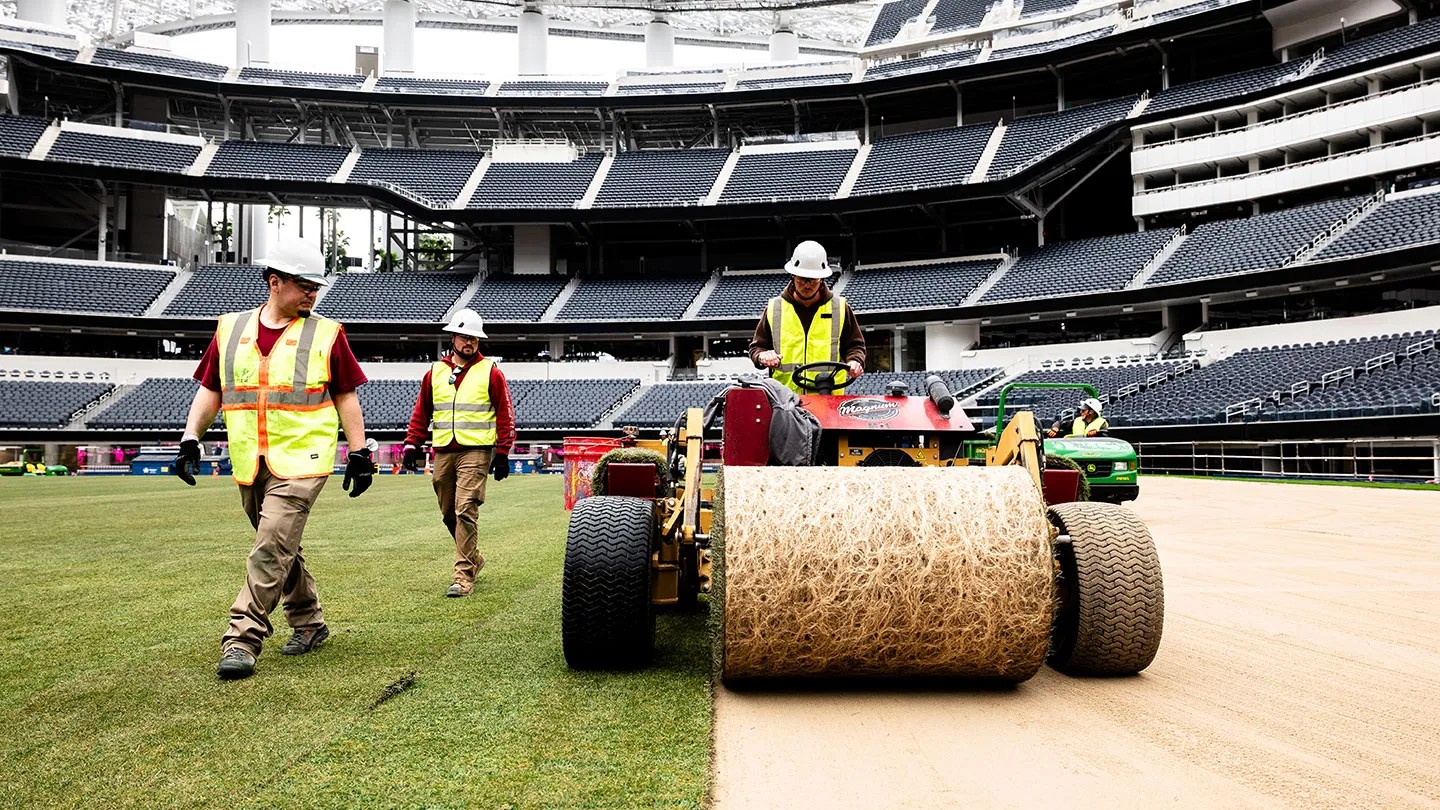
The solution lies in sod farming and a innovative use of plastic. Traditionally, sod is grown on soil, then sliced and transported. This process severs the roots, shocking the plant and requiring weeks of recovery to re-anchor. However, for the 2026 World Cup, sod growers have adopted a new method:
- Plastic Base: Grass seeds are sown on soil laid over a plastic sheet.
- Lateral Growth: When roots hit the plastic, they grow sideways and intertwine, creating an incredibly strong mat.
- Shock-Free Installation: The sod is peeled off the plastic like pizza from a plate, leaving roots intact.
This “instant field” technology allows grass to be installed days before the games and immediately anchor itself. The resulting sod rolls are massive—weighing up to 1,600 kg (3,500 lbs) each—and are often reinforced with synthetic fibers to withstand heavy play.
Beneath the sod, a vacuum-ventilation system manages moisture. It can blow oxygen to roots or reverse flow to suction away excess water during heavy rain, preventing standing water and ensuring the pitch remains playable.
Maintaining the Green: Light and Robotics
Installing perfect turf is only half the battle; maintaining it for 40 days of intense play is the other. Grounds crews must groom the fields daily to remove dead plant matter that can make the surface slimy and inconsistent.
Indoor stadiums face a unique challenge: lack of sunlight. To compensate, they use specialized LED lighting banks. These lights emit a specific spectrum—90-95% red and 5-10% blue. While blue light promotes sturdy, short growth, it is energy-intensive. Red light encourages elongated growth but is more efficient. The mix is carefully calibrated to keep the grass healthy and resilient underfoot.
For outdoor fields, robotic mowers are emerging as a key innovation. Unlike traditional heavy mowers that compact the soil, lightweight robots trim grass frequently without damaging the ground structure. This technology, initially adopted by universities and community parks, offers a sustainable way to maintain dense, healthy turf with less labor and lower costs.
Why This Matters Beyond the World Cup
The advancements driven by the 2026 World Cup have implications far beyond professional soccer. As communities debate the switch to artificial turf due to maintenance costs, the scientific community argues that natural grass remains superior for player safety and environmental health. Artificial turf can cause more impact injuries, retains dangerous heat, and sheds microplastics.
By refining techniques for sod installation, soil management, and robotic maintenance, researchers are making natural grass more accessible and durable. The goal is to ensure that whether you are watching a World Cup final or playing a local league game, the field supports your performance safely and consistently.
“If all goes well,” says Cornell turf scientist Frank Rossi, “the fields are never part of the story.”
The ultimate success of this scientific effort will be invisible: green, uniform pitches that allow the athletes to shine, keeping the focus exactly where it belongs—on the game.