


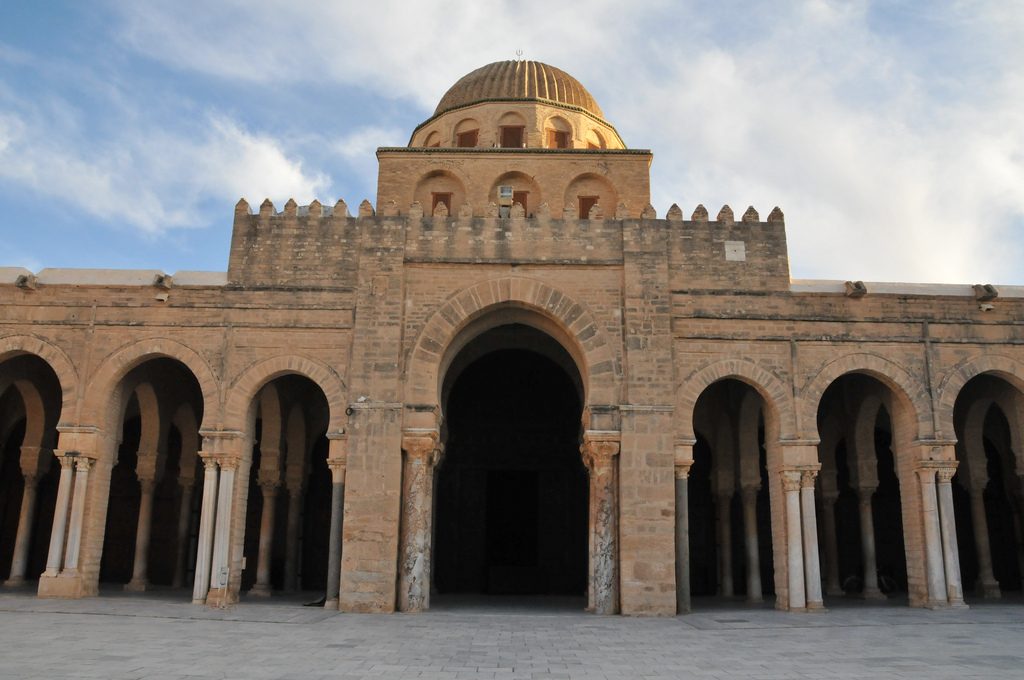
This happened in 670 AD. That’s the official date. More precisely, it corresponds to the 50th year of the Islamic calendar. Who built it? Okba ibn Nafi, the Arab conqueror. He didn’t just create a place for prayer. He built the city of Kairouan around it.
But the mosque you see today isn’t the one from 670. Not really.
The current building was rebuilt in 836 by Prince Ziyadat Allah I, who demolished the original building. He started fresh. Even then, it wasn’t finished. The dome was an afterthought. It was added by the then imam in 1316.
Despite all these layers of buildings, this place still retains its unique status. It is considered one of the three “gates to Paradise” in Islam. The others are Mecca and Al-Aqsa in Palestine. That’s a tough title for a brick and mortar building. But it stands in Tunisia.
Why the Great Mosque of Kairouan is important today
You may wonder why 7th century architecture is still relevant today. It’s not just about age. It’s about influence. This mosque set the template of Islamic architecture in North Africa.
Its layout is huge. The rectangular enclosure is 125 meters long and 75 meters wide. It looks more like a fortress than a traditional mosque. Stone cut from the earth. Thick walls. Eight doors. Towers. Bastions. It feels defensive. Maybe that’s how it should be.
Inside, the details tell a different story.
The prayer hall has ancient columns. There are also some relics from earlier civilizations. Then there’s the minbar. It is the oldest in the Muslim world. You can’t just go in and touch it. But you can look. This is history carved in wood.
The doors is made of Lebanese cedar wood. The worship space itself is decorated in the old faience tiles. light and color. The floor of the courtyard is covered with marble.
How to understand mosque design
Standing in the courtyard and looked up. There is a three-story minaret. It rises from a center of the marble expanse. It’s not just about calling people to prayer. This is a visual anchor.
There is a large sundial nearby. Why is the sundial placed in the courtyard of the mosque? To tell the time for prayer. This was necessary before the advent of digital clocks. The sun doesn’t care about your schedule. It rose. It set. Mosques must adapt.
Architecture has a role to play. It also serves as a reminder.
Okba ibn Nafi gave the soul to this mosque. Ziyadat Allah I gave it its body. In 1316, the imam added a roof.
Is it still “gate to Paradise”? This is a matter of faith. But as part of human endeavor? This cannot be denied. It survived empires. It has stood the test of time.
The dome is still standing. Cedar still holds its shape. The sundial still captures the light.
What happens when the next layer of history arrives? We don’t know. But the stones remain.


