Giza hasn’t collapsed.
Not once.
Not in 4,500 years.
Which is strange, really. Because Egypt sits right on top of seismic faults. Earthquakes happen there. Big ones. The kind that flatten modern buildings and twist steel girders like pretzels. So how do these ancient stone monuments still stand?
It turns out the secret isn’t magic. Or divine protection. It’s geology. Specifically, the bedrock.
For centuries, archaeologists and historians focused on the stones themselves. The limestone. The granite. The massive blocks quarried from distant locations and dragged across the desert. They looked at the engineering of the pyramid. They studied the slope of the sides. But they missed what was underneath.
Everything is about the foundation.
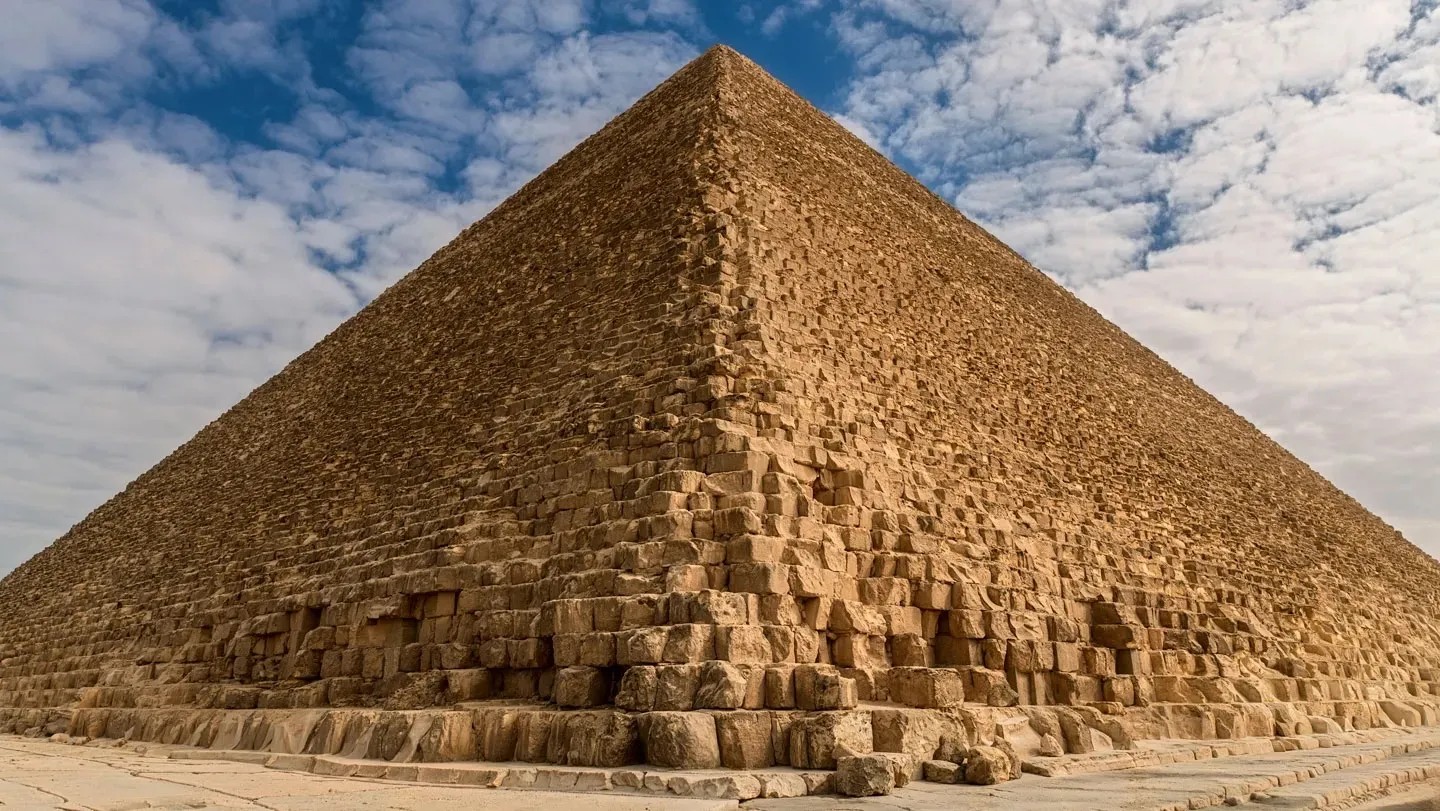
Civil engineers know this. You don’t build a skyscraper on sand. You go down. Past the soft dirt. Past the rubble. Until you hit hard rock. The Great Pyramid sits directly on the surface of the Nubian sandstone bedrock. No intermediate soil. No loose fill. Just rock touching rock.
Recent geophysics studies have started to map the area beneath Giza with much higher resolution than before. Previous models were rough guesses. These new models show distinct channels. Harder channels running beneath the softer sand.
The Pyramids align with the hard channels.
Coincidence? Maybe. But if you align your heaviest structures with the strongest parts of the ground, you reduce the stress placed on the structure during an earthquake. When the earth shakes, it doesn’t shake uniformly. The harder ground moves less than the soft ground. By sitting on the stiff sandstone, the pyramid avoids the amplified shaking that happens in softer sediment.
It’s a factor many experts missed. We assumed the design was purely aesthetic or religious. The angle of the slope. The alignment with the stars. Sure. That matters too. But stability matters more. If it falls over, the symbolism is buried in rubble.
The physics involved here are brutal. Earthquake magnitude scales exponentially. A small increase in number means a massive increase in energy. A magnitude 6 quake releases about 32 times less energy than a magnitude 8. But both are plenty strong enough to kill you if you’re inside a poorly designed house. The Great Pyramid has weathered the equivalent of dozens of these events.
Why?
Resonance is the killer. If a building vibrates at the same frequency as the ground shaking, it amplifies the movement. Like pushing a child on a swing at just the right moment. Push too often, at the right rhythm, and the swing goes dangerously high. Buildings can do the same thing with tremors.
The Pyramid avoids this. Its mass is so large and dense, its natural frequency is very low. Earthquakes typically generate higher frequency vibrations. They miss each other. The energy passes through. The stone stays put. It’s not rigid in a way that resists; it’s stable in a way that ignores the chaos.
This insight changes how we look at other ancient sites. The Roman Colosseum. The ziggurats of Mesopotamia. They all sit on specific geology. Did they choose the spot for spiritual reasons? Possibly. But maybe the builders noticed the ground. Maybe they saw which fields flooded and which didn’t. Maybe they felt the vibrations in the bedrock while walking barefoot.
Subtle cues. Easy to ignore until things fall apart.
The risk to these monuments today comes from a different source. Tourism. Vandalism. Erosion. The earth hasn’t shaken them off. We might.
There is a limit to how much we can retro-fit ancient engineering. You can’t pour concrete under the Great Pyramid. You can’t install dampers inside the King’s Chamber without violating centuries of silence and sanctity.
So we watch.
We measure the tiny shifts. The millimeter-level cracks.
The bedrock holds.
For now.
The best engineering often looks like it belongs to the earth, rather than imposed upon it.
Will the next big quake prove us wrong? Or will the Pyramids stand there again? Mocking us? Waiting for the next century?
Hard to say. The sand moves. The rocks crack. But for four thousand years, they haven’t given way. Not yet.
What do we build now that will still be standing when we’re gone? Probably not much.
Just sayin’.