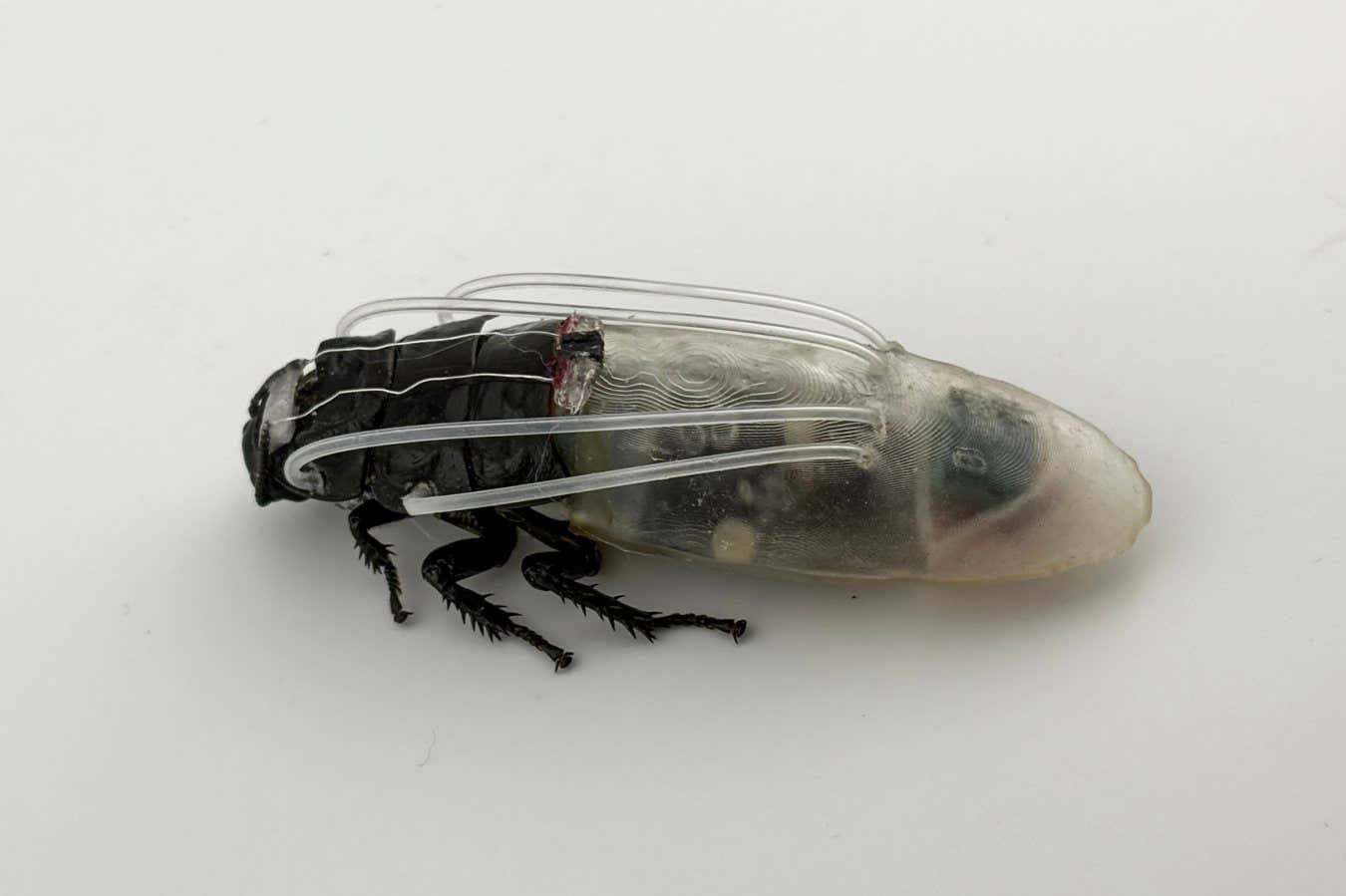
They breathe. Under water. Thanks to a tiny custom-built diving suit.
This isn’t just about pest control gone weird. It is a step toward cyborg swarms that could explore Mars. Or flood zones. Both environments lack things most lifeforms need to survive.
Hirotaka Sato runs the team at Nanyang Technological University. Singapore is their home base. They first proved you can pilot Madagascar hissing cockroaches back in 2021. Electrical implants went into sensory organs called cerci. Then they hit 20 insects. Coordination worked. The swarm moved as one.
Engineers hate building tiny robots. It is hard to replicate nature at that scale. Reflexes are messy. Obstacle dodging requires intuition. Batteries run out fast. Cockroaches? They have all that built-in. Efficient locomotion. Real fuel. Built for disaster response.
But disasters often involve water. Flooding happens. Sato didn’t like that limit. So his team fixed it.
Cockroaches breathe through holes called spiracles on their back and chest. Water gets in the hole, the roach drowns. Simple physics. The team printed a watertight resin shell. It covers the abdominal spiracles. Hoses run forward. They connect to the thoracic spiracles directly. If they covered the whole upper body, legs would get stuck. Mechanics matter.
No oxygen tanks here. Too heavy. Too bulky.
Instead? Hydrogen peroxide mixed with manganese dioxide. Chemical reaction occurs. Hydrogen breaks down. Oxygen bubbles out. The insect breathes. It works for three hours. Depth goes to fifty centimeters.
Five test subjects. All healthy. Three days later. Still walking. No side effects.
Speed? On land, they hit 87.5 mm per second. Underwater, that dropped to 78.4. A slow but negligible loss. They moved naturally. Surprisingly so.
Sato thinks big now. Space is the target. Vacuum conditions. Radiation. Extreme cold and heat. He wants to test the suits against those forces.
“It’s kind of one step… towards space suits for cyborg insects.”
Why go to the trouble?
Because robots need power. Lots of it. Alan Winfield at the University of West England says energy is always the problem. Energy and energy again. Tiny batteries die fast. A cockroach eats. It forages. It operates indefinitely without a charger.
But there is a snag. Space agencies might panic. Sending Earth bugs to Mars risks contamination. Microbes hitch a ride. Planetary protection rules might block it.
Does that mean we stick to Earth applications?
Probably for now. Environmental monitoring needs eyes that can go underwater. Long-lasting. Self-powered. Efficient. The tech is ready. The biology is ready.
We just need to decide where we send them first.