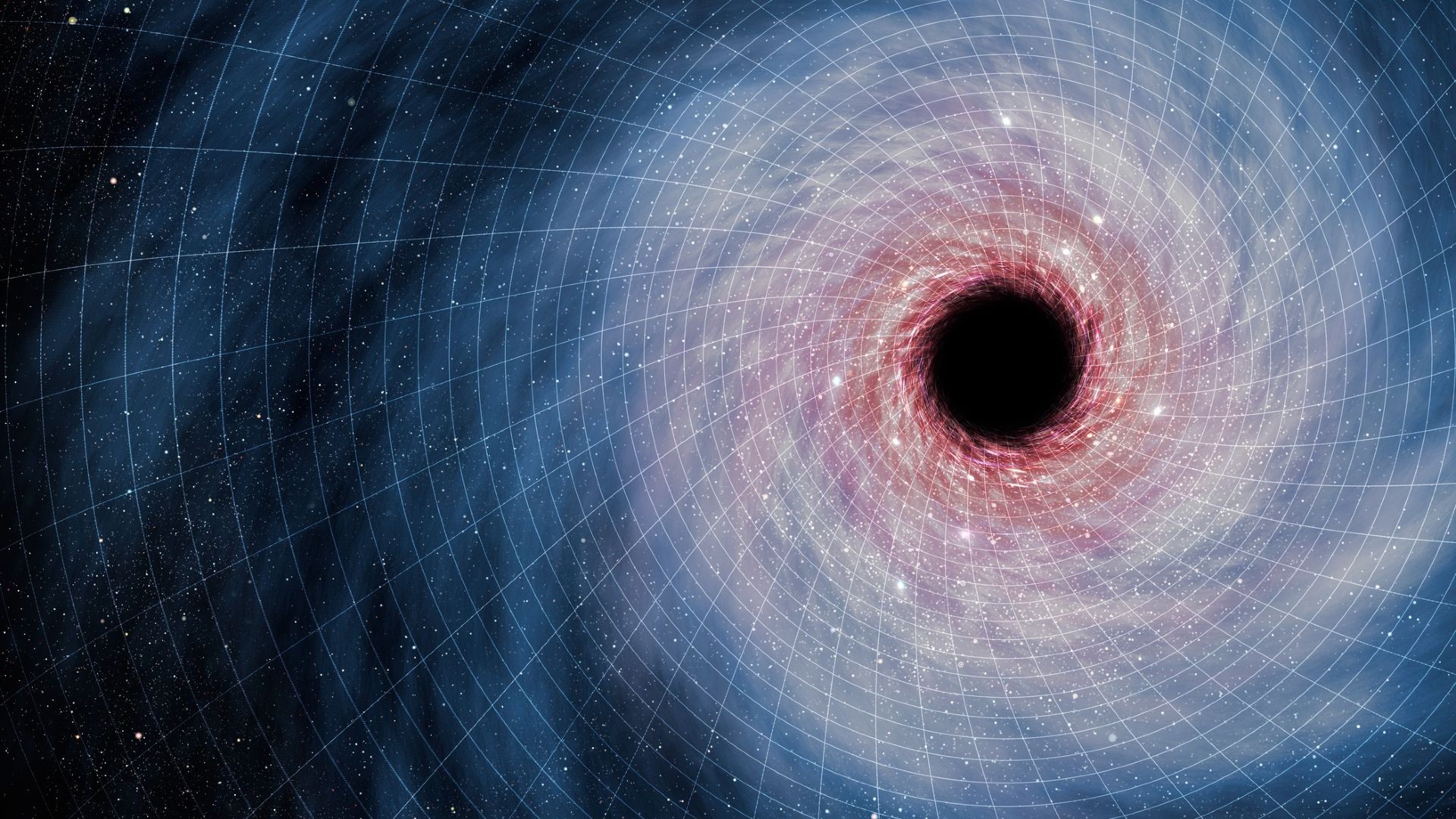
For decades, one of the most profound contradictions in physics has sat at the heart of our understanding of the cosmos: the black hole information loss paradox. A new theoretical study suggests that the solution to this puzzle may not be found in the black holes themselves, but in the very fabric of space-time—specifically, in three hidden dimensions that we cannot see.
The Paradox: Where Does Information Go?
To understand the significance of this new research, one must first understand the problem it seeks to solve. In the 1970s, Stephen Hawking proposed that black holes are not eternal traps; they emit radiation and slowly evaporate over time.
This created a crisis for quantum mechanics. A fundamental law of physics dictates that information can never be destroyed. If you burn a book, the information contained in its pages is scrambled into smoke and ash, but theoretically, it still exists in the universe. However, if a black hole evaporates completely and disappears, the information about everything it ever consumed appears to vanish from existence entirely. This violation of physical laws is the “information paradox.”
A Seven-Dimensional Solution
The new study, published in General Relativity and Gravitation, proposes a radical way out: black holes do not evaporate completely. Instead, they leave behind tiny, stable remnants that act as cosmic “hard drives,” preserving the information they once swallowed.
For this mechanism to work, the researchers argue that the universe must possess seven dimensions rather than the four we experience (three of space and one of time).
The Role of Hidden Dimensions
The model suggests that three extra dimensions are “compactified”—curled up so tightly that they are invisible to our current instruments. These dimensions are organized in a complex geometric structure known as G₂ geometry.
As these hidden dimensions twist and fold, they create a physical phenomenon called torsion. This torsion acts as a specialized force within space-time:
– As a black hole shrinks through Hawking radiation, the torsion field creates a repulsive force.
– This force acts like a “brake,” halting the evaporation process before the black hole can vanish.
– The result is a stable, microscopic remnant with a mass roughly 10 billion times smaller than an electron.
Connecting Black Holes to the Fabric of Matter
One of the most striking aspects of this theory is how it bridges the gap between the massive scale of black holes and the tiny scale of particle physics.
The study finds that the same torsion field responsible for stabilizing black holes also helps explain the Higgs mechanism. This is the process that gives mass to elementary particles like electrons and quarks. By linking the behavior of black holes to the electroweak scale, the researchers have found a mathematical thread that ties gravity, space-time geometry, and the fundamental building blocks of matter together.
Challenges and the Path Forward
While the theory is mathematically elegant, it faces significant hurdles:
- The Quantum Gravity Gap: As black holes shrink toward the “Planck scale” (the smallest possible scale of physics), our current mathematical models begin to break down. This theory provides a mechanism for stabilization, but it does not replace the need for a complete theory of quantum gravity.
- The Difficulty of Testing: The energy levels required to prove the existence of these extra dimensions are far beyond the capabilities of current particle accelerators.
“The important point is that the predictions are concrete — the model can be wrong, which is what makes it scientific,” says study co-author Richard Pinčák.
How could we prove it?
Scientists have identified potential ways to validate the model:
– Kaluza-Klein particles: The theory predicts the existence of massive particles associated with these extra dimensions. If we find much lighter versions of these particles, the theory is disproven.
– Cosmic Observations: Future gamma-ray telescopes or gravitational wave detectors might detect the “fingerprints” of these stable remnants, particularly if they originated from primordial black holes formed in the early universe.
Conclusion
If proven correct, this theory would resolve a fifty-year-old conflict between general relativity and quantum mechanics by revealing that the universe is far more complex—and much more interconnected—than our four-dimensional perception allows.