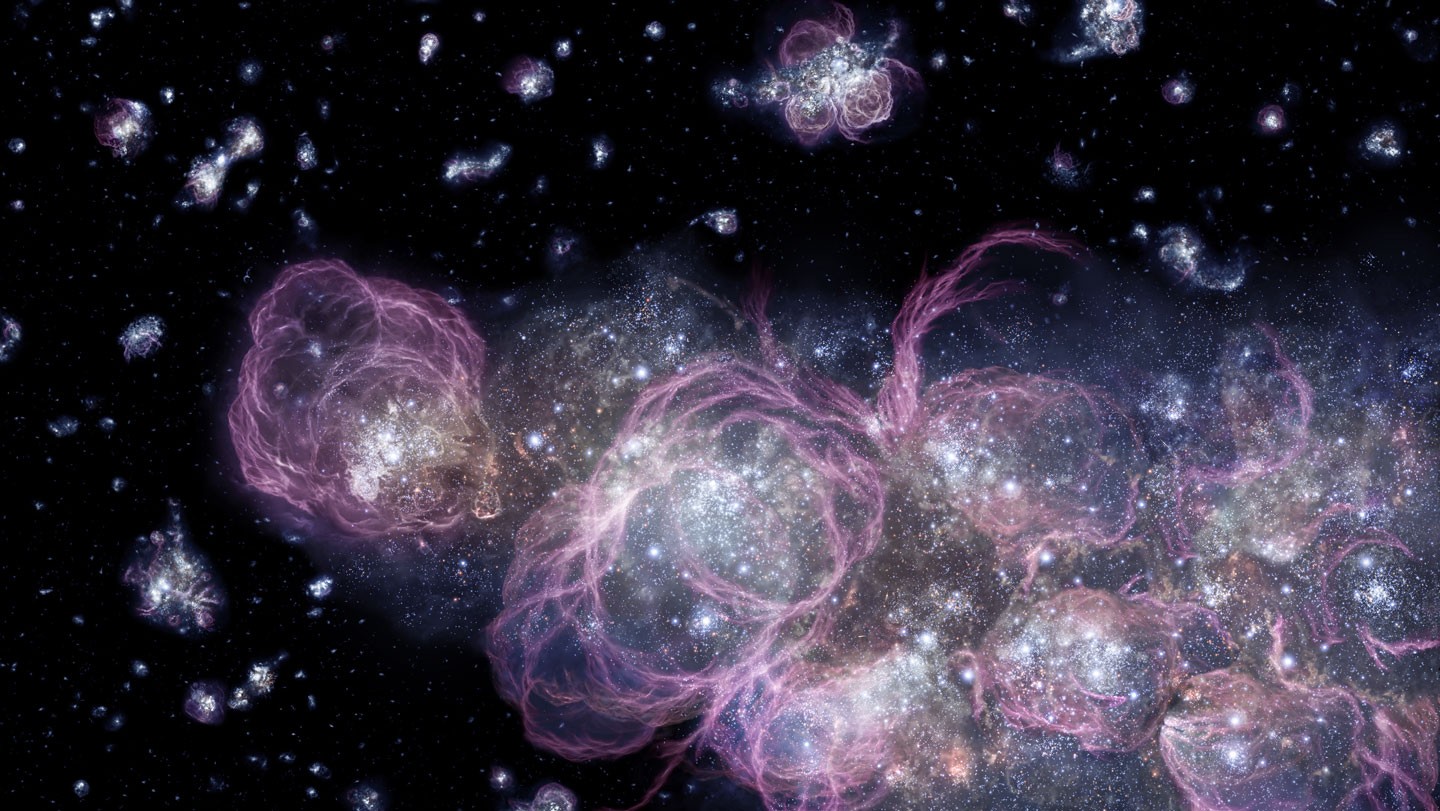
Astronomers may have finally located a “smoking gun” for the universe’s earliest stars. A distant, luminous clump of gas, observed just 450 million years after the Big Bang, shows the distinct chemical signatures of the very first generation of stars ever formed.
The Mystery of Population III Stars
To understand the significance of this discovery, one must look at the cosmic timeline. Astronomers categorize stars into “populations” based on their chemical composition:
- Population I & II: The stars we see today, which contain “metals”—elements heavier than helium (like carbon, oxygen, and iron) created by previous generations of dying stars.
- Population III: The theoretical first generation of stars. These were born from the pristine material left over from the Big Bang: hydrogen, helium, and trace amounts of lithium.
Because they lacked the heavy elements that help cool gas clouds during formation, Population III stars are believed to have been colossal—potentially up to 1,000 times the mass of our Sun —and incredibly bright. While scientists have long theorized they formed roughly 13.5 billion years ago, most evidence found so far dates back to much later in cosmic history, around 1 billion years after the Big Bang. This new discovery pushes that timeline significantly further back.
Meet “Hebe”: The Chemical Signature of Youth
The object, dubbed Hebe (a nod to the Greek goddess of youth), was first detected in 2024. However, it was high-resolution observations from the James Webb Space Telescope (JWST) in 2025 that provided the definitive data needed to analyze its makeup.
The research, detailed in a series of papers on arXiv.org, highlights two critical findings:
1. Lack of Heavy Elements: The clump shows no signs of elements heavier than helium.
2. High-Energy Radiation: The gas emits specific light patterns from highly energized hydrogen and helium. This suggests the presence of an intense, high-energy radiation source—exactly what one would expect from massive, short-lived Population III stars.
“It’s a textbook case for the first generation of stars,” says Roberto Maiolino of the University of Cambridge, a coauthor of the study. “There’s no other really satisfactory explanations for other kinds of sources.”
A Cosmological Puzzle: The Proximity Problem
The discovery introduces a new complication for existing astronomical models. Hebe is located near GN-z11, a massive galaxy containing the mass of 1 billion suns.
Under current simulations, Population III stars should not exist near such large galaxies. Large galaxies are “chemically evolved,” meaning they have already undergone enough star birth and death to “pollute” their surroundings with heavy elements. Finding a pristine, metal-free clump like Hebe so close to a massive galaxy raises fundamental questions:
- How do these pristine systems survive in environments that should be chemically contaminated?
- Could gravity play a role? Some theorists suggest the massive gravity of galaxies like GN-z11 might pull in pockets of untouched, pristine gas from the surrounding cosmic web, providing the raw materials for these ancient stars to ignite.
Looking Forward
Hebe is estimated to be roughly 1,200 light-years across, consisting of two distinct clusters with a combined mass equivalent to anywhere between 10,000 and several hundred thousand suns. Given the massive scale of Population III stars, the cluster might contain only a few hundred individual stars.
This discovery provides a new roadmap for astronomers. By studying Hebe, researchers hope to unlock the secrets of how the very first light sources in the universe were born and how they shaped the cosmos we inhabit today.
Conclusion: The detection of Hebe offers a rare, early glimpse into the era of Population III stars, challenging our understanding of how the first stars formed and survived in the presence of massive, chemically evolved galaxies.