


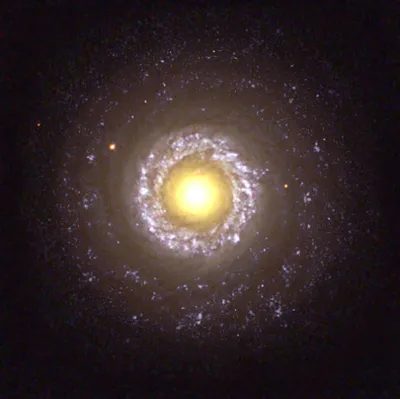
Seyfert galaxies look like unremarkable spirals in a standard optical photograph. Then you point an infrared telescope at them. The energy output is staggering. These active galactic nuclei (AGN) were named after Carl K. Seyfert, an American astronomer who highlighted their distinct characteristics in 1944. He noticed that while the outer disks resembled normal galaxies, the centers were acting up significantly.
What Distinguishes Type 1 From Type 2 Seyfert Galaxies
Astronomers split these objects into two categories based on their nuclear spectra. Type 1 Seyfert galaxies display broad emission lines. This broadness indicates a central concentration of hot gas expanding at tremendous speeds, reaching thousands of kilometres per second. The gas is moving fast enough to blur the spectral lines.
Type 2 Seyferts tell a different story. Their emission lines are strong, but they indicate more modest velocities, generally less than 1,000 km/sec. The difference in speed hints at the geometry or orientation of the gas surrounding the core. Regardless of the type, these galaxies are incredibly strong sources of infrared radiation. Many also pump out powerful amounts of radio energy and X-rays.
How Do Seyfert Nuclei Compare to Quasars?
Seyfert nuclei are closely related to quasars. Both are thought to be powered by massive black holes at their centers. The key difference is scale. Quasars are among the brightest objects in the universe, releasing energy on a colossal scale. Seyfert galaxies, while energetic, involve smaller amounts of energy release. They are essentially smaller, dimmer cousins of the quasars.
This distinction matters because it allows us to study black hole accretion in a more accessible way. We can observe Seyfert galaxies in much greater numbers than quasars. They provide a laboratory for understanding how black holes feed and how that energy affects the surrounding galaxy.
How Common Are Seyfert Galaxies in the Universe?
About 1 percent of all spiral galaxies exhibit Seyfert properties. Another perspective suggests that perhaps all spiral galaxies are Seyferts 1 percent of the time. This implies that active nuclei might be a phase that normal spiral galaxies pass through periodically. The exact prevalence depends on how you define the active state and when you take the snapshot.
The takeaway is simple. These galaxies are not just background noise. They are active systems where a supermassive black hole is reshaping its host galaxy. The infrared and X-ray data from these sources continue to refine our understanding of cosmic evolution. The next time you see a spiral galaxy, remember that 1 percent of the time, it might be screaming in infrared.


