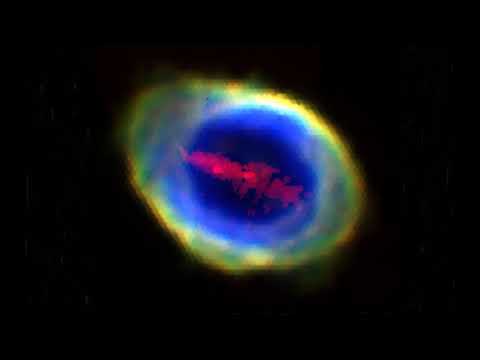
Astronomers have discovered an unprecedented structure at the center of the well-studied Ring Nebula: a massive, linear bar composed of glowing, ionized iron. This peculiar feature, stretching across the core of the nebula, defies easy explanation and challenges existing models of planetary nebula formation. The discovery highlights how even familiar astronomical objects can still harbor significant mysteries.
A 250-Year-Old Nebula Yields a New Surprise
The Ring Nebula, located 2,570 light-years away in the Lyra constellation, has been observed since 1779. These nebulae are the remnants of dying, Sun-like stars that gently shed their outer layers, leaving behind a white dwarf core. While thousands of planetary nebulae are known, the Ring Nebula stands out due to its clarity and extensive study. Yet, this familiarity did not preclude a startling discovery.
The iron bar was identified using the WEAVE instrument on the William Herschel Telescope, which captured detailed spectroscopic data across the entire nebula in a single observation. Previous studies, relying on narrow “slit spectroscopy,” would have missed this feature unless perfectly aligned with its orientation.
Why This Matters: Rethinking Nebular Evolution
The existence of this iron bar is unexpected for several reasons. First, iron in nebulae is typically locked within dust grains, not floating freely in ionized form. Second, the structure’s mass – exceeding that of Mars – is substantial, yet its origin remains unclear. Third, its observed motion doesn’t align with typical stellar jets or planetary debris.
The discovery raises fundamental questions about how planetary nebulae evolve and how heavy elements distribute within them. If this structure is unique to the Ring Nebula, it suggests that our understanding of these objects is incomplete. If it’s common, then current models require significant revision.
Possible Explanations and Remaining Uncertainties
Several hypotheses have been proposed, but none fully explain the iron bar:
- Dust Destruction: High-energy processes could vaporize dust, releasing iron. However, no evidence of such conditions exists in the Ring Nebula’s serene center.
- Torn-Apart Planet: While intriguing, the neat, linear shape doesn’t align with planetary disruption patterns, and other elements would likely be present.
- Unseen Geometry: The bar could extend beyond our line of sight, appearing as a flat structure when viewed edge-on.
The research team emphasizes the need for further observations of other nebulae to determine if similar structures exist. This discovery underscores the limitations of current observational techniques and the importance of continued exploration.
The iron bar in the Ring Nebula serves as a reminder that even well-studied astronomical objects can still surprise us. Uncovering its origin will require more data, improved modeling, and a willingness to challenge existing assumptions.