Astronomers may have observed an unprecedented cosmic event: a star that exploded in two distinct phases, first as a supernova and then as a kilonova. The discovery, made by a team at Caltech after analyzing gravitational wave data detected in August 2025, suggests that such hybrid events are possible, though exceedingly rare.
What Are Supernovas and Kilonovas?
Supernovas occur when massive stars collapse under their own gravity, often leaving behind neutron stars. These explosions are energetic but relatively well-understood.
Kilonovas, in contrast, are far more violent. They result from the merger of two neutron stars – incredibly dense remnants of collapsed stars. These mergers generate detectable gravitational waves, ripples in spacetime, and also create heavy elements like gold. The first confirmed kilonova, GW170817, was a landmark event in astrophysics.
The Anomaly: AT2025ulz
The newly observed event, designated AT2025ulz and located 1.3 billion light-years away, initially resembled GW170817. Its early glow indicated the creation of heavy elements, consistent with a kilonova. However, unlike previous observations, AT2025ulz brightened again after its initial fading, now displaying hydrogen in its spectra – a signature of a supernova rather than a kilonova.
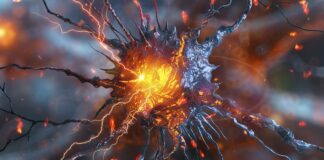
This sequence suggests that the same explosion produced both phenomena. The team proposes that the supernova ejected two neutron stars, which then collided and merged within the expanding debris, generating the gravitational waves and the subsequent kilonova signal.
Why This Matters: Rare Physics in Action
The discovery has significant implications:
- Unusual Neutron Star Masses: The colliding objects appear to include at least one neutron star smaller than typical, a finding that challenges current models of stellar evolution. Forming such low-mass neutron stars is theoretically difficult, requiring either fission during the initial supernova or fragmentation within a collapsing star’s disk.
- Hidden Kilonovas: If kilonovas can occur inside supernovae, many similar events may have been misidentified as standard supernovae. This means the true frequency of kilonovas could be much higher than previously thought.
- New Element Formation: Hybrid events like AT2025ulz could contribute significantly to the cosmic abundance of heavy elements, as both the supernova and kilonova processes produce them.
The Mystery Remains
The exact mechanism behind AT2025ulz remains unconfirmed, but it highlights how little we still understand about extreme cosmic events. Future observations will be critical to confirm whether this is a true “superkilonova” or a unique combination of circumstances.
As astronomer Mansi Kasliwal concludes, “Future kilonovae events may not look like GW170817 and may be mistaken for supernovae.”
This discovery emphasizes that the universe continues to reveal surprises, challenging our current models and prompting further exploration.