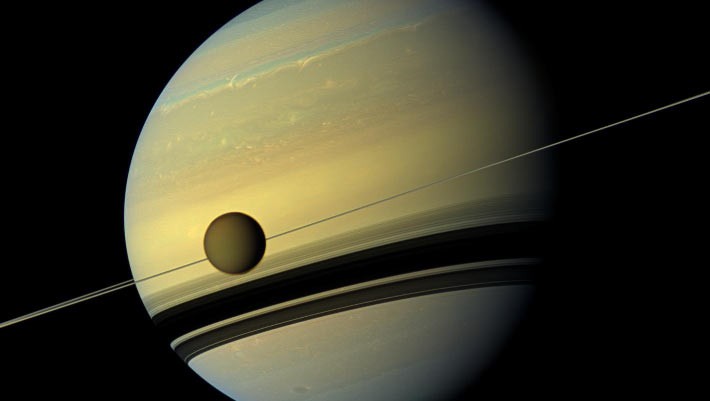
New research suggests that Saturn’s iconic rings and two of its major moons – Titan and Hyperion – may be the result of a catastrophic collision between two ancient proto-moons hundreds of millions of years ago. The findings, published in the Planetary Science Journal, challenge long-held assumptions about the stability of Saturn’s system and offer a compelling explanation for its unexpectedly young age.
A Young and Restless Saturnian System
For decades, scientists have puzzled over the relatively recent formation of Saturn’s rings, estimated to be only a few hundred million years old. This is surprisingly young given the planet’s 4.5 billion-year history. The new model proposes that this youthfulness isn’t an anomaly, but rather evidence of a dramatic upheaval that reshaped the entire system.
The key to this theory lies in the peculiar orbit of Hyperion, a small, irregularly shaped moon locked in a 4:3 orbital resonance with Titan. Simulations show that Titan has moved outward by about 4-5% since the two became gravitationally bound. This suggests that the current configuration is not primordial, but the result of recent dynamical changes.
The Lost Moon and Titan’s Growth
The research team, led by Matija Ćuk of the SETI Institute, posits that a third mid-sized moon, dubbed “proto-Hyperion,” once existed between Titan and Iapetus. As Titan’s orbit expanded, this additional moon was driven into chaos, ultimately colliding with Titan.
This collision wouldn’t just have been a singular event. It would have broken a long-standing spin-orbit resonance between Saturn and the planets, altering the planet’s tilt. Debris from the impact could have accreted into the present-day Hyperion, explaining its low density and porous, rubble-pile structure.
Ring Formation and System Instability
The instability wasn’t limited to the outer Saturnian system. The researchers suggest that an excited Titan could have destabilized Saturn’s inner moons through resonant interactions. Collisions and re-accretion among these moons may have generated the material that formed the present ring system. This links the young age of the rings to the same event that created Hyperion and reshaped the outer system.
Evidence and Future Tests
Independent evidence, including the rings’ mass and composition, already pointed towards a young age. The new model provides a plausible mechanism for this recent activity. The team’s simulations show that such collisions occur frequently under the right conditions, and that the aftermath aligns with observed orbital inclinations and eccentricities of Saturn’s moons.
“Hyperion, the smallest among Saturn’s major moons provided us the most important clue about the history of the system,” Dr. Ćuk said.
Future orbital, geophysical, and geological data—particularly from missions targeting Saturn’s moons—will be essential to testing this scenario. However, as the authors conclude, the evidence increasingly suggests a dynamically active and relatively young Saturnian system shaped by recent, dramatic events.