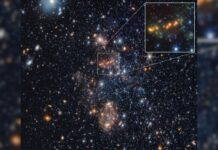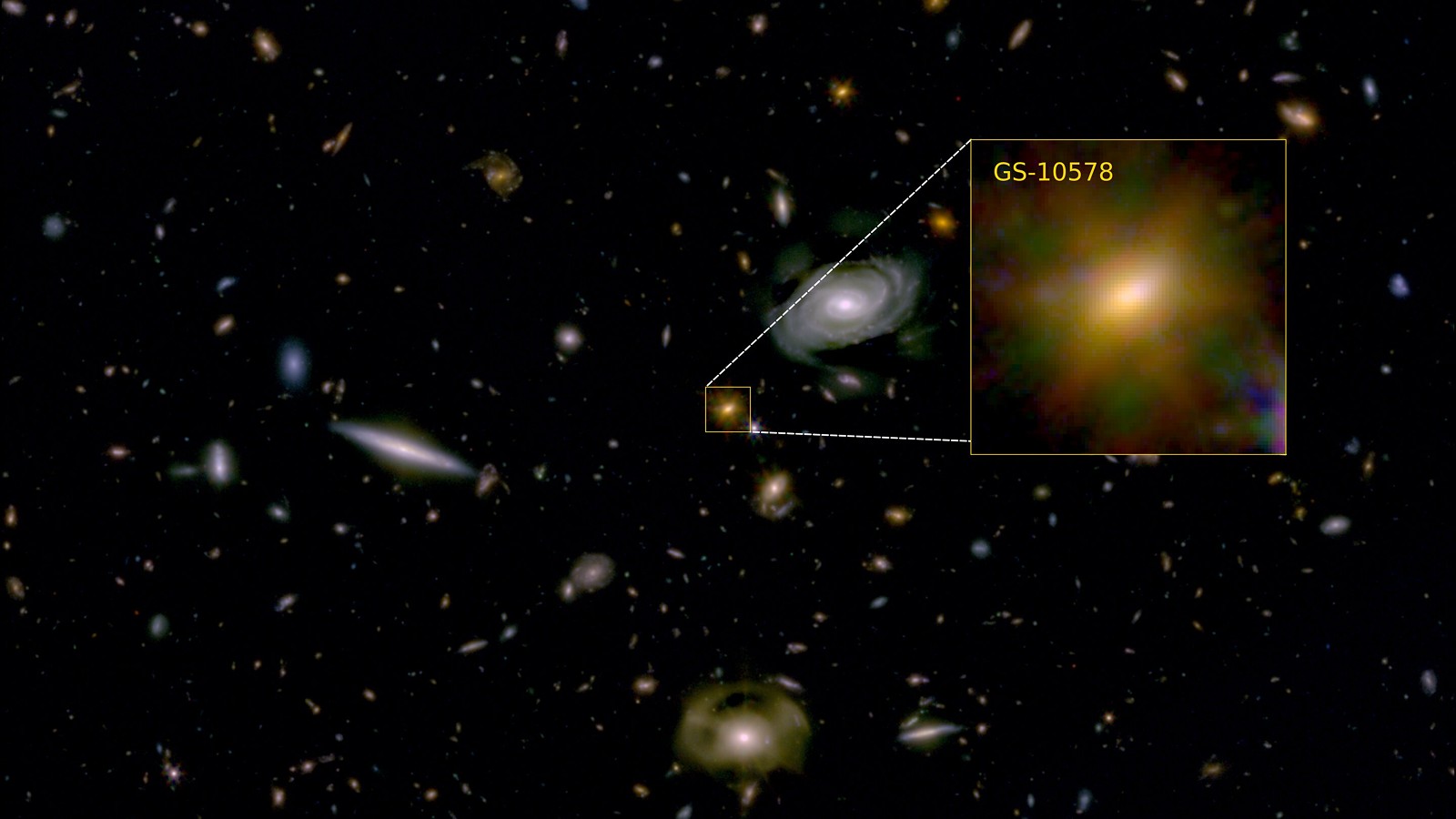
New observations from the James Webb Space Telescope (JWST) and the Atacama Large Millimeter Array (ALMA) have uncovered a rare case of galactic self-destruction: a massive, ancient galaxy nicknamed “Pablo’s Galaxy” (GS-10578) was slowly suffocated by its own supermassive black hole. This process, described by researchers as “a death of a thousand cuts,” challenges existing models of galactic evolution.
The Galaxy That Aged Too Fast
Pablo’s Galaxy, roughly 11.5 to 12.5 billion years old (in a universe that is 13.8 billion years old), is unusually large for its age – approximately 200 billion times the mass of our Sun. What makes it remarkable isn’t its size, but how it died: not in a catastrophic collision or explosion, but through the gradual depletion of the cold gas needed to form new stars.
This discovery is significant because most models predict that supermassive black holes either tear galaxies apart or trigger intense star formation through gravitational disruption. Instead, in Pablo’s Galaxy, the black hole methodically heated the incoming gas, preventing it from cooling and condensing into star-forming regions.
How the Starvation Happened
The team, led by Jan Scholtz of Cambridge University, found no traces of carbon monoxide – a key indicator of cold, star-forming hydrogen – using ALMA. JWST observations confirmed that the black hole was ejecting neutral gas at nearly 900 miles per hour (400 kilometers per second). At this rate, the galaxy would have exhausted its star-forming fuel within a mere 16 to 220 million years, a blink of an eye in galactic time.
“There was essentially no cold gas left. It points to a slow starvation, rather than a single dramatic death blow,” explains Scholtz.
Implications for Early Universe
This isn’t an isolated case. Researchers suggest that Pablo’s Galaxy represents a previously underestimated population of galaxies in the early universe that may have died prematurely due to similar starvation mechanisms. Before JWST, these galaxies were largely unknown. Now, the evidence suggests they may be far more common than previously thought.
This means the standard models of galactic aging may need reevaluation. The discovery forces astronomers to consider that black hole-driven starvation could be a common fate for galaxies in the early universe. Further research will be needed to determine how widespread this process is and its impact on galactic evolution across cosmic time.
The findings highlight how the James Webb Space Telescope is revolutionizing our understanding of the early universe. Its ability to observe faint signals from ancient galaxies is revealing previously hidden processes that shaped the cosmos as we know it.