Half-forgotten in a drawer. A prehistoric nightmare. It has been sitting there for decades, waiting to be seen.
Everyone knows Tyrannosaurus rex. It’s the king. But oceans have kings too. And now, we found one that rivals the dinos. Not in the sky or the mud, but in the deep water. Roughly 80 million years back, during the Cretaceous. This creature sat at the top of the food chain.
It’s a mosasaur. Call it Tylosaurus rex. Or just the “king of the tylosaurs.” The kicker? It’s not new to science. We had the bones. We just missed them. Multiple fossils sitting on shelves, labeled wrong. Under our noses. Literally.
Bigger and meaner
Twelve point two meters. Forty-three feet. That’s how long Tylosaurus rex got. Think about a great white shark. The biggest ones? This thing is twice that size.
Ron Tykoski knows his stuff. He’s the vice-president of science at the Perot Museum. He calls Tylosaurus rex a meaner animal than its cousins.
“Besides being huge,” he says, “it appeared to be a much meaner animals.”
The violence was internal. They fought each other. Bone damage proves it.
Imagine a saltwater croc. Mix in a komodo dragon. Throw an orca into the pot. That’s a mosasaur, roughly speaking. Except way longer. Double the length. These things dominated the oceans in the late Cretaceous. Giant marine lizards. Nothing like them today.
Why do we know so much about them? Luck. Geology.
They lived in the water. Bodies sank. Buried in silt. Low oxygen kept the scavengers away. Land carcasses get torn apart. Sea carcasses just sink and rot slowly. Perfect for fossilization.
Then there’s geography. North America used to have a shallow sea in the middle. It’s gone now. Dry land remains. Which means those fossils? Easy to dig up.
Museums are stacked with them. Hundreds of tylosaur samples in American collections alone. That’s just one type of mosasaur.
The mix-up
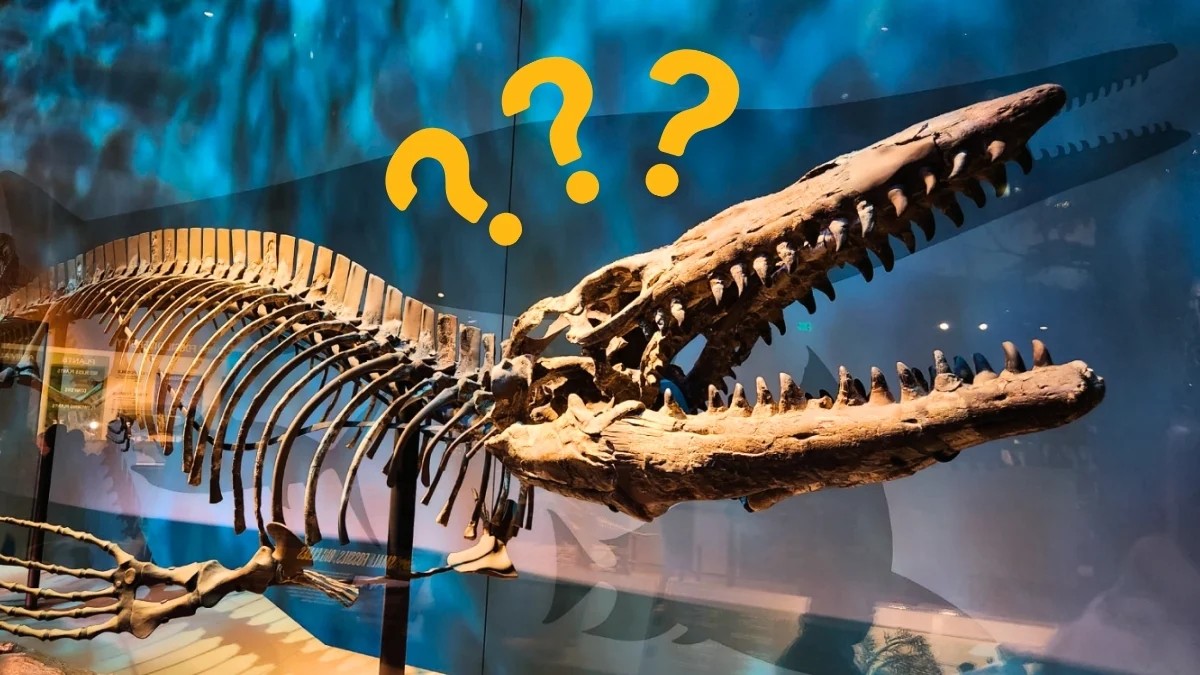
This specific specimen was dug up in Texas. Back in 1979. Forty-five years ago. It sat in the Perot Museum’s vaults (formerly the Dallas Museum of Nature History). Tagged as Tylosaurus proriger. The Heath Mosasaur.
Amelia Zietlow noticed the problem. She’s at the American Museum of Natural History. Working on her PhD in comparative biology, she looked closer at the skeleton. Something didn’t fit. T. proriger should look different.
Past researchers said it was just age. Growth changes how things look. But Zietlow disagreed. The bones told a different story.
The skull. The jaw. The teeth. All distinct. The neck muscles must have been powerful. Terrifying. The teeth? Serrated. Like steak knives. Rare in mosasaurs. It didn’t just bite. It shredded. It sheared flesh.
Rewriting the roster
It wasn’t just one bone. They checked others. Labeled as T. proriger, big ones, sitting around.
They found twelve specimens that were definitely T. rex.
Take the Black Knight. Also at the Perot Museum. Look at its face. Smashed. Jaw broken. Who did it? The damage was so severe only another T. rex could cause it. Bite force was no joke.
Famous fossils got reclassified. Bunker? Discovered in 1911, sits in Kansas now. That’s a T. rex. Sophie? In Yale’s Peabody Museum? Also a T. rex.
Family tree sorted, mostly.
True T. proriger folks were in Kansas, older, around 84 million years. T. rex showed up later, four million years on. Stuck in Texas.
So, what’s next?
Museum cabinets hold secrets. Assumptions stick. Decades of familiarity blind us. Maybe other monsters are just mislabeled right now.
“We need to modernize our tools,” Zietlow says.
We do. The fossils don’t care.