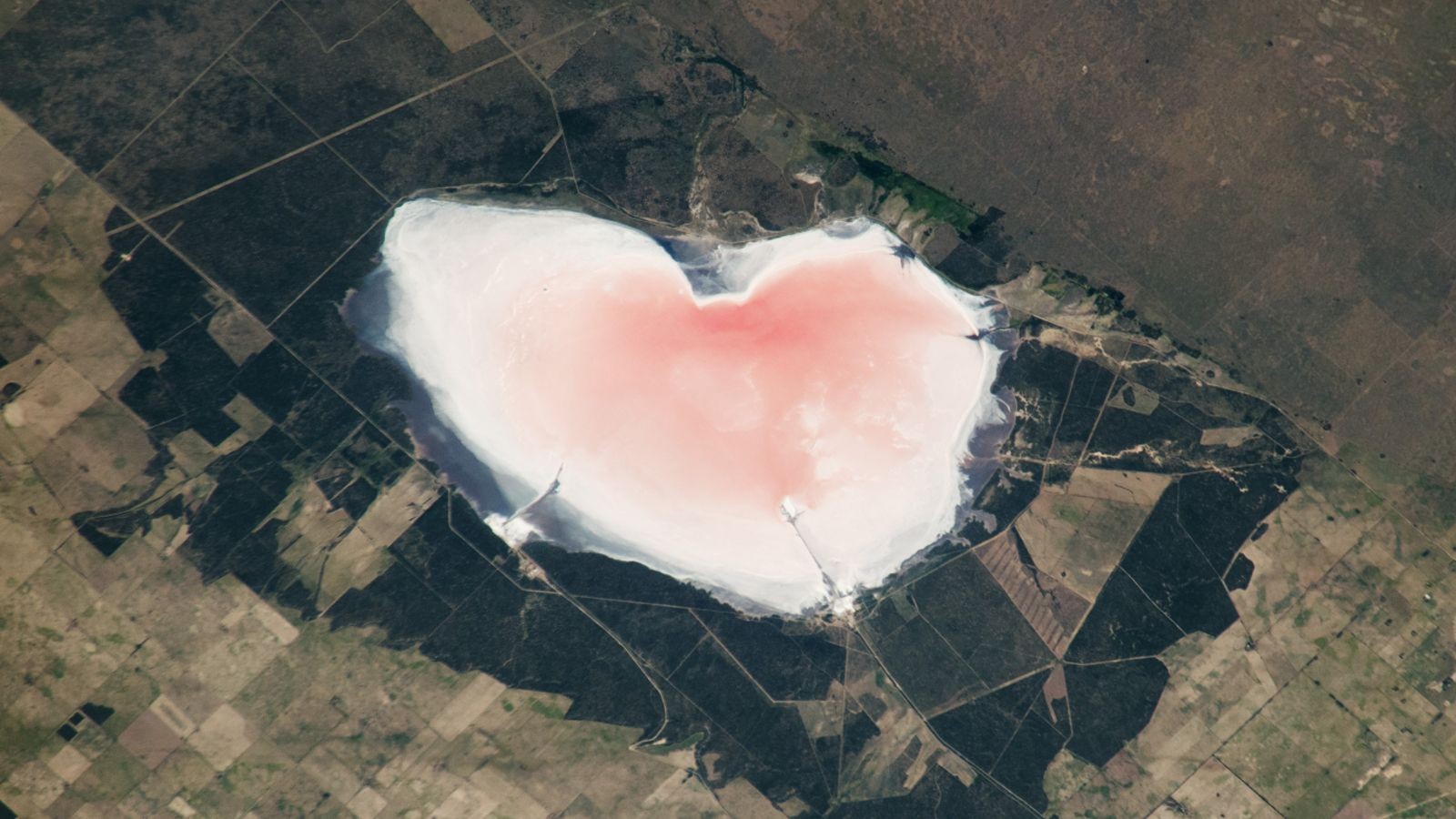
A striking image released by NASA on Valentine’s Day 2025 shows a naturally occurring, heart-shaped salt lake in Argentina. The formation, known as Salinas Las Barrancas or Laguna de Salinas Chicas, showcases a vivid pink hue due to unique biological conditions.
The Geography and Mining of Las Barrancas
Located approximately 33 miles west of Bahía Blanca in Buenos Aires province, the lake spans roughly 6 miles at its widest point. It’s a shallow basin that fills with rainwater, which quickly evaporates under intense sunlight, leaving behind extensive salt flats. These flats are actively mined by local workers, who extract up to 330,000 U.S. tons of salt twice yearly. According to a 2019 report by Argentine news site La Nación, this practice is sustainable, with experts predicting viable mining for another 5,000 years.
The mining process is largely manual: workers scrape salt from the surface using basic tools, taking precautions against the harsh glare off the crystals. As one worker told La Nación, “The salt becomes part of your life… you get used to not being able to see.” This illustrates the deep connection between the local community and the resource.
The Science Behind the Pink Color
The lake’s unusual pink coloration is driven by a delicate balance between microorganisms. When water levels are high, Dunaliella salina algae thrive, giving the water a brownish-red tint. However, during dry seasons, the salinity increases, killing off the algae and allowing archaea and bacteria to dominate, turning the lake a striking pink. As microbiologist Lilliam Casillas Martinez explained to Smithsonian Magazine, these shifts in microbial dominance are directly tied to rainfall patterns.
Wildlife and Ecosystem Dynamics
Despite its extreme salinity, Salinas Las Barrancas supports unique wildlife. Salt-resistant vegetation grows around the edges, providing habitat for birds like vibrant yellow cardinals (Gubernatrix cristata ) and bright-pink Chilean flamingos (Phoenicopterus chilensis ). The birds’ striking colors are directly linked to their diet, which includes tiny crustaceans that consume the Dunaliella algae. These algae contain carotenoids, organic pigments that naturally produce both red and yellow tones. Without these pigments, the birds would have drastically different coloration: cardinals would be red, and flamingos would be grayish-white.
This example highlights how even in harsh environments, life adapts and creates vibrant ecosystems. The lake’s pink hue is not merely an aesthetic feature; it’s a visible sign of complex biological processes.
The image captured by the astronaut is a reminder of Earth’s hidden wonders, showcasing a naturally occurring phenomenon that combines geological forces, biological activity, and human resourcefulness in a single, striking vista.