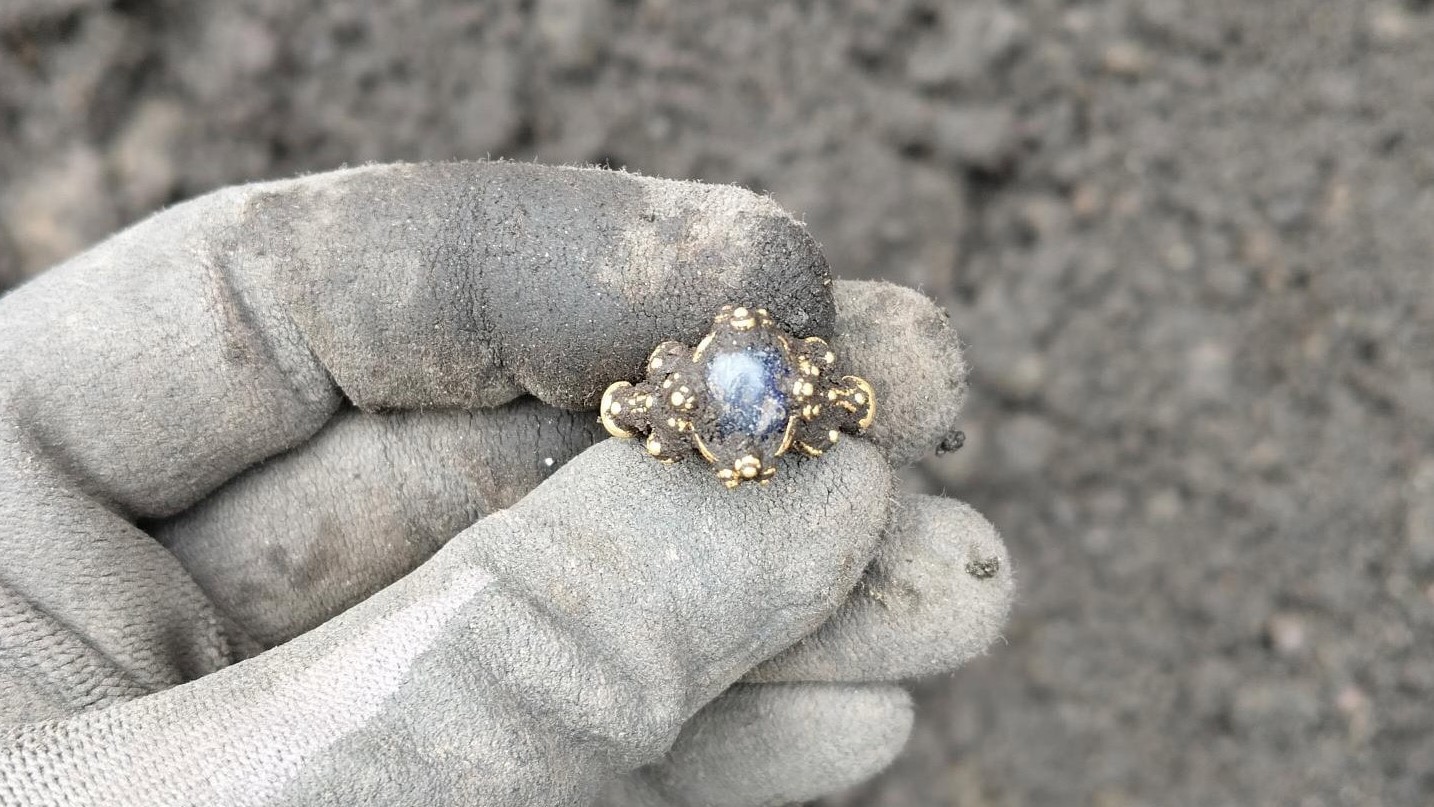
Archaeologists in Norway have discovered a remarkably preserved gold ring dating back to the Viking Age, featuring a striking blue gemstone. The find, made during excavations in Tønsberg – Norway’s oldest city – is being hailed as a “fantastically beautiful and rare specimen” by experts.
Discovery and Context
The ring was unearthed during ongoing archaeological work in the center of Tønsberg, a site that once housed a bustling medieval town founded in the ninth century. The town existed beneath a royal castle complex built by the Yngling dynasty, highlighting the region’s historical importance as a center of power and trade. Archaeologist Linda Åsheim, who made the discovery, described her initial reaction as one of disbelief, stating she was “completely shaken” by the find.
Ring Description and Dating
The ring itself is constructed from delicate gold threads twisted into an intricate pattern around an oval-shaped blue stone, likely a sapphire or a high-quality cobalt-colored glass. The design incorporates small, soldered gold balls as additional decoration. Archaeological dating, based on the style of goldwork, places the ring’s creation between the ninth and eleventh centuries. This craftsmanship originated in the Byzantine Empire and was brought to Norway through trade and cultural exchange during the early Middle Ages.
Significance of the Find
The ring’s size suggests it belonged to a high-status woman, with an estimated finger circumference between 50 and 55 millimeters (U.S. women’s ring sizes 5 1/2 to 7 1/2). Wearing such jewelry likely served as a symbol of wealth and social standing. Beyond status, the blue gemstone itself may have held deeper cultural significance. In the Middle Ages, sapphires were believed to represent divine power, promote chastity, and even possess medicinal properties, such as curing skin ailments.
Rarity and Historical Value
The discovery is particularly noteworthy because gold rings are rarely found in Tønsberg. This marks only the second such find in fifteen years. The ring provides valuable insight into the lives of elite women in medieval Norway, demonstrating the extent of their wealth, fashion, and belief systems.
“It has been 15 years since we last found a gold ring in Tønsberg, and this one is a fantastically beautiful and rare specimen,” stated Hanne Ekstrøm Jordahl, project manager at NIKU.
This find underscores the enduring historical richness of Norway’s medieval past and the continuing importance of archaeological research in uncovering these hidden treasures.