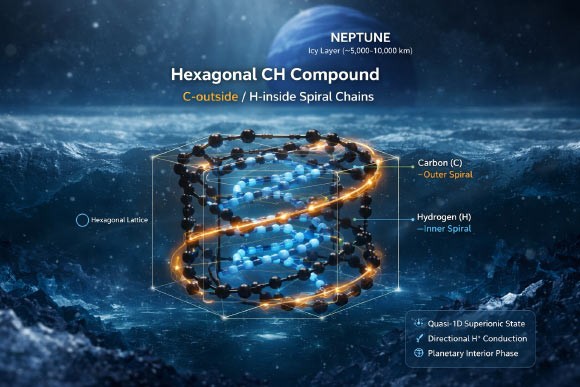
New computational research suggests that the interiors of Uranus and Neptune may contain a previously unknown form of matter. Scientists have identified a “quasi-one-dimensional superionic state” of carbon hydride—a discovery that could fundamentally change our understanding of how these massive planets function.
The Mystery of the Ice Giants
Uranus and Neptune are classified as “ice giants,” a term that refers to their composition rather than their temperature. Unlike the gas giants Jupiter and Saturn, which are primarily hydrogen and helium, these planets possess thick layers of “hot ices” located between their outer atmospheres and their rocky cores.
These layers are composed of water, methane, and ammonia. However, the conditions deep within these planets are so extreme that standard chemical rules no longer apply. To understand these environments, researchers must look beyond traditional states of matter—solid, liquid, and gas—to explore the exotic physics born of intense pressure and heat.
A Hybrid State of Matter
Using high-performance computing and machine learning, a team led by Dr. Cong Liu from the Carnegie Institution for Science simulated the behavior of carbon hydride under conditions mimicking the deep interiors of these planets. The simulations focused on:
* Extreme Pressure: 500 to 3,000 gigapascals (up to 30 million times Earth’s atmospheric pressure).
* High Temperatures: 4,000 to 6,000 Kelvin.
The results revealed a superionic state, a rare phase of matter that acts as a hybrid between a solid and a liquid. In this state, one type of atom forms a rigid, crystalline framework (the carbon), while another type of atom (the hydrogen) becomes mobile and flows through that structure.
The “Spiral” Discovery
What makes this specific finding unique is the direction in which the hydrogen moves. Rather than flowing freely in all directions like a liquid, the hydrogen atoms move along well-defined, helical (spiral) pathways within the carbon structure.
“This newly predicted carbon-hydrogen phase is particularly striking because the atomic motion is not fully three-dimensional,” noted Dr. Ronald Cohen of the Carnegie Institution for Science. “Instead, hydrogen moves preferentially along well-defined helical pathways embedded within an ordered carbon structure.”
Why This Matters for Planetary Science
This discovery is more than a theoretical curiosity; it has profound implications for the physical characteristics of Uranus and Neptune. Because the hydrogen atoms move in such a specific, directional way, they will influence two critical planetary processes:
- Heat Redistribution: The way energy moves from the core to the surface depends on how atoms move within the interior.
- Magnetic Field Generation: The electrical conductivity of these layers is a key driver in how a planet generates its magnetic field. If the matter inside is “quasi-one-dimensional,” it changes how electricity flows, which may explain the unique magnetic signatures observed in ice giants.
Conclusion
By uncovering this complex behavior in a simple combination of carbon and hydrogen, researchers have demonstrated that even the most common elements can organize into unexpected patterns under pressure. This finding provides a new lens through which we can interpret the internal dynamics and magnetic mysteries of the solar system’s ice giants.