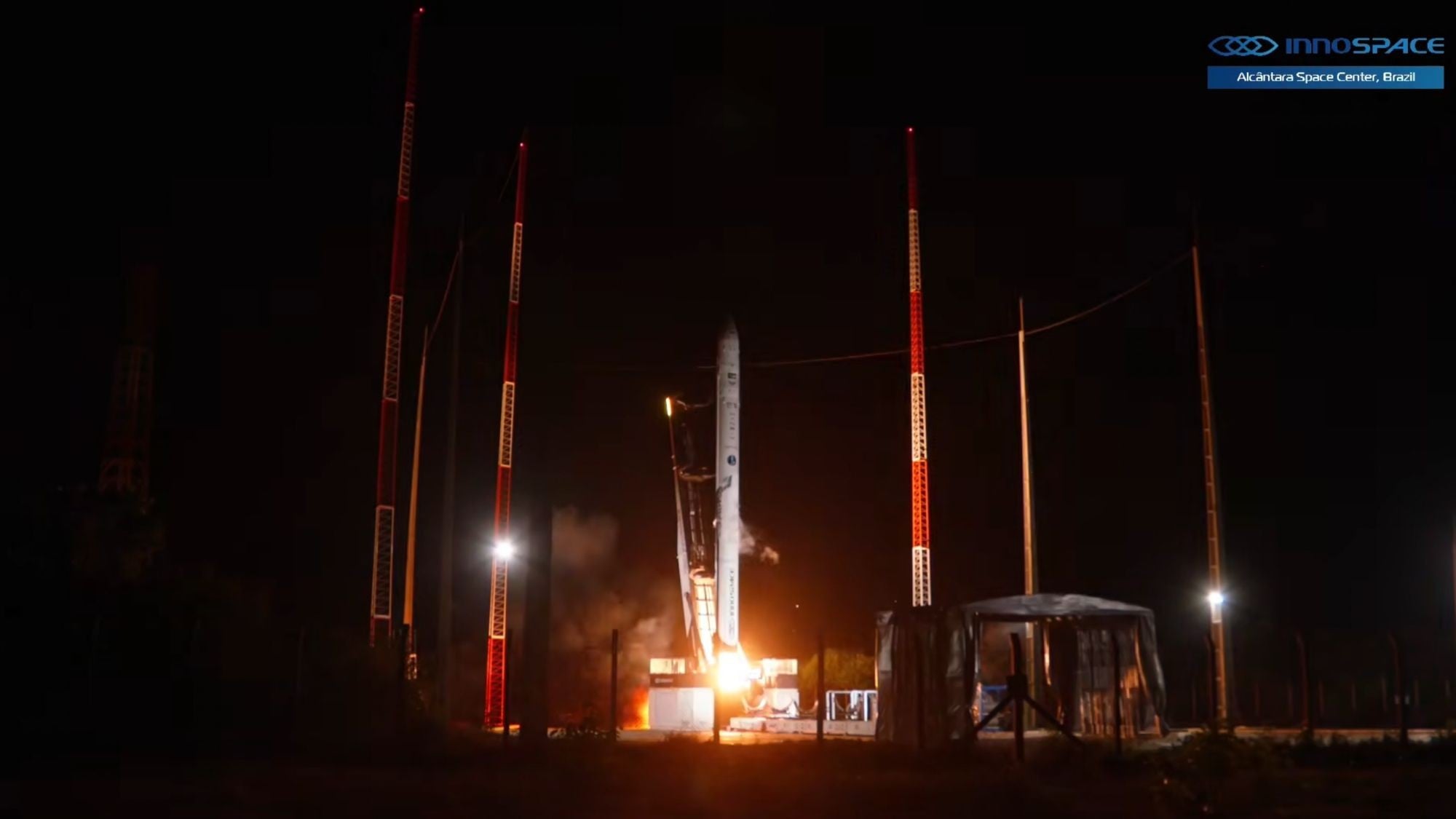
South Korea’s Innospace experienced a setback on Monday night as its debut orbital launch attempt ended in failure. The company’s Hanbit-Nano rocket, lifting off from Brazil’s Alcantara Space Center at 8:13 p.m. EST, crashed back to Earth approximately one minute after launch.
This marked the first orbital launch attempt by a private South Korean company, and, as is common with inaugural flights, technical issues emerged. Innospace abruptly cut off its live webcast following the incident after reporting an anomaly. The exact cause of the failure remains unknown at this time.
Hanbit-Nano Rocket Details
The Hanbit-Nano is a two-stage rocket designed to carry up to 198 pounds (90 kilograms) of payload into sun-synchronous orbit. Its first stage burns liquid oxygen (LOX) and paraffin, while the upper stage can operate with either LOX and paraffin or LOX and liquid methane. The failed launch carried five commercial satellites from Brazilian and Indian customers, plus three experimental payloads.
Company Background and Future Plans
Founded in 2017, Innospace has internally developed all its launch technology, boasting a team of around 260 employees. The Hanbit-Nano is just the first step in their broader ambitions: the company is also developing larger rockets, the Hanbit-Micro and Hanbit-Mini.
The launch was delayed multiple times due to technical problems and unfavorable weather conditions before the eventual attempt on Monday.
This failure underscores the inherent risks of space launch, especially for first-time orbital attempts. The setback will likely prompt a thorough review of Innospace’s systems, but the company remains committed to its long-term vision of expanding South Korea’s private space capabilities.