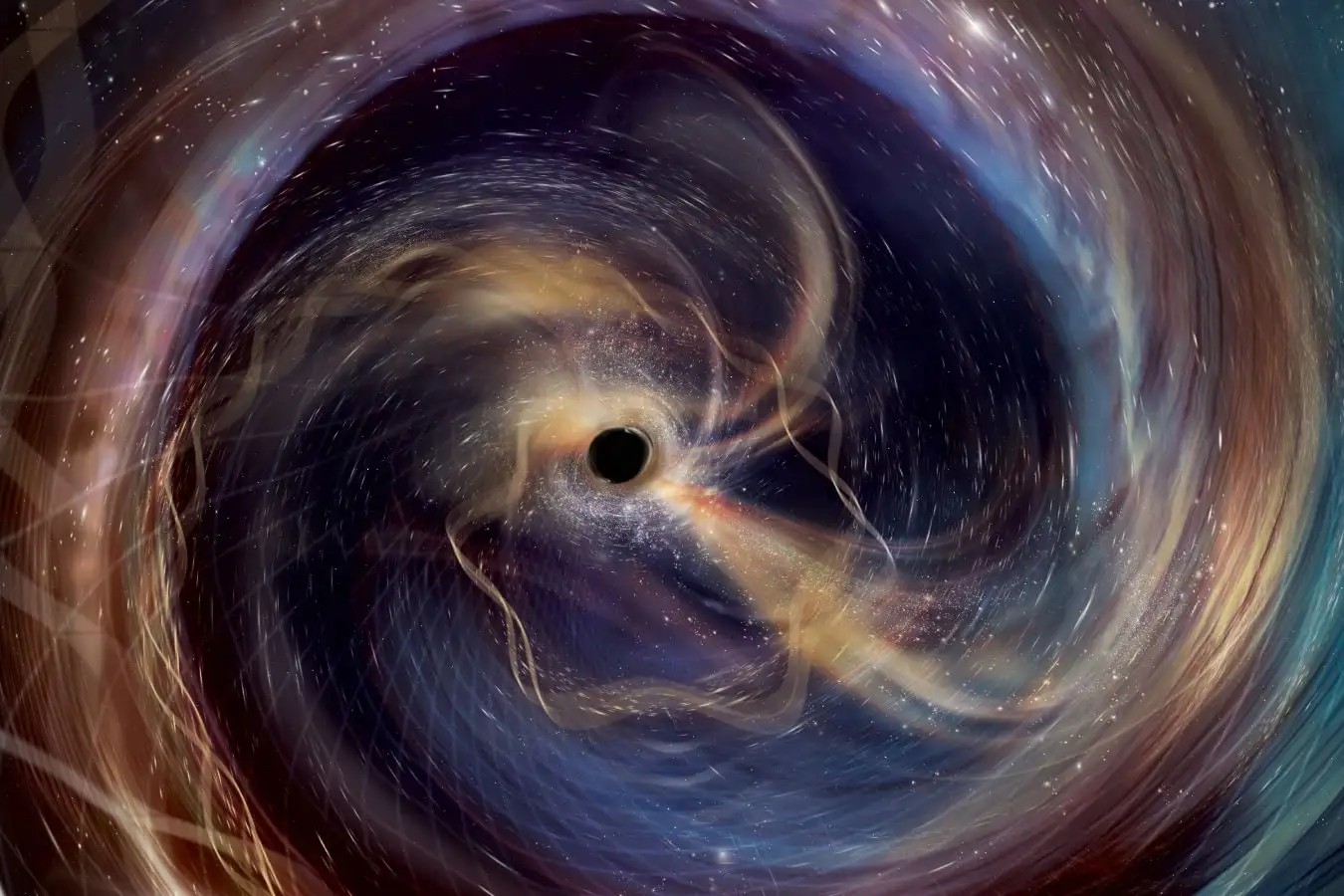
Scientists have once again validated Albert Einstein’s theory of general relativity with unprecedented precision, thanks to the detection of the most powerful gravitational wave event to date. The signal, named GW250114, originates from the merger of two black holes and provides the clearest test yet of Einstein’s century-old predictions.
A New Era of Gravitational Wave Detection
The collision was observed in 2025 by a network of advanced gravitational wave detectors – including the Laser Interferometer Gravitational-Wave Observatory (LIGO) in the United States and the Virgo detector in Italy. These instruments are significantly more sensitive than their 2016 predecessors, enabling the capture of exceptionally clean data. This clarity is critical because it allows for rigorous testing of fundamental physics.
Researchers previously used GW250114 to confirm Stephen Hawking’s theorem, stating that the resulting black hole’s event horizon wouldn’t shrink beyond the combined size of its progenitors. The findings supported Hawking with near certainty. Now, a team led by Keefe Mitman at Cornell University has taken the analysis further, directly comparing the event to Einstein’s equations.
How General Relativity Predicted the Collision
Einstein’s theory describes how mass warps space-time, dictating the movement of objects within it. When applied to merging black holes, the equations predict a specific sequence: the black holes spiral inward, accelerate, collide, and then vibrate at distinct frequencies – analogous to a ringing bell.
Previous events lacked the clarity needed to verify these “ringdown modes,” but GW250114 was loud enough for precise testing. Mitman’s team simulated the expected frequencies based on Einstein’s equations and found an astonishing match with the observed data.
“The amplitudes that we measure in the data agree incredibly well with the predictions from numerical relativity,” Mitman explained. “Einstein’s equations are really hard to solve, but when we do solve them and we observe predictions of general relativity in our detectors, those two agree.”
What This Means for the Future of Physics
The latest results reinforce the robustness of general relativity. Laura Nuttall of the University of Portsmouth stated, “Everything seems to look like what Einstein says about gravity.” However, the study also highlights the limitations of current detectors.
While the match is strong, it can’t rule out deviations of up to 10%. Mitman noted that this uncertainty will shrink as detector sensitivity improves. If discrepancies emerge, it would indicate that Einstein’s theory is incomplete or incorrect.
The pursuit of greater precision will continue as scientists observe more events and refine their tools. Each observation brings us closer to understanding the universe’s fundamental laws, and whether Einstein’s vision remains unchallenged.