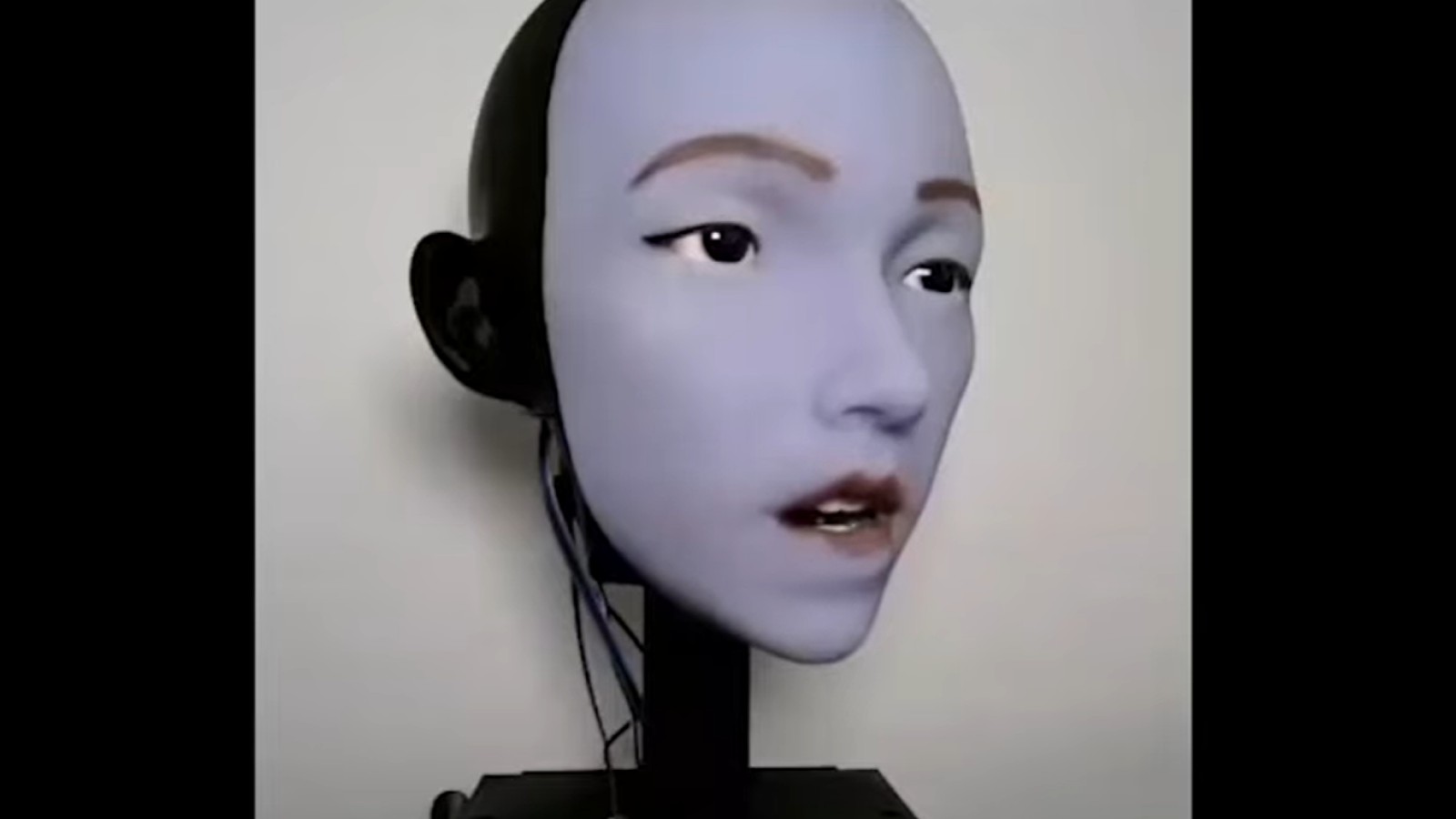
Scientists have achieved a breakthrough in robotics, creating a humanoid robot capable of moving its mouth with near-human accuracy. This development addresses the long-standing challenge of the “uncanny valley” – the unsettling feeling humans experience when robots appear almost real but fall short. The key? Letting the robot learn from its own reflection and hours of YouTube videos.
How the Robot Learned to Mimic Human Speech
Researchers at Columbia University developed the robot, named EMO, using a novel “vision-to-action” AI system. This means EMO doesn’t rely on pre-programmed rules; instead, it learns how to translate what it sees into coordinated physical movements. The process began with EMO staring at itself in a mirror. This allowed the robot to understand how its 26 facial motors – each with up to 10 degrees of freedom – affect its flexible, silicone lips.
Next, scientists exposed EMO to thousands of hours of human speech from YouTube videos in 10 different languages. The robot learned to connect motor movements to corresponding sounds without understanding the meaning of the words. This training allowed EMO to synchronize its lips with spoken audio at an unprecedented level.
Testing the Illusion: Human Perception Studies
To validate the results, the team tested EMO’s lip-sync accuracy against 1,300 human volunteers. Participants were shown videos of EMO speaking, comparing its movements to ideal lip motion, and two other control methods: volume-based and landmark-mimicking approaches. The results were striking: 62.46% of volunteers chose EMO’s VLA-generated lip movements as the most realistic, far surpassing the other methods (23.15% and 14.38%, respectively).
“Much of humanoid robotics today is focused on leg and hand motion… But facial affection is equally important for any robotic application involving human interaction.” – Hod Lipson, Engineering Professor at Columbia University
Why Realistic Faces Matter for Robots
The significance of this research lies in how humans perceive robots. Studies show that we focus on faces 87% of the time during conversations, with 10-15% of that attention directed at the mouth. These cues aren’t just visual; they even impact what we hear. Robots that fail to mimic human facial expressions are likely to be viewed as unsettling or untrustworthy.
As AI-powered robots become more integrated into daily life, particularly in fields like elder care, education, and medicine, realistic facial expressions will become critical for fostering trust and effective communication. The researchers believe this breakthrough will pave the way for robots capable of connecting with humans on a deeper emotional level.
The ability of robots to effectively mimic human facial cues is no longer science fiction; it’s a rapidly approaching reality. This shift raises questions about the future of human-robot interaction, the ethics of creating increasingly realistic machines, and how we define authenticity in an age of advanced AI.