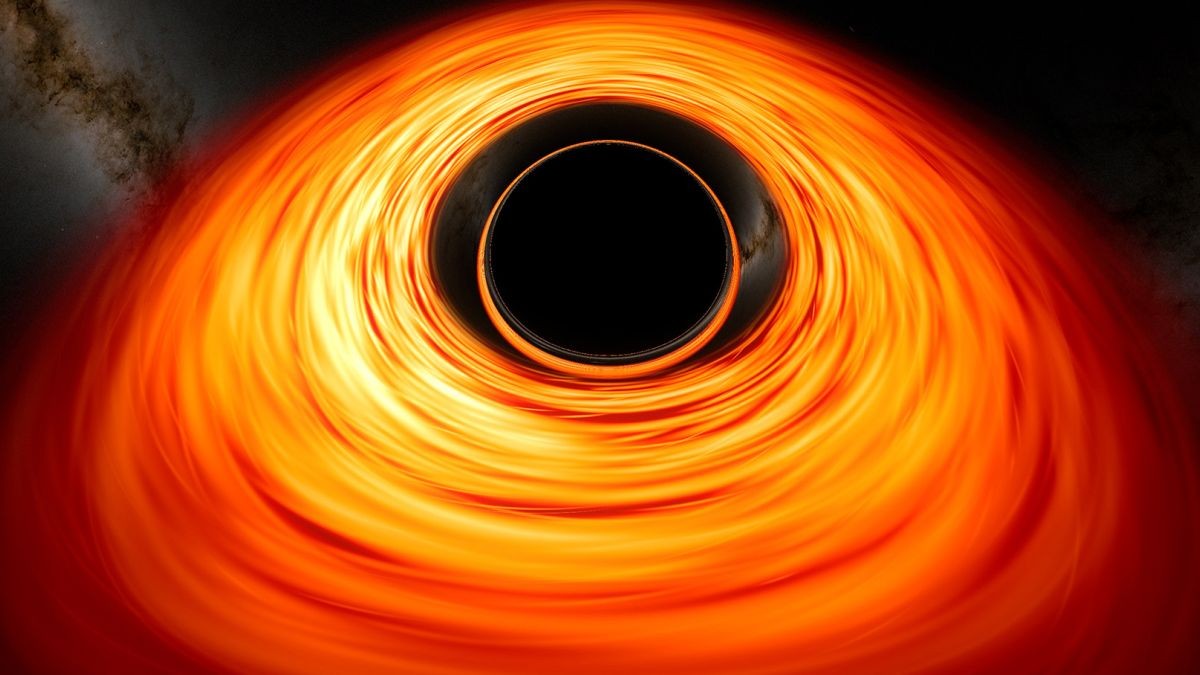
Physicists have explored a surprisingly specific question: what would happen if a microscopic black hole passed through a human body? The answer, according to recent calculations, is… probably not as bad as you’d think.
The Physics of a Black Hole Encounter
Contrary to science fiction tropes, a small primordial black hole – one that might theoretically exist from the early Universe – would likely cause damage similar to a gunshot wound rather than immediate annihilation. This is because the primary threat isn’t the black hole eating you; it’s the supersonic shock wave it generates as it moves through tissue at extreme speeds.
The minimum mass required for significant damage is staggering: around 140 billion metric tons. At this size, the black hole would still be incredibly small, with a diameter less than that of a hydrogen atom. The real issue arises from its velocity – typically around 200 kilometers per second – which creates a shock wave capable of tearing through flesh.
Tidal Forces and Spaghettification
Beyond the initial shock, gravitational forces come into play. While the popular image of a black hole involves “spaghettification” (being stretched into a noodle-like shape), this only becomes a factor with much larger black holes, at least 7 trillion metric tons.
To meaningfully disrupt human tissue, particularly the brain, a black hole would need to be comparable in mass to an asteroid. Even then, the supersonic shock wave would likely inflict more immediate harm. It’s crucial to remember that the gravitational forces exerted by such objects are weak at the scale of individual cells; your body exists under the much stronger pull of Earth’s gravity daily without disintegrating.
The Improbability of an Encounter
The good news? Such an event is almost statistically impossible. If primordial black holes even exist (their existence remains unproven), the density of these objects is so low that a collision with a human is estimated to occur only once every quintillion years. Given that the Universe is only 13.8 billion years old, humanity likely won’t be around long enough for this scenario to play out.
“A sufficiently large primordial black hole… would cause serious injury or death if it passed through you. It would behave like a gunshot,” says physicist Robert Scherrer. “A smaller primordial black hole could pass through you, and you wouldn’t even notice it.”
Ultimately, while the thought experiment is fascinating, the risk of being pierced by a tiny black hole is so negligible that it falls firmly into the realm of theoretical curiosities rather than practical threats.